
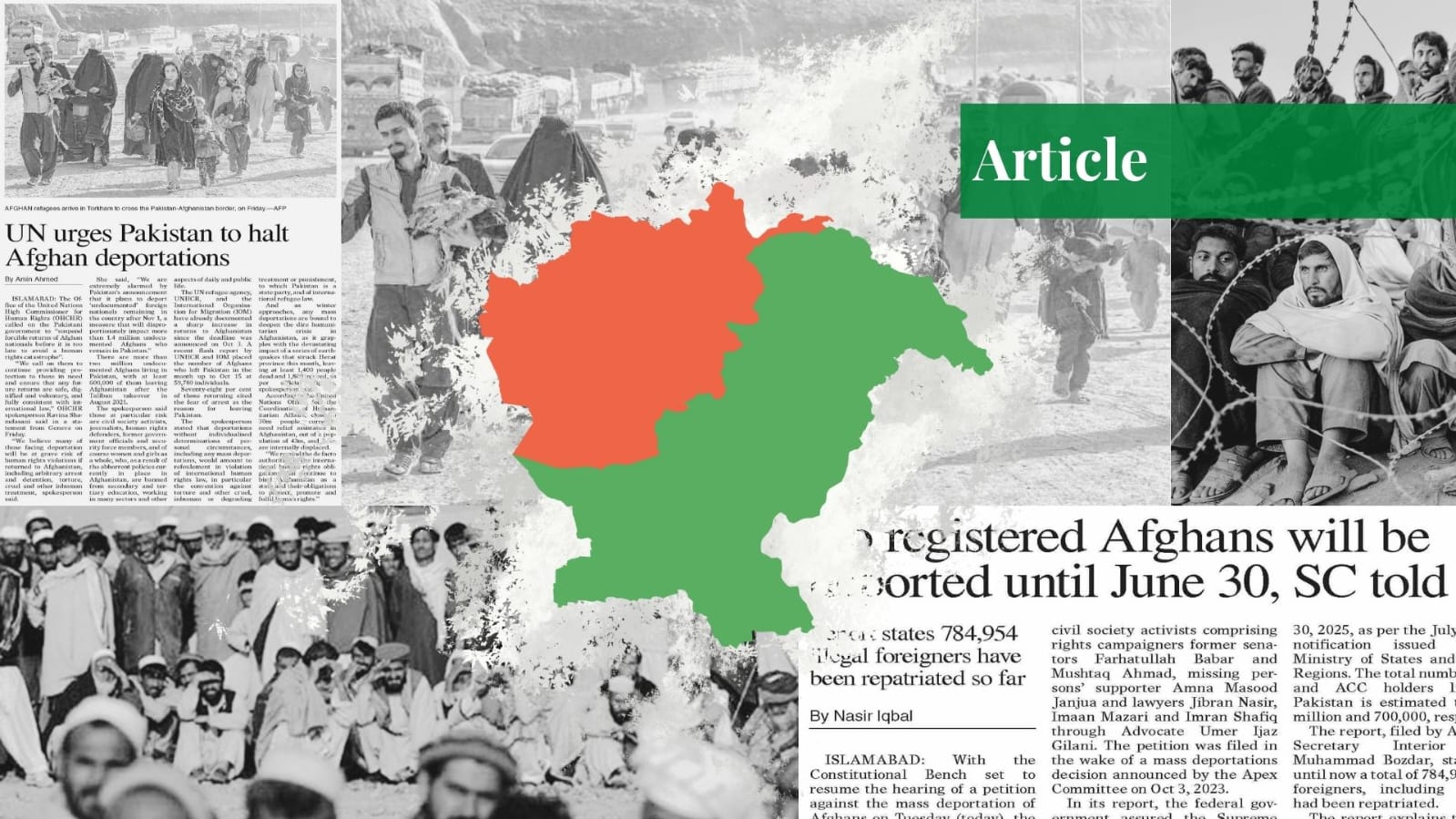

In a move that has reignited debates over border policies, the Government of Pakistan is caught in a crossfire between border regulations and human rights, and its decision to deport the refugees from Afghanistan from its territory will significantly affect the taboo debate over regional stability. Such a tortured decision, the cauldron of domestic political pressure, economic woes, and historical hangovers, now demands a confrontation with an agonizing past.
For many Afghans who have lived on Pakistani soil for generations, the question arises: what future do they have under a new and challenging stance on migration and asylum? This article looks into the historical context of Afghan migration to Pakistan, the various legal statuses attributed to said migrants, and the possible fallout that this will have on Afghan lives, regional stability, and the response by the international community, particularly whether the US will ultimately take on some of the burden for the displacement.
Historical Overview of Refugees from Afghanistan Migrating to Pakistan
In 1979, when the Soviet Union invaded Afghanistan and began to destabilize the entire region, a new chapter in the long saga of Afghan immigration to Pakistan started. As Soviet forces advanced, millions of Afghans ran away from the python of war towards what seemed to be the most hospitable direction: Pakistan. What began as a temporary humanitarian exodus into neighboring Pakistan quickly turned into a permanent crisis, as various waves of displacement augmented the region’s existing demographic and cultural landscape. Ever since, Pakistan has witnessed an influx of several waves of Afghan refugees.
This was truly not one event; it was compounded by various conflicts, threatening from the ghastly Afghan civil wars of the 1990s to the emergence and later collapse of the Taliban regime to the disrupting effects following the US intervention in the year 2001. Each epoch had its own consequences, leaving a bitter imprint on the respective countries that intensified their interdependence in more ways than one.
Over time, millions of Afghans sought temporary refuge and decided to remain in Pakistan, some later settling into distinct communities, which, despite their precarious legal status, played a great role in that country’s social and economic fabric. Such communities became an inextricable part of Pakistan, adding their own colors to its landscape.
Yet, the lack of a formal refugee law within Pakistan meant that while such integration was also impelled, challenges still existed. In the absence of a clear and uniform legal framework, the political dynamics in relation to refugee status turned out to be nothing but an amalgamation of decisions and measures doing nothing other than jeopardizing the standing of several refugees, caught between the ambiguous promise of safety and mere speculation of legality.
The Legal Statuses: A Triad of Uncertainty
The current refugee crisis leaves behind a legacy of legal uncertainty surrounding the status of Afghan families in Pakistan. Lacking comprehensive refugee law, the state is forced to adopt some ad hoc measures that classify Afghan migrants under the following three categories:
1. Registered Afghan Refugees:
A major part of the Afghan diaspora in Pakistan is registered with the United Nations High Commissioner for Refugees (UNHCR). These people were given registration documents and allowed international refugee status. Although this carries some rights, such as allowing access to basic services according to international guidelines and principles of protection, the inherent fact remains that it is still temporary. Registered refugees continue to live under the shadow of their legal status, under constant reminder that in times of political or economic pressures, their recognition may be subject to periodic review or even revoked.
2. Temporary Protection Holders:
Pakistan has, for many years, in the absence of any formal law, provided some form of temporary protection for Afghan migrants who have not been registered properly with the UNHCR. The individuals in this discriminatory group tend to be those who have had a somewhat effective hobby existence without, nevertheless, any legal frameworks. Their legal status remains precarious, subject to abrupt political changes, and, as the latest decision indicated, may very well be rescinded with little advanced notice.
3. Illegal Immigrants:
The third category consists of those who remain within the undefined sphere of the undocumented, voluntarily or verbally. Deemed to be “illegal immigrants” by state authorities, it is with no means of legitimatization available that these people find themselves even more exposed to arbitrary arrest, exploitation, and immediate deportation. This class frequently becomes a target for certain crackdowns and reassessments of political allegiance. They do not have legal status, and such a conspicuous lack of protection cranks the wheels of marginalization and social exclusion.
This overlapping triad of statuses further points to a broader inconsistency in Pakistan’s refugee policy between humanitarian imperatives and national security interests. Historically, the state may have turned a blind eye to millions who fled conflicting stories, but it has experienced problems contending with the political, social, and economic aftertaste of accommodating a community in almost every respect in legal limbo.
Impact on Afghan Lives: Humanitarian and Social Ramifications
The policy, stripped down, takes the form of disrupted human lives and futures dislocated as decisions keep being made in the corridors of power. Afghan refugees with strong recognition of their Afghan legacy, economic connection, and sociocultural connection to Pakistan are now threatened by forced deportation back to a homeland caught up in conflict and uncertainty.
This has many implications, some of which are:
Loss of Livelihood and Security:
Over the decades, the Afghan refugees have built lives in Pakistan, contributing to local economies and communities. Deportation will lead to uprooting these established networks and plunge them into precarious economic and social conditions.
Psychological Trauma and Social Dislocation:
The risk of sudden deportation brings serious psychological hazards. For many, such deportation carries significant emotional consequences, leading to anxiety, depression, and a deep sense of loss due to a crucial element of belonging in Pakistan built over the years.
Heightened Vulnerability:
Refugees, in particular those who lack legal status on returning home, often remain at risk of exploitation and trafficking as well as further displacement. The country, still in instability, adds to its vulnerability. These prospective features are not just projections. Historical records have made clear that forced repatriations, particularly when carried out against a backdrop of a serious humanitarian crisis and without adequate regard for the safety and dignity of the refugees, stand to aggravate the crisis.
The decision to deport Afghan refugees threatens to bring back these situations with devastating consequences for people who have been caught up between political expediency and geopolitical rivalry.
Potential for Increased Radicalization:
In the past, forced repatriations have helped create increasingly disenfranchised, radicalized environments. Suppose large numbers of Afghan refugees are deported without significant support and measures to help assimilate them. In that case, they might be lured into militant activities that would even further destabilize an already volatile region.
Alleged Involvement in Illicit Activities and Security Challenges
While the majority of Afghan refugees in Pakistan have remained peaceful members of the communities, incidents over the years have cast some dispersions on those few who chose to pursue illegal activities. There are historical reports dating from the 1980s and 1990s that claim during periods of intense regional instability, some isolated criminal networks were engaged in arms smuggling and generally other forms of illicit cross-border trade with some refugees.
Security officials in early 2009 reportedly carried out a major operation against heroin smuggling in the city of Quetta. Local reports indicated that a coordinated raid resulted in the arrest of some suspects, some reported to be Afghan nationals. Enhanced intelligence from across the border had helped in busting the networks abusing the border between Afghanistan and Pakistan.
It’s important to realize that such instances do not represent the entire Afghan diaspora in Pakistan. Critics say they are implicitly showcased as justification for stricter immigration measures, which seems to underplay the immeasurable contributions that millions have made in assimilating themselves into Pakistan over the decades. Managing Pakistan’s porous borders, combined with the ad hoc manner in which refugee policies are implemented, creates an enabling environment for criminal elements to take advantage of such nebulous legal states.
Nonetheless, the overwhelming majority of Afghan refugees have proved themselves as law-abiding citizens, and the misdeeds alleged emphasize much larger overarching structural problems in managing border affairs and are not themselves a reflection of any inherent defect within the refugee community.
Will the US Step In? Evaluating the Prospects of American Resettlement
As a result of Pakistan’s deportation decision, the question arises: will the United States intervene by housing these displaced Afghan refugees? The answer to this draws deep historical roots regarding refugee resettlement activities of the US toward Afghan populations, especially after the quick withdrawal of American forces from Afghanistan in 2021 and the related Taliban takeover. Many factors complicate any prospects for large-scale American resettlement programs at this moment. While in the past, the US has undertaken resettlement projects for vulnerable Afghans, the unique conditions wrought by decades of conflict, compounded by the rapid collapse of a foreign-backed state, framed those interventions.
An influx of deported refugees from Pakistan provides a different logistical challenge, calling for long-term planning, financial outlay, and reconsideration of US immigration priorities. Resettlement is met with fierce opposition at home. Given the division of US domestic politics on the issue of immigration and refugee resettlement, rising populism, and a climate suspicious of large-scale movement, any proposal to take in thousands of extra refugees will surely meet with strong political opposition.
The question of who qualifies as a “deserving” refugee is laden with ideological, economic, and security considerations, which add to the baggage of any such decision. An international responsibility about burden-sharing cries for collective involvement. Though the US indeed has the capacity and moral obligation to offer sanctuary, the regional neighbors and the international community are equally expected to share the burden. The very assumption that the US might single-handedly assume the responsibilities for millions of Afghan refugees would undermine broader international cooperation on refugee protection.
International Law, Human Rights, and the Future of Afghan Refugees
The deportation of undocumented Afghan refugees raises serious questions about states’ responsibilities under international law. Though Pakistan is not a signatory to the 1951 Refugee Convention, its practice of tolerance towards refugees obliges it to stay within at least a quasi-obligatory boundary established by guidelines of the UNHCR and customary international law, according to which it would not be possible to return refugees to states in which their lives or freedom would be in danger, something known as the principle of non-refoulment.
The practice of forced deportation has long attracted serious criticism from international human rights organizations, alleging that it undermines basic rights and, thereby, exposes the most vulnerable to high risks, in the case of Afghan refugees, many of whom have built their lives in Pakistan over generations, forced deportation poses a dual threat: the safety of the refugees and the very chance of erasing the sociocultural fabric developed in exile. For instance, children who have no other home than Pakistan may suddenly be thrust into an environment fraught with conflict and instability. This scenario could impose various long-lasting implications for regional peace and development.
As global attention increasingly focuses on the plight of displaced peoples, the new demands on the international community to reconsider its relationship to refugee protection involve recognizing refugees not as burdens or transitory issues but as constituent members of the global community, deserving of protection, dignity, and a path towards a secure future. At the very least, it is about this recognition that national policy must now be thought of as having to be supportive of multilateral efforts to ensure that all refugees’ rights are guaranteed without considering their legal status.
Navigating Uncertain Futures
The expulsion of Afghan refugees from Pakistan appears to be symptomatic of a bigger global crisis where the dichotomy between political expediency and domestic pressures at times leads against long-established humanitarian obligations. Millions of Afghans flowed into Pakistan and took refuge, building communities, contributing to local economies, and coloring a great tapestry of cultural and social integration with their presence. But judicial accommodation for so many people in Pakistan from the neighboring country has always been premised upon a shifty foundation of legal ambiguity, leaving many of them susceptible to the whims of uncertain policies.
In these turbulent times, governments, civil society, and international organizations must come together to find a way forward that balances their national interests with global humanitarian imperatives. A collaborative approach is the only way for the international community to convert this crisis into an opportunity, an opportunity to redefine what it means to be a refugee and to create a future wherein no individual has to choose between exile and a homeland at war.
In conclusion, the deportation of the Afghanistan refugees from Pakistan is a complex process, yet one that is multilayered, which transcends borders and hence challenges the very basis of international humanitarian law. It offers a classic tale of the fact that behind every policy choice, there remains a blend of human stories, full of resilience and hope, and an unyielding quest for life free from fear.
If you want to submit your articles and/or research papers, please visit the Submissions page.
To stay updated with the latest jobs, CSS news, internships, scholarships, and current affairs articles, join our Community Forum!
The views and opinions expressed in this article/paper are the author’s own and do not necessarily reflect the editorial position of Paradigm Shift.

Momina Areej is currently pursuing an MPhil in Clinical Pharmacy Practice. With a passion for writing, she covers diverse topics including world issues, literature reviews, and poetry, bringing insightful perspectives to each subject. Her writing blends critical analysis with creative expression, reflecting her broad interests and academic background.