
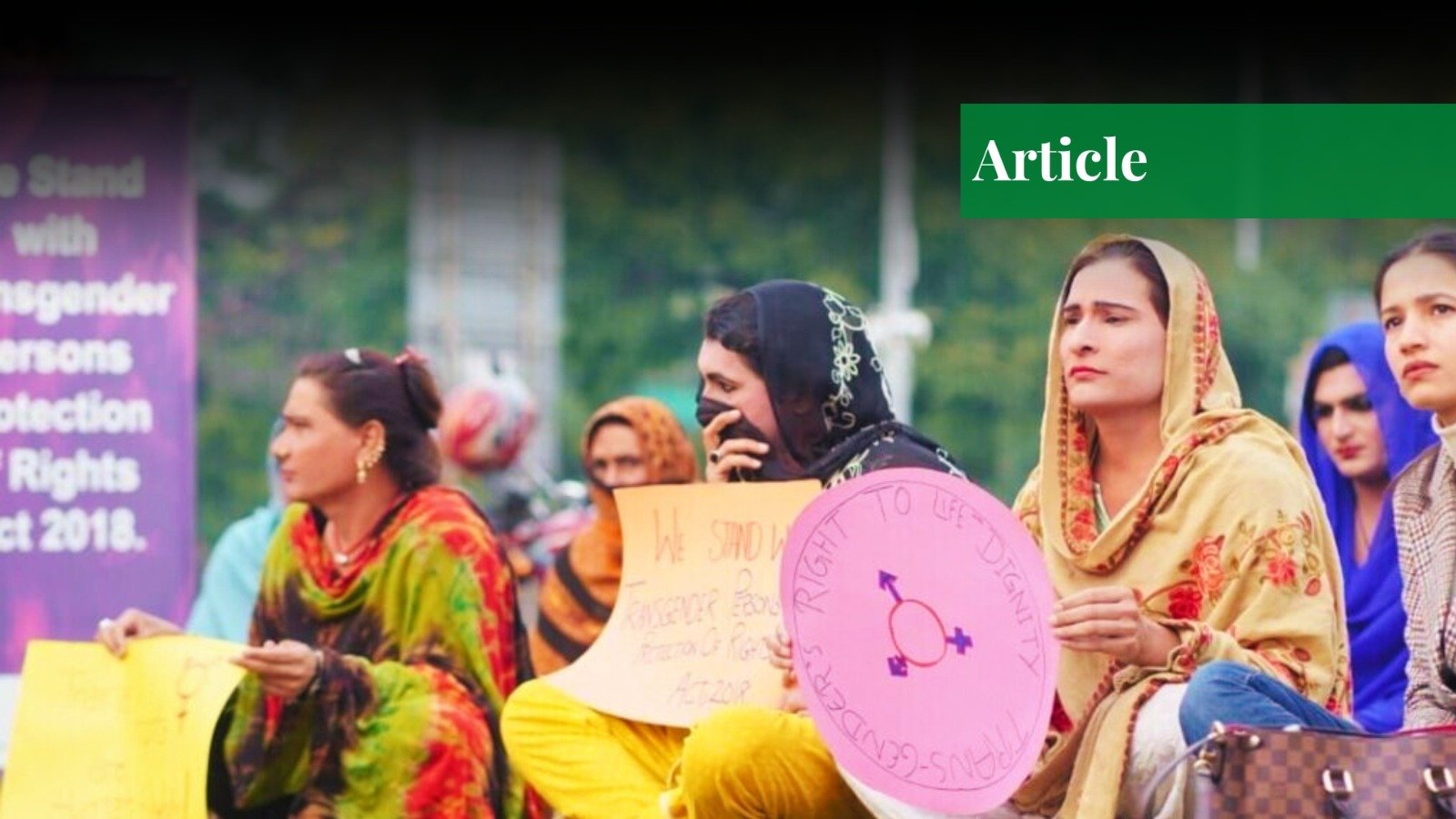

In contemporary discussions about rights, representation, and inclusion in Pakistan, some populations remain perpetually on the fringes of public policy and national identification. Religious minorities, ethnic populations, and women have become more visible in today’s conversations, although the extent of genuine engagement has varied. However, there is one group that is missing from not only public conversation but from statistics as well: intersex Pakistanis. The absence of intersex Pakistanis from the national statistics is not simply a missing set of numbers but the act of silence inscribed within the state recognition machinery. Without a place in census figures, all forms of planning by the state are rendered obsolete as invisibility justifies neglect and neglect reinforces invisibility.
This problem is not just limited to Pakistan; intersex people (those born with variations in sex characteristics) are routinely statistically invisible across the world. However, here, the issue is exacerbated by the intersection of conservative social attitudes, bureaucratic inertia, and a lack of adequate legal frameworks. Although there have been legislative advancements, such as the landmark Transgender Persons (Protection of Rights) Act of 2018, intersex identity is often either collapsed, misclassified, or fully excluded in a categorization strategy. Thus, that population in Pakistan is omitted from the quantitative evidence that shapes development priorities, resource allocation, and rights-based policy development.
This lack is not just a data problem; it is a matter of political will, cultural recognition, and epistemic justice. If there is no data, there is no feasible policy and if there is no policy, there is no accountability. By surveying the historical development of intersex recognition in Pakistan, identifying the statistical gaps, and discovering the implications of invisibility, it should be understood that the act of counting intersex Pakistanis is not simply a bureaucratic process but a political responsibility.
Historical Context of Intersex Recognition in Pakistan
The history of intersex recognition in Pakistan is closely linked with the broader category known as khwaja sira, which includes many identities, including transgender women, eunuchs, and intersex people. The khwaja sira were historically respected and treated with ceremonial roles in the Mughal courts, but functions of colonial rule articulated these identities through pathological and criminal lenses. The Criminal Tribes Act of 1871, and especially its provisions on “eunuchs”, were pivotal in moving towards a criminalization and surveillance of gender non-conforming communities and aggregating identities away from more traditional modes of recognition.
The Supreme Court decisions of 2009 and 2012 were the first to legally recognize khwaja sira rights, directing the government to add them to the NADRA system and provide them with rights in social welfare programs. The decisions and the subsequent laws also recognized rights in broad and unspecified ways. For example, the Transgender Persons Act of 2018, while novel, defined the scope of the law mainly in terms of gender identity and not biological differences in sex characteristics. This meant that intersex individuals were often miscategorized into other identity categories.
The Statistical Blind Spot
Census taking is not simply a technical task. By deciding which categories to count, the state also determines which existences will be acknowledged, and which will be left unspoken. The shape of national data reflects national priorities; therefore, erasure by omission is not simply a clerical error on behalf of the state.
In Pakistan’s 2017 national census, there was a “third gender” option for the first time, an accomplishment in the wake of civil and administrative legal actions taken by transgender rights organizations, which called for further recognition. Nevertheless, this inclusivity was also a limitation of a different kind. It essentially collapsed all identities into the statistical purgatory of “other,” thus rendering intersex people invisible under a label that was never theirs.
This oversight in statistics is also a result of bureaucratic reductionism. Often, policymakers will justify the lack of a discrete intersex category by saying the population is “too small” to be tracked in this way. This ignores the original intention of using disaggregated data. A count is not simply a count of the majority, but also the count of the tiniest of groups, so that their needs can be addressed. By including intersex populations in larger, undefined categories, the state obliterates the unique medical, educational, and socio-economic contexts.
Technical and procedural barriers reinforce this invisibility. The Pakistan Bureau of Statistics (PBS) has not yet created explicit operational definitions and enumerator training modules that acknowledge, count, and also sensitively record intersex identities. Without the explicit instruction in the operational guidelines, census workers will rely on binary assumptions, or worse, their own judgments about someone’s gender, which leads to miscounting. Using a traditional household-based enumeration model further contributes to the problem; the mode of enumeration only counts intersex people who belong to a household, while many intersex people (especially those who have been rejected by their families) may be residing in community-based settings or they may not be living with proper housing conditions, therefore they are statistically invisible.
The results are cyclical and self-perpetuating. Without reliable baseline data, no comprehensive sense of how many intersex people live in Pakistan, or the challenges they contend with, the government has no fundamental empirical basis on which to develop targeted policies or mobilize resources. Because there are no numbers, it is easy for the state to absolve itself from responsibility; if statistics are absent, the issue may be too marginal to matter.
Consequences of Invisibility
The implications of intersex people not being included in national statistics are extensive. Policy-wise, invisibility means exclusion from development programs, healthcare planning, and educational change. Without official numbers, intersex-specific health services, which include safe, non-invasive medical interventions where needed, hormone therapy, and specialized counseling, will not be considered on public health agendas. Intersex children still face these medically unnecessary surgeries to “normalize’ their bodies, without measures of legal oversight, accountability, or protections regarding informed consent. With the continued absence, the state also does not challenge any outdated medical protocols either.
Statistical invisibility in educational settings prevents a full understanding of the breadth of harmful behavior inflicted upon intersex students, including bullying, harassment, and barriers to enrollment and staying in school. Dropout rates go untracked, allowing education systems to avoid the responsibility for systemic change, as there is no data to force change. Education providers are not resourced enough to provide safe, inclusive learning environments. The absence of training for teachers and administrators is routinely ignored in policies.
The same structural gap is present in employment policies. The absence of data forces intersex individuals into informal, low-waged work, which lacks job security, and which further entrenches patterns of economic marginalization for intersex people.
Culturally, the lack of data sustains stigma. When intersex people lack visibility in national narratives, myths and misunderstandings continue to breed unchecked. Invisibility allows the perception that intersex people are rare, abnormal, or shameful and not a part of the natural biological variation and therefore, need to be hidden. These narratives contribute to family-level rejection, the continuation of childhood operations that violate human rights, and exclusion from inheritance rights. In a society where legal and social rights are often bound to gender, erasure has serious and lifelong consequences.
Towards Inclusive Data and Policy
In order to address the exclusion of intersex Pakistanis from national data, both technical and political change is needed. From a technical perspective, the Pakistan Bureau of Statistics needs to go beyond a single category and include disaggregated options that span intersex and transgender identities, which will require clearly defined definitions developed in cooperation with intersex-led organizations, human rights bodies, and medical and ethics specialists.
Training enumerators is essential. Data collectors need to have technical instructions, but they also need to cultivate an understanding of cultural sensitivity that allows them to ask questions about gender respectfully. Pilot surveys could be done before the national rollout to test the appropriateness of these questions, allowing for better methodologies.
Politically, the shift must occur away from mere symbolic recognition towards true substantive inclusion. Legislative changes should require that intersex-specific data be collected in all government surveys, not just the national census, but in health, education, and workforce data as well. This would facilitate specific policy, budgetary, and performance evaluation solutions.
Civil society is crucial in connecting communities to the state. Intersex advocacy groups, while small, are a critical element of determining definitions, establishing priorities, and ensuring that the data collection is not weaponized for state surveillance or discrimination. Research partnerships between intersex-led advocacy groups, academics, and governmental departments could lead to developing the evidence base for policy change.
Conclusion
The erasure of intersex Pakistanis from national statistics is not a technical blunder; it is an act of political erasure. The state can deny them visibility when they are not counted, and when visibility is denied, policies aren’t made. Counting intersex individuals is about recognizing intersex people as citizens with rights, needs, and contributions. It is a chance to counter the institutional ignorance that feeds harmful medical practices, educational exclusion, and social and economic marginalization. Without data, all advocacy is anecdotal and all policymaking is hypothetical. Until intersex Pakistanis appear in those documents, not as an afterthought, but as a recognized category, the promise of equal citizenship will remain incomplete.
If you want to submit your articles and/or research papers, please visit the Submissions page.
To stay updated with the latest jobs, CSS news, internships, scholarships, and current affairs articles, join our Community Forum!
The views and opinions expressed in this article/paper are the author’s own and do not necessarily reflect the editorial position of Paradigm Shift.

Momina Areej is currently pursuing an MPhil in Clinical Pharmacy Practice. With a passion for writing, she covers diverse topics including world issues, literature reviews, and poetry, bringing insightful perspectives to each subject. Her writing blends critical analysis with creative expression, reflecting her broad interests and academic background.