
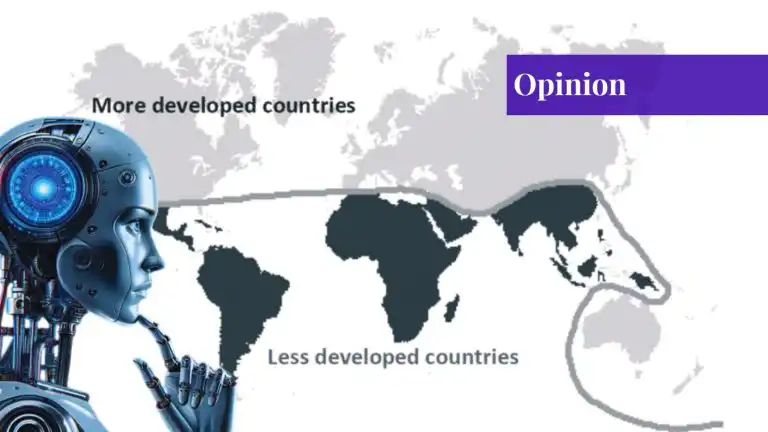

AI is not just another new technology anymore; it is turning into the foundation of economic progress, military power, political structure, and even social structure. The most advanced countries in AI will form the future regulations in trade, security, and communication. In the contemporary day, this power is concentrated in a small number of developed economies, with most being situated in North America and East Asia, where labs of research, data storage centers, and money-granting networks are densely concentrated. Such an increase in disparity poses a significant question: rather than making the world a more equal place, AI can, on the contrary, increase the divide between the wealthy and the developing states. The question many nations in the Global South are asking is whether they will or will not be producers of AI technology or remain on the other side as users of systems created elsewhere.
Digital Colonialism
This disproportion is primarily caused by structural constraints. The three fundamental ingredients of modern AI are the large volumes of data, the mighty computing devices, and a stable internet connection. Instability in electricity, poor coverage of broadband connections, and nearly zero-scale computing infrastructure are problems faced by many developing countries. There are areas where there are high populations of people that have very small proportions of the computing capacity of the world.
Meanwhile, large technology firms in the wealthier nations usually gather, archive, and manage the data with which global AI models are trained. Developing societies tend to offer raw data to their users and markets, but seldom regulate or exploit the data. This state of events is usually referred to as digital colonialism. It is further increased by financial and human resources. Venture capital, research grants, and high-tech investments are excessively invested in already formed innovation hubs.
Consequently, in any given case, the poor countries lose their talented engineers and researchers to other countries where they find better opportunities. Such brain drain compromises research ecosystems in the country, and local industries do not have a chance to develop. In the absence of a skilled labor force and investment, such nations can hardly generate their own technologies or dictate the standards of the world. They are at risk of being dependent on imported AI systems that might not comprehend their languages, cultures, or economic realities.
Unless these trends are reversed, AI may increase inequality in the world. Technologies that are well-trained around Western languages and ways of life tend to fail to work well in other social settings. To illustrate, the automated decision systems might fail in the local dialects, health complications, or even farms typical of developing societies. Lack of control over the tools on which countries base their lives means that they also have no control over privacy, security, and ethical regulations. Under this type of future, the digital world would be more or less designed by some countries, and others would just live within it and have fewer economic gains under automation and productivity.
Localized Innovation as a Path Forward
But there is no reason to despair. One benefit that the Global South enjoys is local knowledge. Developing nations do not need to be involved in direct competition with the major technological giants in all spheres and areas; they can concentrate on resolving their immediate issues. AI usage in farming, weather forecasting, education services, and healthcare services in rural areas can have a direct positive impact.
Predictive tools can help small farmers to enhance their harvests, local clinics can count on diagnostic systems, and governments can better handle floods or heatwaves. These niche solutions need not be the ones controlling the world markets, but something that produces a significant effect and economic value within the borders. In most instances, scale is of second importance as opposed to relevance.
Governments should be involved to achieve this. There is a need to invest in digital infrastructures, vocational training, and research centers. The local startups should be encouraged by policies protecting national data and encouraging collaboration between universities and industry. The regional collaboration can assist smaller economies to share resources and datasets and make more equitable deals with technology.
Under collective effort, nations will be able to gain a higher bargaining power and not rely on a small number of global companies. The emergence of artificial intelligence is an opportunity as opposed to a fate: through concerted policies and collaboration, the developing nations will be able to achieve a positive role in the AI age and make sure that technology is used as a tool of common human development and not as an instrument of further global polarization.
If you want to submit your articles and/or research papers, please visit the Submissions page.
To stay updated with the latest jobs, CSS news, internships, scholarships, and current affairs articles, join our Community Forum!
The views and opinions expressed in this article/paper are the author’s own and do not necessarily reflect the editorial position of Paradigm Shift.

Aamir Abbas is a PIEAS graduate with an MSc in Data Science from UET, Lahore. He is also a CSS/PMS mentor.