
Introduction
Nemesio Rubén Oseguera Cervantes, alias El Mencho, was born on 17 July 1966 in Aguililla, Michoacan, Mexico. It is a village with poverty and high drug trafficking networks. Farmers of villages in Mexico have some local connections with small drug cartels. The drug smuggling rate is also high in Mexico, as the young public is also involved in this act. El Mencho also started smuggling in his teens. Prosecutors said he was involved in the heroin trade.
After a few years, he was arrested by the US, but he didn’t change in any way. After serving his prison sentence, he was sent back to Mexico, where he joined the Milenio Cartel. Mencho failed to become the leader of the Milenio Cartel. Eventually, after splitting from it, he declared war on the Sinaloa Cartel, a powerful cartel in Mexico and also a strong ally of the Milenio Cartel. Then in 2009, he founded his own cartel named “Jalisco New Generation Cartel” (CJNG; in Spanish, Cártel de Jalisco Nueva Generación).
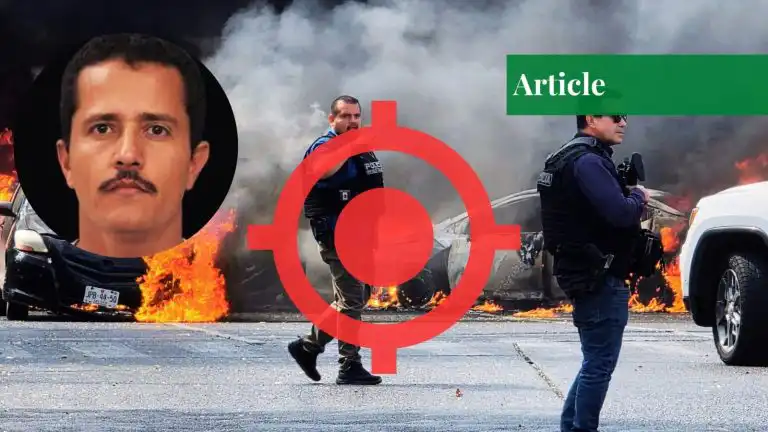
CJNG is a key supplier of fentanyl, due to which thousands of people have lost their lives. By expanding his network, El Mencho became the most wanted “drug lord” of Mexico. This cartel is known as the new generation, as it differs in structure from old cartels. CJNG is decentralized and extremely violent. Decentralization helps in the working of the cartel even if the leader is killed or arrested. El Mencho was killed on 22nd February 2026 by Mexican special forces. The cartel is still operating due to its decentralized structure.
Transnational Drug Trafficking Network of CJNG
Mexico’s geographic location benefits CJNG in drug trafficking. Mexico lies between North America and South America. It has access to the Pacific and Atlantic Oceans. This makes it easy to traffic drugs from the least risky route. CJNG is a transnational drug cartel. It operates on land, air, and sea routes. Through Mexico, drugs are transported to North and South America, Europe, and Asia. In short, CJNG transports drugs to the world. That’s why El Mencho was known as a “drug lord.”
Drug smuggling happens from Northern Mexico to the US. Through this porous border, 90-94% of drugs are exported easily, which includes cocaine, heroin, and fentanyl. Fentanyl is also exported from Guatemala to the US via Mexico. Drug trafficking also happens from Jalisco, Colima, and Nayarit through the Pacific Ocean to California and Texas. Pacific Ocean shipping containers are used to transport drugs to Asian states. Ports like Manzanillo and Veracruz are used in this trafficking. Atlantic shipping routes through Caribbean ports are used to export cocaine, fentanyl, and meth. When sea and land routes are blocked for transporting drugs, it uses air routes through private jets. Caribbean islands are the hub for drug shipments in Europe.
The Assassination of El Mencho
CJNG was designated as a foreign terror group by the US in February 2025. El Mencho was escaping from Tapalpa (hideout), which was raided by Mexican special forces, when he was wounded. He died on 22nd February, 2026, in a helicopter when he was being taken to Mexico City. The US has offered $15M for the information leading to his arrest. During the operation, cartel gunmen started firing at the Mexican security forces, which led to the deaths of eight cartel members. 25 national security guards were killed in six separate attacks on CJNG. As per the reports of Sky News, rocket launchers, grenade ammo, and armored vehicles were found at the location.
The Mexican army and National Guard used the ground cordon technique to isolate the hideout. Six helicopters and special forces were ready in states near Jalisco for any emergency. The Mexican air force also provided support with aircraft. Mexico’s president, Claudia Sheinbaum, was kept informed of every development of the raid.
Heavy protests were conducted by cartel members. They damaged civilian property and blocked roads. 73 people died in this violent attempt by CJNG members. Approximately 70 people have been arrested in several states of Mexico. Mexico’s security minister Omar Garcia Harfuch said, “27 cowardly attacks were conducted against the authorities.” On Monday, Mexico’s president, Claudia Sheinbaum, said that “the country was now at peace and calm.” The White House has confirmed that the US provided intelligence to arrest El Mencho, as he was a criminal for both states.
Cartel members spread fake news to increase fear among citizens. As per Jane Esberg, assistant professor at the University of Pennsylvania, “They are trying to show that the Mexican government doesn’t have control over the country.” False reports and images of the following were spread: the Guadalajara airport was taken over by assassins, a plane on the runway was on fire, smoke was billowing from a church, and multiple buildings in the city of Puerto Vallarta were on fire. Reuters reviewed those images and declared them fake. According to Reuters, cartel members were using the media as a soft tool to spread misinformation across the world.
Implications of El Mencho’s Assassination
El Mencho was the most wanted criminal in the USA. His assassination leads to regional and cross-border implications. Due to his death, many other cartels are emerging to gain influence. They are competing for legitimacy and creating security concerns for Jalisco, Guanajuato, and Chihuahua. These states were hubs from which drugs were transported around the world. This destabilization can cause difficulty for Mexican police to deter them. They need support from federal forces to control the growth of other cartels.
To retain its influence, CJNG may increase its narcoterrorism. The new leader of the cartel can increase smuggling, especially in North America, as intelligence was provided by the US. Destabilization in Mexico could have a spillover effect in Central and South America, which can also affect their trade. To mitigate these challenges, the High-Level Security Cooperation Group should be promoted at a higher level. It provides intelligence sharing and addresses organized crimes. This would be beneficial in strengthening the US-Mexico border.
After the assassination of El Mencho, Mexico’s president praised the forces. Cartel members spread fake news and images to spread fear among the public. They also conducted protests, burned civilians’ cars, and blocked the roads. Many civilians were killed in these protests. But at last peace was obtained. Looking forward, analysts say that targeting the top leadership of any terrorist organization leads to an increase in extremism. CJNG is a decentralized cartel that operates even after the death of its leader.
In decentralized terrorist organizations, they divide into small groups when their leader is killed or has died. Those groups are known as phantom cells. This dispersion causes it to be nearly impossible for intelligence to locate them. Due to this, those groups with their shadow commanders conduct several violent activities. Now, CJNG may also increase its drug supply in different regions of the world.
Conclusion
February 2026 marks the end of the era of the most wanted drug lord, Nemesio “El Mencho” Oseguera Cervantes. Unlike the traditional “federation” model of Joaquin ‘El Chapo’ Guzmán, Mencho’s CJNG operated as a hierarchical and highly militarized organization, using extreme violence to occupy a territory and expand the drug trade. Similar to the post-2014 chaos following El Chapo’s arrest, Mencho’s death is expected to trigger a severe power vacuum, causing CJNG to divide into small groups. However, unlike the aftermath of Chapo’s arrest, which led to its end, CJNG’s decentralized structure is beneficial for its further expansion through phantom cells. This event can cause an increase in narcoterrorism. Due to this, the addiction rate will increase, and human rights will be violated.
From history, it is clear that the kingpin strategies only cause temporary damage to these organizations. Intelligence should eventually target the shadow commanders after killing top leadership. Narcoterrorism can be resisted if the intelligence of the US and Mexico collaborate. Mexico must focus on strengthening law enforcement because El Mencho’s assassination may lead to a new phase of organized crime. This will require a hybrid approach of military and intelligence collaboration.
If you want to submit your articles and/or research papers, please visit the Submissions page.
To stay updated with the latest jobs, CSS news, internships, scholarships, and current affairs articles, join our Community Forum!
The views and opinions expressed in this article/paper are the author’s own and do not necessarily reflect the editorial position of Paradigm Shift.

Syeda Farani Fatima is an undergraduate student of International Relations at the International Islamic University of Islamabad, with a strong interest in anti-corruption, counter-terrorism and geopolitics. Strongly committed to fighting corruption, terrorism, and supporting national reform through research and public service.