
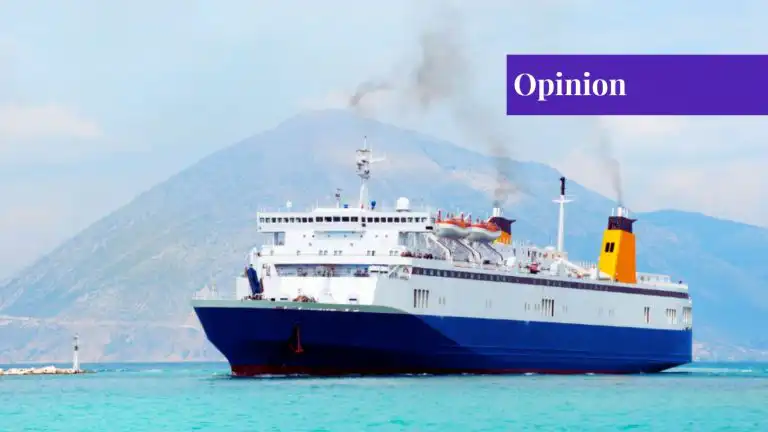

Pakistan’s Ferry Service
Pakistan is at a historic turning point in the maritime industry. The country is developing a comprehensive ecosystem of maritime potential to preserve and create value, generate employment, and increase exports through the growth of container fleets, recycling of ships compliant with HKC, digital fisheries traceability, and new international ferries. The Ministry of Maritime Affairs has advanced into fields that have been overlooked, particularly the ferry service.
With the acceptance of the inaugural international ferry service in Pakistan, the Karachi-Chabahar route, passenger shipping has resurfaced after decades, having been lost. To the coastal communities, traders, and pilgrims of Pakistan, this route is both cheaper than flying and safer than traveling long distances by road through Balochistan. More strategically, it provides the expansion of the network of ferry connections with Oman, the UAE, and possibly other Gulf countries, which will make Pakistan a part of the people-to-people economy of the Arabian Sea. Ferry services will be able to boost tourism, minor trading, and coastal development, and will also alleviate congestion on the airports and highways.
Why Ferry Services Die Out
Nonetheless, the practice of other countries demonstrates that ferry services can be regarded as one of the most failure-prone forms of transport. Governments and the private operators around the globe have opened projects on ferries with a lot of hope, only to close them a few years later. This is attributed to imbalances in high operating costs and politically limited ticket costs, among others. Ferries are costly to run, as they have to have huge crews, high fuel usage, constant upkeep, docking expenses, insurance, and adherence to safety standards. In cases where the governments insist on maintaining fares at low levels due to social or political factors, the revenue is not usually adequate to cover the costs.
In the United Kingdom, there are numerous ferry routes in Scotland and northern England that would otherwise die out due to the unfading long-term government subsidies. Private operators have left some of the routes due to the inability to remain profitable under regulatory and cost pressures. In India, numerous modern roll-on/roll-off ferries introduced in the Sagarmala coastal shipping program have not influenced a sufficient number of paying passengers to maintain them, even after receiving heavy investment.
The other significant cause of ferry failure is inadequate port and terminal infrastructure. The passenger ferries need much more than a dock; they need immigration and customs, security checks, waiting bays, bag handling, emergency services, and quick queuing. The developing countries have a lot of ports that are designed to accommodate only cargo and cannot accommodate the flows of passengers effectively. An example is the Colombo-Tuticorin ferry, which was introduced and closed several times in Sri Lanka-India due to delays, poor terminals, time-consuming immigration, and the service not being as attractive as the flights. This is the very risk that Pakistan would run in the case of Karachi and Gwadar being unprepared to have dedicated ferry terminals, which fulfill international passenger standards.
Advertisements and media also have a conclusive influence on ferry failure or success. Along multiple Southeast Asian routes between Thailand and Malaysia, ferry services have not been shut down due to a lack of potential demand within the route, but rather because airlines have intensively marketed the cheap flights, whilst ferry operators have not advertised their services or established consumer confidence within their operations. In Pakistan, where ferry culture is decades old, customers simply prefer buses or planes to ferries, even in cases when the latter may be cheaper and more comfortable. The Karachi-Chabahar ferry will be lost to under-utilization in the absence of long-term marketing and interaction with the citizens.
Ferry economics are further complicated by the competition with transport means that are faster. In Hong Kong and Macau, ferries used in the past lost significant numbers of passengers when high-speed bridges and tunnels were constructed. In the case of Karachi-Chabahar, airlines and long-range buses are also good competitors, especially for people who need to cover short distances in time. Cross-border ferries are also large targets of political and regulatory risks. Travels between Greece and Turkey are often interrupted due to diplomatic strains and visas.
The same vulnerabilities will be experienced in Pakistan-Iran ferry services in case of the change of border policies and security conditions or bilateral relations. Finally, there is concern about safety and trust among the people. The 2014 Sewol ferry crash in South Korea demonstrated that one accident can ruin the years-long trust in ferries as a mode of transport. In Pakistan, where awareness of maritime security is poor, and the media is very critical, a single incident of a serious nature would be a lasting blow to the sector.
If you want to submit your articles and/or research papers, please visit the Submissions page.
To stay updated with the latest jobs, CSS news, internships, scholarships, and current affairs articles, join our Community Forum!
The views and opinions expressed in this article/paper are the author’s own and do not necessarily reflect the editorial position of Paradigm Shift.

Dr. Waqas Khaliq Bhatti is a research fellow associated with the National Institute of Maritime Affairs, Karachi, Pakistan. He may be contacted at[email protected].