
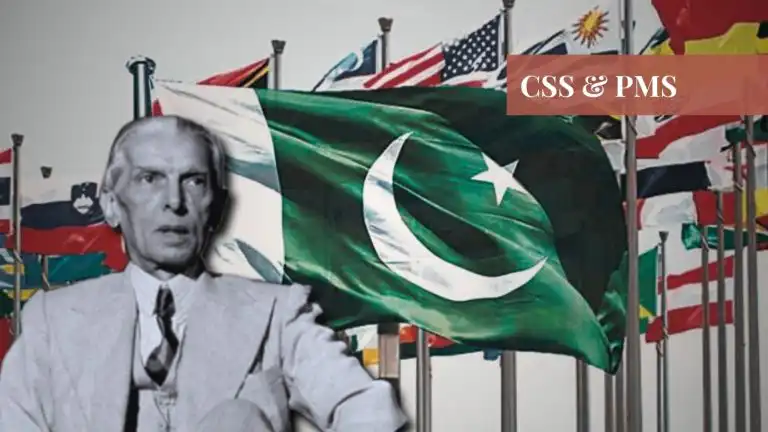

“I do not believe in taking the right decision; I take a decision and make it right.”
– Muhammad Ali Jinnah
Pakistan’s foundational foreign policy goals and state attributes were already decided before it appeared on the world map. The freedom movement that led to its creation set the very goal of what a future state for Muslims should look like. No doubt, the Muslim cause was supported and promoted by various leaders, but the entire Muslim movement became indebted to the efforts and far-sightedness of one man – Muhammad Ali Jinnah.
The pioneer of the Pakistan movement and, later, the founder of the Pakistani nation, Jinnah, acted as a one-man army against a number of obstacles in his way. His major trait was leadership through strength, no matter whether the resources were scarce or the possibilities felt narrow. Jinnah knew the fact that the newly born state would require visionary and policy-oriented goals to withstand future storms. Therefore, he not only provided an impetus to the Pakistan movement but also prepared his people for the post-independence situation.
Guiding Principles of Jinnah’s Foreign Policy Approach
Through untiring tours and direct contacts with locals during the movement, Jinnah has already articulated his very principles of forming a new sovereign state for the Muslims of the subcontinent. Soon after the emergence of Pakistan, Jinnah became the Governor-General of the country. During his thirteen months of life after the creation of Pakistan, he delivered various speeches at national and international platforms that clearly identified the overarching principles of the foreign policy of Pakistan. On that note, Jinnah had a very clear vision, which could be measured by one of his broadcast talks to people of the United States in February 1948: “Our foreign policy is that of friendship and goodwill to all the nations of the world.”

- Independence
Pakistan was created during the era of colonial emancipation. Empires were dismembering, and the world map was bestowed with a large number of sovereign entities. However, it was also the fact that the newly established states were becoming protectorates of the colonizers, whereby the empires retained control of foreign policy decisions of the newborn country. Jinnah was against this notion. He believed in the right of a state to formulate its foreign policy without any external intervention or dictation.
Addressing the first constituent assembly on 11 August 1947, Jinnah stated, “The most important point I want to make is this: keep in mind that you now possess all authority as an independent legislative body. As a result, the weight of your decision-making rests heavily upon you.” This statement clearly shows that, as per Quaid, serving the country’s national interest should be the foremost responsibility of its officials.
- Peaceful Coexistence
Jinnah held the viewpoint that Pakistan should present itself to the world as a peaceful country, both in its internal and external affairs. No doubt, Pakistan was established based on Islamic ideology, but people belonging to any other religion will have the right to live and practice their rituals. The reality of the Pakistan movement basically hides in the fact that it was not a religious movement only meant for Muslims; rather, it aimed at establishing a homeland where every person can live in liberty with respect to his/her religious, political, or social inclinations. While addressing the constituent assembly, Jinnah explicitly mentioned, “You are free; you are free to go to your temples. You are free to go to your mosques or to any other places of worship in this State of Pakistan. You may belong to any religion, caste, or creed – that has nothing to do with the business of the state.”
Likewise, Jinnah wanted to make the world realize that Pakistan does not seek to create animosity toward other states. Even he was of the view that India should be considered a peaceful neighbor that can coexist with Pakistan, setting a precedent for others to follow suit. In 1948, addressing the people of the US, he stated, “We do not cherish aggressive designs against any country or nation.”
- Rule of Law
Jinnah strongly adhered to the principles of justice, law, and order in every situation. He is often known as the ‘man of rules.’ It is evident in history that Jinnah explicitly negated the idea of the civil disobedience movement of Mahatma Gandhi. During the Kashmir crisis (1947-48), Jinnah advised both sides to uphold the rule of law and resolve the issue through peaceful negotiations. Highlighting Pakistan’s point of view regarding the rule of law, he stated, “We are committed to the principles of honesty and fair play in domestic and international relations and are willing to do everything we can to advance peace and prosperity among the nations of the world.”
- Muslim Brotherhood
Jinnah was a prominent contender of the Muslim Brotherhood and laid the very principles of Pakistan’s foreign policy under this pillar. In a 1948 broadcast, Jinnah declared, “The vast majority of us are Muslims. We adhere to the teachings of the Prophet Mohammed (P.B.U.H). As members of the Islamic Brotherhood, we believe that everyone is equal in terms of rights, dignity, and self-respect.” Through this, he meant to provide the people of Pakistan a room to practice their religious affairs, not to establish a caliphate system.
He famously stated, “But make no mistake: Pakistan is not a theocracy or anything like it.” According to him, Pakistan should provide moral and diplomatic support to every Muslim nation, in particular those in the Middle East and Africa, while simultaneously maintaining a non-offensive stance towards other states. Talking to the BBC about the Palestine issue, Jinnah expressed that the decision was ‘unjust and cruel’ and pledged to support the cause of the Arabs in Palestine in every possible way.
Variables of Jinnah’s Foreign Policy Approach
As symbolized by Mohammad Ali Jinnah, Pakistan’s foreign policy is the product of three factors: the Quaid’s worldview or cosmology, Pakistan’s security needs, and the new Cold War international system. Despite his deteriorating health, the Quaid was able to establish the strategic parameters in line with his own intellect due to the Muslim League’s overall lack of a foreign affairs focus. Before December 1947, Pakistan had no permanent Foreign Minister, and all papers were submitted to Quaid-i-Azam for guidance or judgment.
- Worldview
One could describe the Quaid-i-Azam’s perspective as rationalistic. Jinnah had never been extreme in his religious views. As an example, in 1920, Jinnah specifically cautioned Hindus and Muslims in Turkey against being emotional and agitated about the Khilafat issue, and thus, his commitment to religious non-extremism was clear. But Jinnah opposed both the division of Palestine and the creation of Israel.
To evade the direst effects and ramifications, he sent a cable to President Truman requesting him to defend the rights of the Arabs. Additionally, he deemed the Dutch invasion of Indonesia to be unlawful and denied Dutch ships and planes access to transit facilities, transporting war supplies to Indonesia.
- Defense and Security
Jinnah has never viewed India as a rival nation; on the contrary, he has consistently preached the notion of peace and reconciliation, founded on justice and equity. However, from the very first day, Indian officials had refuted Pakistan’s existence. The Indian government had significant reservations about the Partition Plan, as evidenced by Jawaharlal Nehru’s statement, “The proposal to allow certain parts to secede if they so will be painful for any one of us to contemplate.” The Indian invasion of Kashmir was vehemently opposed by Jinnah. He viewed Kashmir as Pakistan’s ‘jugular vein.’ The Durand Line problem in Afghanistan was another challenge Pakistan had to confront. With the backing of the Indian National Congress, the Khudai Khidmatgar movement had already made the term “Pakhtunistan” famous in 1946. Even though Jinnah viewed Afghanistan as a friendly Muslim country, he also made it clear that the territorial integrity and security of Pakistan could not be doubted.
- Cold War
Jinnah’s cold war policies reflected strategic alignment rather than ideological inclination towards the major powers. Being a former colony of Great Britain, Pakistan’s inclination towards the West was justified. However, Jinnah maintained close contacts with the Soviet Union also. Although Pakistan accepted the invitation of the West after Jinnah’s death, the call from the USSR also reflected the diplomatic space that Jinnah had created.
As Pakistan was facing economic and security challenges, Jinnah sought technical and financial assistance from the West. In addition, Jinnah was a staunch supporter of the UN Charter and always emphasized the importance of international laws and the peaceful resolution of conflicts. Thus, Jinnah’s policies towards the international community were characterized by engagement and restraint.
Where Did We Go Wrong?
The entire foreign policy approach of M. Ali Jinnah revolved around one central concept – “Our object should be ‘peace within, and peace without.’ We want to live peacefully and maintain cordial, friendly relations with our immediate neighbors and with the world at large.” Jinnah laid the foundation of Pakistan’s foreign policy on this principle, which contends that while preserving the national interest, the government of Pakistan should maintain a strong social contract and peaceful relations with the entire international community. However, it has often been unsuccessful on multiple fronts as well. For instance, instead of being known as a peace-loving country, Pakistan is labeled as a ‘terror state.’ Its placement on the Financial Action Task Force’s grey list has further destroyed its credibility globally.
“Politics is too serious a matter to be left to the politicians”
–Charles de Gaulle
In addition, the nation’s silence about issues like the treatment of the Uyghur Muslims in the Chinese Xinjiang province sparked widespread public outrage. In the same vein, Pakistan made a complete U-turn after the 9/11 attacks by breaking all ties with the Taliban in Afghanistan and becoming devastated by terrorism as a result of its policy of complete collaboration with the United States. Thus, it can be concluded that throughout history and even in the modern era, Pakistan has been playing on both sides of the field, whereby sometimes the Quaid’s vision is strictly upheld, while on some occasions it is completely sidelined. Today, Pakistani politicians, elites, and the bureaucracy have been interpreting Quaid’s statements as per their biases. This is exactly where we have been going wrong.
Conclusion
Jinnah’s foreign policy approach is a benchmark for Pakistan in every era. His adherence to international laws and human rights provides us with a clear path to follow and stand out in the international arena. How Jinnah dealt with both internal and external challenges through diplomacy is a beacon of light for the current leadership of our country. No doubt, major developments have occurred since 1947, but Jinnah’s core principle of ‘peace within and peace without’ will always be the crown jewel of our foreign policy.
If you want to submit your articles and/or research papers, please visit the Submissions page.
To stay updated with the latest jobs, CSS news, internships, scholarships, and current affairs articles, join our Community Forum!
The views and opinions expressed in this article/paper are the author’s own and do not necessarily reflect the editorial position of Paradigm Shift.

He is pursuing a BS in International Relations programme from International Islamic University, Islamabad and has a keen interest in research works, policy analysis, defence and strategic studies and conflict resolution.