
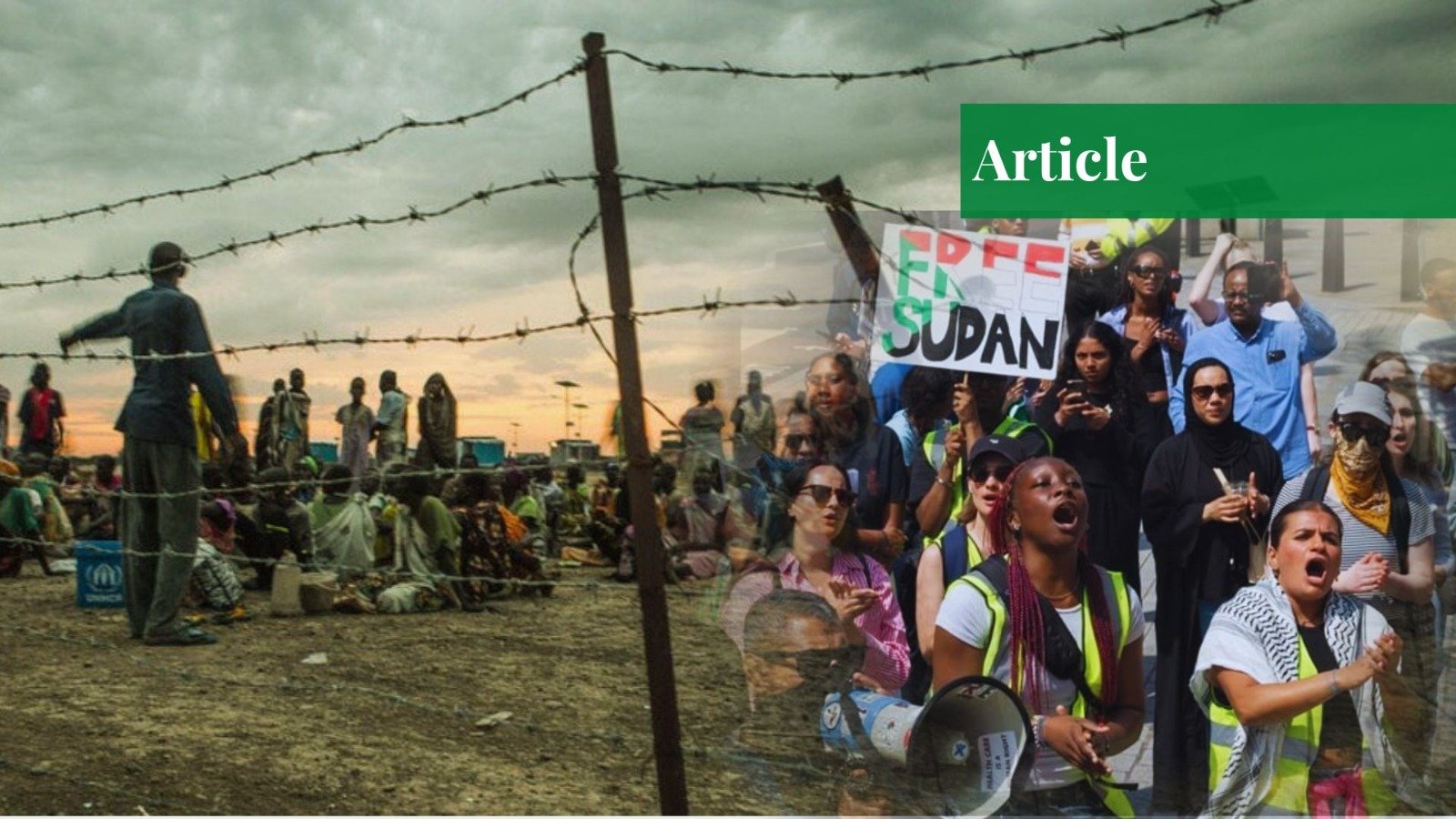

Global Attention on Gaza vs. Silence on Sudan
The conflict in Gaza and the ensuing massive human suffering immediately led to a global outcry, with millions of people expressing their sympathy simultaneously. The streets are occupied with protesters, social media is loaded with hashtags, and world leaders are compelled to take action. Nevertheless, when the whole world is witnessing Gaza suffering every minute, Sudan is experiencing another genocide that is quietly and slowly “killing” the world’s interest to act, the very conscience that is hardly stirred, and the little aid that is cut off. The quietness around Sudan’s misery is a sign of darkness in terms of humanity’s concern, as it always goes hand in hand with politics, race, and media value instead of the scale.
Sudan’s Escalating Civil War and Humanitarian Crisis
Sudan has been experiencing a ferocious civil war since April 2023, which has led to the battle between the Sudanese Armed Forces (SAF) and the Rapid Support Forces (RSF) escalating. It is estimated that in 2025, more than 30 million Sudanese need humanitarian assistance, and out of these, 16 million are infants. The number of internally displaced persons (IDPs) has been reported to be over 11.5 million, and this figure is expected to continue rising by thousands each month. More than 4 million Sudanese were projected to be refugees in neighboring countries by June 2025. The UN Human Rights Office has reported a minimum of 3,384 civilian deaths documented during the first half of 2025, which accounts for almost 80% of the total documented civilian casualties in 2024 during the same period.
Global Neglect and Media Silence on Sudan
The world hardly ever notices Sudan’s crisis in the same way as if it were to hang/display its magnificent human cost. No promotional campaigns are spreading virally, no death tolls are counted and reported on primetime news, and no Western capitals are arranging urgent meetings. The same society that successfully asserted the most massive support for humanity ever in the case of Ukraine, or simply flooded public spaces with Palestinian flags, has now chosen to ignore the blood-soaked streets of Sudan.
Convenience Over Ethics: The Politics of Global Empathy
Convenience is the factor determining the answer to the question, not ethics. Global empathy has never been universal. The global audience focuses on wars where the countries involved are allies, the West has economic or political interests, or there are ideological disputes between East and West. Conflicts in areas regarded as having no economic or political value, such as sub-Saharan Africa, are often written off as “tribal wars,” which is a derogatory expression. It implies that there is nothing but chaos among savages and that the planned massacres have been reduced to chaos.
Sudan is not a country that attracts much political activism due to its lack of geopolitical charm. It has no oil worth talking about like the Gulf, no superpower conflict like Ukraine, and no religious saga like Jerusalem. For most news agencies, the story is “too complex,” the pictures “too monotonous,” and the casualties “too remote.” The consequence is a loud silence, one that results in death.
Race and Selective Empathy in Global Coverage
Race is still a global empathy issue. Victims of war in Europe are depicted as “civilized” and “us.” Africa is considered a “crisis zone” where famine or slaughter is the norm. The majority of the Sudanese people are black and Muslim, which places them at the lowest position on the world’s empathy ladder. The Western press is often compassionate to some victims, while others are treated as mere figures in the statistics.
A single picture of a crying European child can make governments change their minds. On the contrary, the genocide in Sudan rarely makes it to the front page. The language used is indicative of the separation: Sudanese are said to have “fled from violence,” while Ukrainians “are defending democracy,” and Palestinians “are resisting occupation.” The choice of words is crucial; they determine the right to support and the invisibility of the neglected.
Media Attention and the Humanitarian Aid Gap
Humanitarian assistance largely relies on media attention. The scenario is that when the media are no longer there, the donors, the governments, and the humanitarian agencies are affected, respectively, by losing interest, withdrawing pressure, and struggling for funds. While Sudan and the genocide of its people are receiving neither food nor attention. As of the end of March 2025, only US$4.2 billion was needed for the humanitarian response plan, but only 6.6% had been funded. This means that the lives of millions of people are being considered only through the small fractions of the aid they need urgently.
Double Standards in Global and Regional Response
The double standards in the response are not only from the West. The Muslim nations, which normally criticize the West over Palestine, have gone quiet on Sudan. The Organization of Islamic Cooperation (OIC) made some statements, but not much more than that. Arab media give scant attention; governments in the area dealing with the situation prefer to maintain silence, and therefore, they do not open the borders to refugees.
For the countries of the Global South, including Pakistan, the tragedy of Sudan should have been a compelling reason to unite and expose the double standards in global justice. However, silence still prevails. This selective outrage diminishes the moral authority of all those claiming to be the defenders of human rights. If the Muslims only react to the victims who have the same political or geographic visibility as they do, then such support can be considered as mere sentiment, not as a principle.
Consequences of Global Neglect
Neglect sure has repercussions. While the world is discussing the possibility of a ceasefire in other places, civilians in Sudan are close to being wiped out. Humanitarian activities are almost impossible, and the attacks are on both main hospitals and aid convoys; the threat of famine hangs over the lives of millions. According to the UN, the displacement of over 140,000 people from one single month, mainly in North Darfur, was reported as of March 2025. The lack of international scrutiny allows the evildoers to massacre the innocent without any fear of facing the consequences.
This neglect further aggravates the situation in the end. A darkened Sudan loses the entire Horn of Africa—feeding the refugees into Chad, Egypt, and South Sudan; strengthening the militias; giving the extremists easy access through the networks. Still, the world would rather turn a blind eye until the disarray overspills the borders.
Widening the Moral Circle of Humanitarian Concern
The disparity between Sudan and Palestine does not invalidate the argument in favor of Gaza’s support. Rather, it is an appeal to widen the scope of our moral circle. The acknowledgment of suffering does not need to be politically justified. Both Palestinians and Sudanese people are entitled to empathy, justice, and global support. But the pickiness of our compassion reveals a common shortcoming: we express our sorrow loudly but only when it is a matter of fashion and remain silent at other times.
True humanitarianism is consistent. It means that we have to denounce genocide irrespective of whether it has been carried out by a superpower, an ally, or a forgotten militia. It means that news outlets have to treat African lives as no less valuable. It means that Muslim nations and developing countries should speak not only for political causes but also for human ones.
Sudan’s Legacy and the Cost of Global Apathy
Sudan will be remembered by history not just because of the barbarity of its warlords but also because of the world’s apathy. The genocide is taking place not only on the battlefield but also in our silence, our selective hashtags, and our dwindling attention spans. If solidarity is determined by visibility, Sudan has long been buried under the scroll of new wars. However, algorithms cannot measure conscience. Every death in Darfur should be felt by the world just as much as every death in Gaza. Until humankind gets to a point where all suffering is considered equally, the phrase “never again” will continue to be the most repeated untruth in modern history.
If you want to submit your articles and/or research papers, please visit the Submissions page.
To stay updated with the latest jobs, CSS news, internships, scholarships, and current affairs articles, join our Community Forum!
The views and opinions expressed in this article/paper are the author’s own and do not necessarily reflect the editorial position of Paradigm Shift.

Munaza Zainab is a final-year strategic studies student at National Defence University, Islamabad, with an academic focus on national and international security, strategic stability, and South Asian geopolitics. Her undergraduate thesis, “India’s Limited War Doctrine and Controlled Escalation: Implications for Strategic Stability in South Asia,” critically examines evolving Indian military doctrines, escalation dynamics, and their consequences for deterrence and regional stability. Her research interests include terrorism studies, information and psychological warfare, and contemporary security challenges in South Asia.