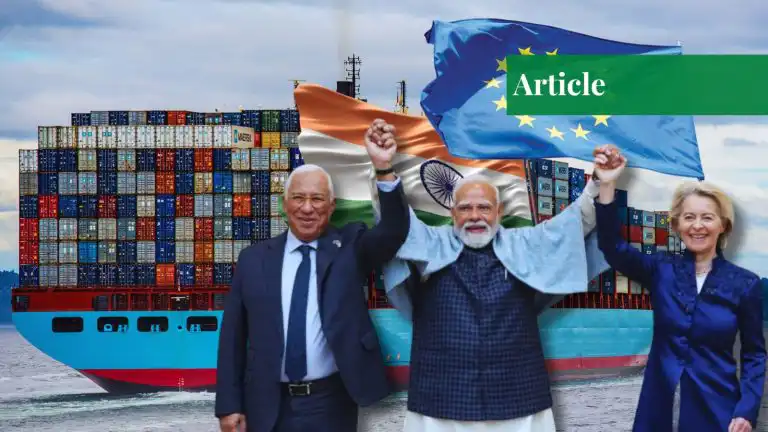

When India and the European Union finalized their long-negotiated India-EU Free Trade Agreement, they did more than liberalize trade — they redefined their strategic calculus. The pact signals a deliberate move away from overdependence on Washington and toward diversified, rules-based economic partnerships.
On 27th January 2026, two of the world’s booming economies, India and the European Union, finally concluded the long-awaited free trade agreement, which is being titled as the ‘Mother of All Deals.’ In the past, nearly 21 trade deals have been signed between the two partners, but this particular agreement has been elevated to the level of a ‘comprehensive partnership’.
The deal has been signed at a critical time when the entire world is suddenly realizing just how much it has been under the shadow of US protectionism. Both the EU and India have become victims of harsh US policies under Trump 2.0 – and because of that, both parties are now formally cooperating to diversify their domestic production, rather than relying on a single partner.
Genesis of the Deal
The Free Trade Agreement between India and the EU dates back to 2007 negotiations. These talks were put on hold due to differences on tariffs, duties, and property rights. In July 2022, the deal was reinstated. This came as a response to the Russia-Ukraine conflict, as Europe slowly reduced Russian energy imports.
Trying to keep Russia isolated, former US President Joe Biden stated that it is against India’s interests to purchase Russian oil, essentially threatening India. In the same spirit, Indian External Affairs Minister Jaishankar offered statements on several occasions, saying, “Europe must come out of the imagination that Europe’s problems are the world’s problems; the world’s problems are not Europe’s problems.” As a result of these persistent tensions and differing opinions, the India-EU trade agreement remained inactive.
Key Provisions
Now that both parties have realized that Trump can change his mind about anything at any time, they are working towards diversifying their allies and interests. The India-EU FTA deal opens doors for different avenues, mutually benefiting both parties. From goods and services to sustainable development, the agreement covers a wide variety of products with a significant reduction of heavy duties applied in the past.
Tariff Reduction
Across 97% of tariff lines, representing 99.5% of trade value, India has secured preferential access to the European markets. Approximately 92.1% of India’s tariff lines, accounting for 97.5% of EU exports, are being offered. These tariffs will be lowered in clear steps over time.
Agricultural Exports
Both parties have agreed to remove trade restrictions on vital agricultural goods, considering the local scenario. The Indian tariffs on EU agricultural exports have been reduced from 36% to zero, giving the EU a large consumer base for its goods. Conversely, the Indian agricultural and processed food industries are predicted to gain a lot from the FTA. By balancing between export growth and domestic concerns, India has cushioned major sectors of its economy, including the dairy industry. The FTA has put Indian agriculture in a better position to attract higher prices and get strategic access to the European markets.
Automotive Access
The agreement stipulates that India will reduce the car tariffs from 110% maximum to 10% within a span of five years, creating quota-based access to 250,000 EU automobiles annually. In response, the EU gave India instant duty-free access to its labour-intensive products, including textiles, clothing, leather, footwear, gems, and jewelry.
Trade-in Services
With the FTA, the EU has made more extensive and profound commitments across 144 service subsectors, including IT, professional services, education, and other commercial services. Indian service companies will be able to offer their services in the EU market under a stable and supportive environment throughout a wide range of the service sector.
European Autonomy
For Europe, the deal comes at a time when it is surrounded by threats from all sides. Europe’s key security guarantor, the US, has shifted its focus away from it. With warnings of leaving NATO, halting the ‘promised’ defense support to Ukraine, imposing tariffs, and demanding Greenland, the US has created a kind of hell for Europe. President Trump has declared Europe ‘a failing civilization’, whose erasure would be inevitable if it follows the current trajectory. Moreover, in July 2025, the EU signed a trade deal with the US under immense tariff pressure from the Trump 2.0 administration, which ironically resulted in a zero-sum deal.
Thus, the India-EU trade agreement provides Europe with the best alternative, sending signals to Washington that the current multipolar world can be operated under a rules-based system. “This is the story of two giants – the second and fourth largest economies in the world,” said European Commission President Ursula von der Leyen. “Two giants who opted to collaborate in a genuinely beneficial way. The best way to address global problems is via cooperation.”
Indian Self-Reliance
India has long enjoyed a strategic partnership with the US. Due to the China factor, Washington has always provided leniency to India over other matters. Even though India is a very close ally of Russia, the US and Europe have always given it a free hand. But under the Trump 2.0 administration, as the US pursues inward foreign policy and bilateral engagements (G-2) with China, India has started losing its central position in the Indo-Pacific. Rather, it became a victim of the US tariffs, some of them reaching up to a whopping 50%. President Trump further warned that the US could impose 500% tariffs on India. Assessing all of this, it became strategically imperative for India to restart and establish a decade-long frozen deal with the EU, showing Washington that it can also step back.
Like the EU, India has now signaled to the entire world that agreements can be conducted with or without the US. According to Commerce and Industry Minister Piyush Goyal, the trade deal between India and the EU is expected to maximize the nation’s exports to Europe in five years, and that this “mother” will be “compassionate and loving,” making sure that all of her 28 children benefit from the agreement.”
Strategic Diversification
The Indian FTA is a significant component of the EU’s trade diversification. What the Mercosur deal lacks, the Indian FTA fulfills: A pact with a large, democratic, market-oriented economy, with maximum business opportunities. For example, unlike Brazilian beef production, the Indian industry does not compete directly with European agriculture. Thus, the agreement with India can proceed with less friction. As of 2024–25, bilateral trade between the EU and India in commodities totalled about $136.5 billion.
Given the high stakes for India, the FTA deal will significantly strengthen the EU-India connection by establishing long-term productivity gains from lower trade barriers and regulatory harmonization. The deal will remain beneficial, regardless of the course that US-India trade ties take, because the EU-India FTA establishes a permanent reorientation of supply networks and strengthens integration between two of the biggest democratic economies in the world.
Conclusion
The ‘mother of all deals’ signifies the strength of middle powers in an era of uncertainty and self-help. Creating a market of about $27 trillion, the deal provides mutual strategic advantages to both India and the EU, emphasizing the significance of a rule-based order.
Moreover, it also sent shock waves to major powers, in particular the US, that the current geopolitical order is marked by multiple power centers that could collectively defy any coercive act against them. This FTA can be regarded as the ‘deal of the century,’ as two major US partners have collectively sidelined Washington, setting a precedent for others to do the same in the near future.
If you want to submit your articles and/or research papers, please visit the Submissions page.
To stay updated with the latest jobs, CSS news, internships, scholarships, and current affairs articles, join our Community Forum!
The views and opinions expressed in this article/paper are the author’s own and do not necessarily reflect the editorial position of Paradigm Shift.

He is pursuing a BS in International Relations programme from International Islamic University, Islamabad and has a keen interest in research works, policy analysis, defence and strategic studies and conflict resolution.