
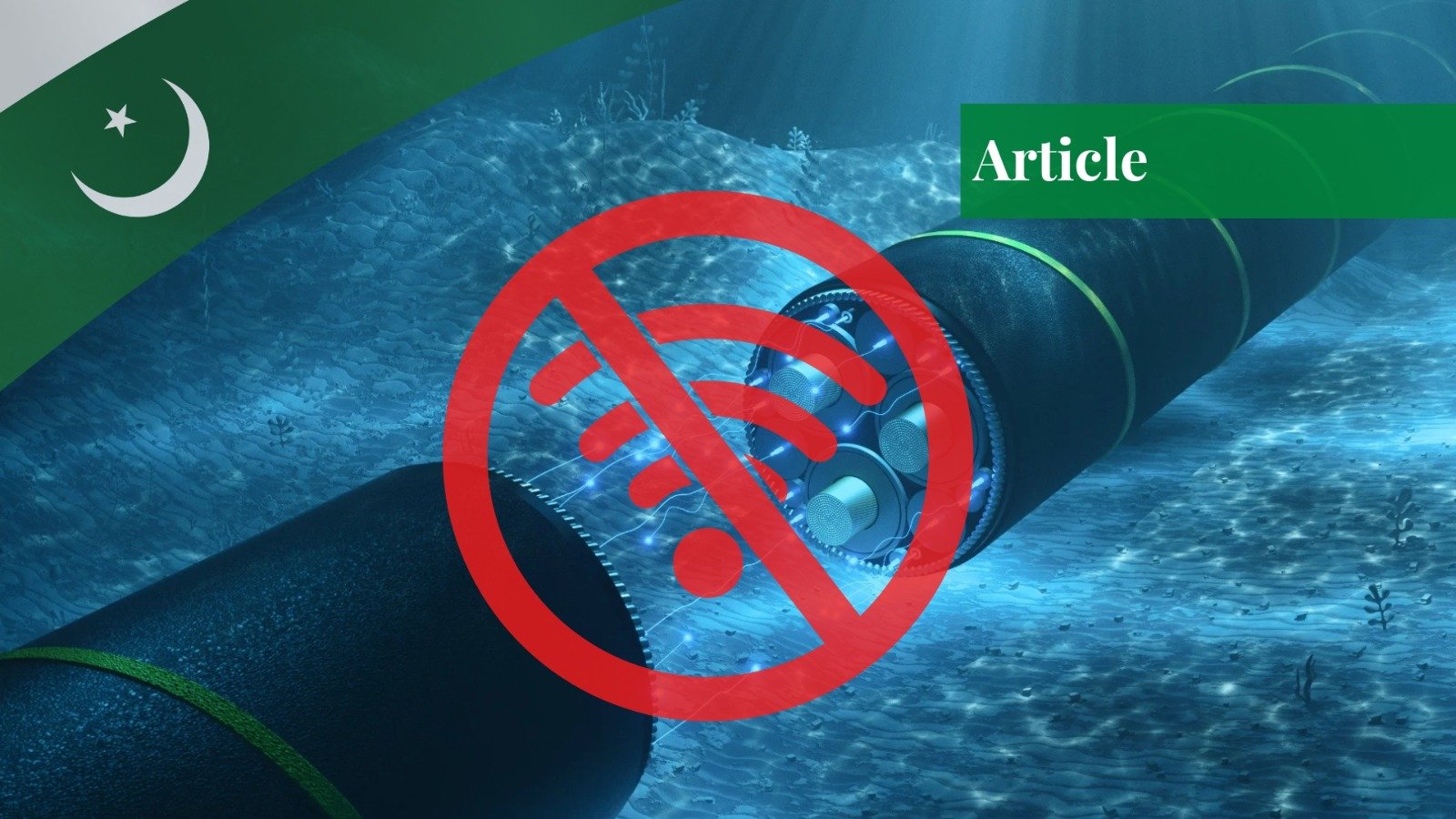

Pakistan has suffered a hard time with the major telecommunication provider, PTCL (Pakistan Telecommunication Company Limited), as there has been a series of external and internal network failures resulting in the disruption of internet services in Pakistan.
The recent outages have brought into focus the vulnerability of the country to a fragile digital infrastructure that has affected millions of users and businesses, remote work, and daily life around the country.
One of the main factors that has led to the present service deterioration is the technical breakdown of the global submarine cable system. PTCL verified that South Asia-Middle East-Western Europe (SMW4) and India-Middle East-Western Europe (IMEWE) submarine cable systems had been cut off at Jeddah, Saudi Arabia. These are highly important backbones of the global internet connection and have a huge percentage of internet traffic between Europe, the Middle East, and Asia. The destruction of these vital undersea paths has contributed to a partial loss of bandwidth capacity and sluggish internet connections, especially at peak times. At the same time as international partners strive to re-establish the cables, which can take weeks or even months, PTCL local teams are trying to alleviate the blow by securing alternative bandwidth.
This is not the first occasion that destruction of internet services in Pakistan affected undersea cables, as a fault in the AAE-1 undersea cable had already caused damage in earlier parts of the year. These frequent events highlight the susceptibility of the Pakistani internet infrastructures to extraneous events and how they need to be more redundant in their international connectivity.
Besides the international faults of the cable, there are also the localized disturbances and internal fiber optic network failures that have been experienced by PTCL. On August 19, 2025, a large outage occurred, which resulted in an internet disruption in the entire nation, with the internet connection falling as low as 20 percent of its usual speed, according to the global internet monitor NetBlocks. The spokesperson of PTCL admitted that there had been a significant failure in its distribution network, namely in Karachi, which had compromised services. Technical teams of the company labored to fix the problem, and services were mainly brought back to normal in less than 24 hours. Nevertheless, these domestic breakdowns, which in most cases are aggravated by external weather conditions such as heavy rains and floods, also attest to the weaknesses of the local network.
Even temporary localized outages have a domino effect. Other internet service providers (ISPs), which tend to use the backbone infrastructure of PTCL, are also affected, which causes extensive disruptions. This shows that there is a structural problem whereby a single malfunctioning point in the PTCL network can paralyze internet connectivity in a large portion of the population.
The common internet disconnections cause a great economic and social cost. It is especially susceptible to Pakistan, with its developing IT industry that has a significant population of freelancers and remote workers. The disconnection stops the working process, which affects productivity and sales. Online banking, e-commerce sites, and other digital services are also affected, and people end up losing money and getting frustrated. The social effect is no less significant, since individuals cannot communicate with relatives and friends, have no access to online learning, or use vital digital tools. In social media, the frustration becomes easily felt, with a lot of people sharing their feelings about how dissatisfied they are with the unreliable service and the absence of a solid, official date when the issue will be resolved.
A multi-faceted approach to developing a more resilient digital infrastructure is the order of the day in this situation. This involves not only beefing up and diversifying international cable connections but also investing in the upkeep and renewal of the internal fiber optic network. The idea of building redundant systems and the provision of alternative connectivity, like the continuous plans of connecting Pakistan to the new Africa-1 submarine cable, is a key milestone to making the internet experience in the country more stable and reliable in the future.
The outage of the internet was occasioned by the breakages of the SMW4 (South East Asia-Middle East-Western Europe 4) and the IMEWE (India-Middle East-Western Europe 4) submarine communication lines in the Red Sea. These cables consist of hair-thin optical fibers wrapped in a layer of steel, copper, and insulation and transmit information at about 2/3 the speed of light. These cables are difficult and time-consuming to repair. Special vessels are required to first find the exact point of the fault, and then remove the broken cable from the bottom. The damaged ones are spliced, and the new connection is tested, then lowered back to the ocean bottom. It can require several days to six weeks, after identifying the fault, to get service reinstated, based on weather conditions, cable depth, and the supply of repair vessels.
Pakistan has high economic and social costs of Internet outages that are either accidental or deliberate. In 2024, Top10VPN.com estimated that the Pakistani economy suffered the largest loss of its internet connections, amounting to 1.62 billion dollars. The IT exports and a huge population of freelance workers who are engaged in the country are dependent on a stable internet. The frequent outages have resulted in setbacks whereby some platforms have classified Pakistani users as inactive, something that is not good for the reputation of the country as an outsourcing destination. Ride-hailing, e-commerce, and mobile banking are companies operating in various sectors that depend on the internet. The CEO of Jazz, one of the largest telecommunication companies in Pakistan, added that internet blockages cost companies hundreds of millions of dollars.
In addition to the economy, internet interruptions have an impact on day-to-day life by restricting access to online education, online health services, and online government programs.PTCL and the Pakistani government are making efforts to improve the network’s resiliency to reduce the effects of future outages. Other existing submarine cables, including AAE-1 and SEA-ME-WE 5, are being used by PTCL and other companies to divert the internet traffic via other submarine cables. This diversification aids in maintaining the services, albeit at reduced speed, in the moments when one main cable is severed.
There is a Network Operations Center at PTCL in order to detect and fix faults proactively, in order to have a more flexible and fault-tolerant network. The Pakistani government has taken certain measures to promote a better digital infrastructure, including waiving charges on the installation of IT and fiber-optic infrastructure in Islamabad to accelerate the implementation of broadband services. The government also established the Universal Service Fund (USF) to install high-speed internet in underserved rural locations.
However, challenges remain. The government has also been involved at times, shutting down or censoring the internet and social media due to security or political reasons, and this has caused a lot of confusion to both businesses and citizens.
If you want to submit your articles and/or research papers, please visit the Submissions page.
To stay updated with the latest jobs, CSS news, internships, scholarships, and current affairs articles, join our Community Forum!
The views and opinions expressed in this article/paper are the author’s own and do not necessarily reflect the editorial position of Paradigm Shift.