
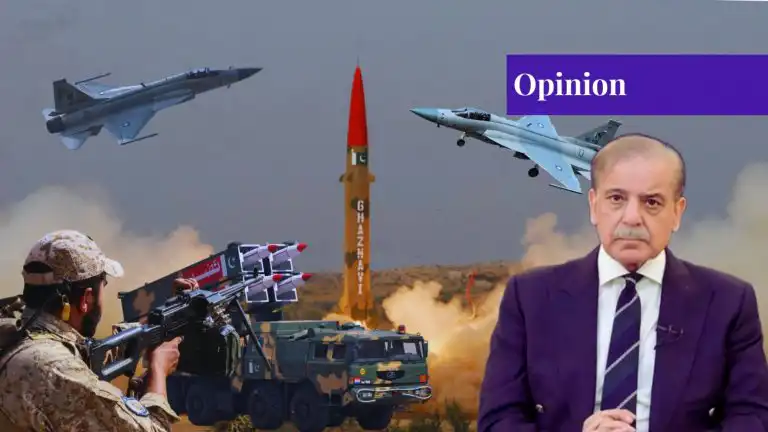

Radical precedents are dangerous. They are troubling because they break free from past restraints and seek to normalize even more consequential actions. The number of rogue precedents established in the last year alone outweighs decades of strategic but non-kinetic geopolitical maneuvering. With Iran’s offensive muscle almost neutralized, its nascent nuclear apparatus obliterated, and economic health stunted, speculations have once again stemmed about the integrity of Pakistan’s nuclear deterrence in ensuring the nation’s sustainability.
Simply, suspects reason, since Iran is not the only “hardline” Muslim nation perceived by Israel as an existential threat; hence, Pakistan could potentially be next in line to be emasculated of its strategic assets to secure Israel’s complete immunity. However, while such conjectures seem to be gravitating, they are equally suicidal even for the world’s strongest military force.
As Pakistan’s DG ISPR rightly said: “No nation has ever experimented with the misadventure against a nuclear-armed state, and the consequences of any such attempt would be horrific.” Setting aside bold rhetoric for a while, this thesis necessitates historical and technical inquiries to ascertain the invincibility of Pakistan or any other nuclear state’s deterrence capacity.
Historically, since the 1945 detonations, no nation has ever attempted to exert disproportional offence against a nuclear power in an effort to check the credibility of its deterrence. For instance, during the Cold War era, both the Soviet Union and the US employed numerous economic and political tactics to overpower each other, but they eventually stopped short of challenging each other’s “nuclear writ”. The inconclusive Cuban Missile Crisis was the watershed event in solidifying the doctrine of Mutually Assured Destruction. Thereby, nuclear weapons changed the way wars were understood. As these weapons entered the equation, the idea of “winning” a war between nuclear powers became almost elusive, because any such conflict could bring unfathomable destruction on both sides. With the gruesome aftermath of Hiroshima and Nagasaki detonations, global leaders began to realize that even a limited clash between nuclear states could quickly grow into a disaster from which neither country could truly recover.
Nuclear weapons again proved deterministic during the Yom Kippur War between the Arab nations and Israel. Although undeclared, the mere suspicion of Israeli nuclear capability barred Egypt and Syria from proceeding to a ground invasion in 1973.
The most candid and historically relevant event, substantiating Pakistan’s deterrence profile, was the 2002 India-Pakistan standoff. Accusing Pakistan of sheltering terrorists who attacked its parliament, India framed the so-called “Operation Parakaram,” deploying over 8 lakh troops along the LOC and the international border. It was the first time Since world war 2 that a state mobilized such a massive number of forces. However, the intelligence sharing between the US and India underscored the likelihood of an impending nuclear offence from Pakistan because it was noted that Pakistan would not be able to sustain a conventional war against an army over two times of its size. Additionally, the imbalance of firepower, logistics, and sophistication was significantly wider in favor of India. Thus, Pakistan’s atomic outlook proved the great equalizer, and an 8-month-long standstill was resolved diplomatically.
The technical assessment of this paradox is more crucial than historical affirmations, because in the current flickering world, irrationally taken actions are no longer uncommon. If the USA can abduct the sitting president of its global rival’s strategic ally and kill the same of another, this makes uncalculated actions against Pakistan probable. It is not to suggest whether they would succeed, but the recurrence of such precedents can certainly bolster them in committing strategic blunders.
One may ask, can the similarly well-calibrated, coordinated, high-tech, multi-national coalition offence be used against Pakistan to achieve “full Spectrum Disabling Strike” or the total annihilation of Pakistan’s nuclear assets? The short answer is biblical “No.”
Since Pakistan’s strategic assets are dispersed across its landscape, offences exerted to dismantle Iranian “silos” cannot be emulated here. Similarly, Pakistan employs a massive array of dummy TELs (Transporter Erector Launchers), so in a crisis, for every real missile moved out of a hangar, an enormous number of decoys must be deployed. More importantly, no satellite, even with modern era AI-driven imagery, can distinguish a decoy with the same thermal and radar signature as a real one with absolute certainty.
Besides, unlike Iranian or another nation’s digitized frameworks, Pakistan’s strategic assets reportedly use “hard-wired systems”, which makes cyber attacks unviable. For the sake of argument, if it is assumed that even if the entire mainland were “neutralized,” the sea-based leg of Pakistan’s triad (Babur-3 SLCM) would remain operational. A submarine sitting in the Indian Ocean doesn’t need “Command and Control” from a destroyed Islamabad. It operates on “Negative Control.”
This implies that if it doesn’t receive a “Stay Down” signal for a certain period, the commander has the pre-delegated authority to strike back. This “ghost” retaliation is the eventual nightmare for any coalition planner. Thus, the mere possibility of a single surviving warhead is enough to deter an aggressor from any misadventure. Simply, in nuclear logic, 99% success is a 100% failure.
These manifestations also highlight that deterrence does not only depend on the number of weapons a state possesses but also on the uncertainty about their survivability. Even a remote possibility that a warhead may endure an initial strike inevitably introduces a level of risk that rational decision makers are unwilling to accept. Strategic planners are, therefore, compelled to consider not only the success of an attack but also the catastrophic consequences of a single failure.
Nevertheless, these are fictional speculations, which no rational global actor would be plunged into.
As the father of neo-realism, Kenneth Waltz posited, “for a nuclear state, deterrence is relatively robust. As long as a state possesses a survivable second-strike capability, no rational adversary, no matter how superior in conventional terms, will risk an attack.” Hence, deterrence is not a math problem; it is a psychological one. As long as the attacker believes there is even a 0.1% chance of a nuclear warhead landing on New Delhi, Tel Aviv, or a U.S. Carrier Group, the ‘rational’ choice remains non-aggression.
If you want to submit your articles and/or research papers, please visit the Submissions page.
To stay updated with the latest jobs, CSS news, internships, scholarships, and current affairs articles, join our Community Forum!
The views and opinions expressed in this article/paper are the author’s own and do not necessarily reflect the editorial position of Paradigm Shift.

I am a Political Science graduate from the University of Punjab, and have a deep interest in the dynamics of power politics and strategic studies.