
Introduction
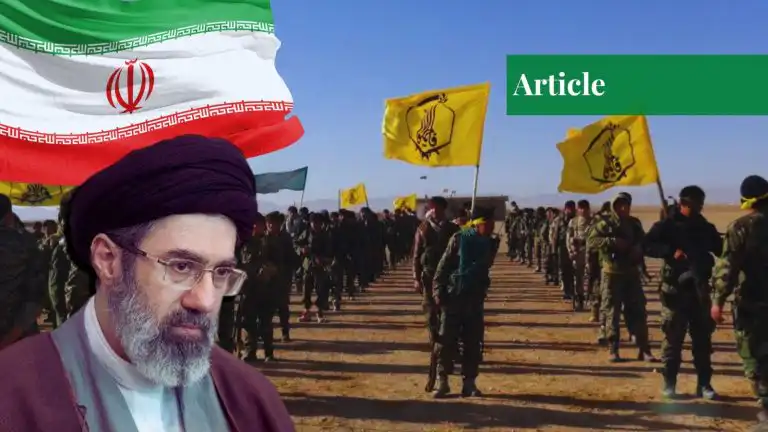
Liwa Fatemiyoun is an Afghan Shia militia formed by the Iranian Revolutionary Guard Corps (IRGC). It is integrated into Iran’s “Axis of Resistance.” The late supreme leader of Iran, Ayatollah Ali Khamenei, described this axis as a defensive buffer against Western threats. It includes Hazara fighters from Afghan refugee communities in Iran. It emerged during the Syrian civil war to support the Al-Assad regime. The Fatemiyoun Brigade, made up of approximately 5,000-10,000 fighters, is a key instrument in Iran’s proxy war strategy, as it enables Iran to showcase its military influence without deploying its own conventional forces.
This brigade is trained for proxy warfare, including urban combat, sniper operations, etc. It has light and medium infantry weapons, rocket-propelled grenades, mortars, and anti-tank guided missiles (ATGMs). Taylor & Francis Online notes that these militias can respond flexibly to shifting battlefronts.
Organizational Structure
The Fatemiyoun Brigade operates under the oversight of the IRGC Quds Force. This brigade has a centralized command structure. A senior Afghan Hazara officer is appointed as a field commander by the IRGC. He is responsible for combat operations in Syria. For training and coordination among various militias, there is a deputy commander. To adhere to Shia ideology, there is an ideological officer who ensures this.
Liwa Fatemiyoun has a brigade commander who commands the overall brigade. Under his supervision, some battalion commanders lead battalions of 400-800 fighters. These battalions are further divided into units of 80-50 fighters led by company commanders. They play a major role in frontline tactical operations. After the commanders, there are platoon and squad leaders who train 30-50 and 6-12 fighters, respectively. The Fatemiyoun Brigade also has some specialized units, such as reconnaissance and intelligence units, shock units, and anti-armour units. They are responsible for scouting, counter-insurgency operations, and neutralizing the enemy’s vehicles, respectively.
Operational Role in Syria
Liwa Fatemiyoun was deployed in multiple Syrian governorates to support the Bashar Al-Assad government. It was active in the Deir ez-Zor and Boukamal region to secure supply routes like the Euphrates and establish bases in the deserts like Sukhnah to counter ISIS. They used RPG-7s and ambush tactics. In 2017, the Abu Kamal Offensive Brigade fought with the Syrian Arab Army and the IRGC to take control of the border states from ISIS. They were also involved in the Battle of Al-Malihah in the Rif Dimashq Governorate. In which they conducted house-to-house fighting.
The operations in Aleppo, Homs, Hama, and Idlib are conducted by Fatemiyoun forces. They also occupied small villages of northwestern Aleppo, Al-Eis, and Al-Hader. Al-Eis is a strategically important village, as it has mountains that could provide a clear vision and can block the vision of the enemy. Al-Hader had the headquarters of the rebels; capturing it showcased the influence of the brigade. In Syria, Liwa Fatemiyoun marked a shift in military strategy from a defensive to an offensive posture. Now, the brigade takes the first initiative in fighting ISIS rather than waiting to be attacked first by the rebels.
Role in Iran’s Axis of Resistance
The Axis of Resistance is not a formal alliance; it is a strategic coalition. It is operating across Lebanon (Hezbollah), Iraq (Shiite militias), Syria (Hezbollah), Gaza (Hamas), and Yemen (Houthis). They all have common objectives and are backed by the IRGC. Axis follows Iran’s “forward defense” doctrine, which says that threats to the Islamic Republic should be countered before they reach Iran. The axis also has links with Hamas, a Palestinian militia. It helps Iran to pressure Israel without directly intervening in Israel.
Iran has provided weapons, training, and economic aid of $100 million annually to Hamas, enhancing Hamas’s operational capabilities. Also, Iran has provided drones and missiles to Houthis to counter operations in the Red Sea. Liwa Fatemiyoun plays a key role in the axis of resistance. It is responsible for the coordination of militias and also serves as a reserve force. If, in any case, regional tensions escalate, these fighters could be redeployed. Currently, they are active in Syrian transport routes, which help them to transport weapons to Iraq and Lebanon.
Strategic Importance of Liwa Fatemiyoun for Iran
Liwa Fatemiyoun is aligned with Iran’s forward defense doctrine. It is beneficial for Iran, as it can intervene wherever there is an opportunity for it. Since the Afghan Shia forces are trained by the IRGC Quds Force, Iran can minimize the political and social expenses of deploying its forces in a foreign country, particularly in risky areas such as Syria or possible hot spots with Israel. This strategy is important, as in the recent Iran-Israel conflict escalation, Iranian proxies, such as Lebanese Hezbollah and Yemeni Ansar Allah, fought indirectly with the Israeli forces, which minimized the risk of the emerging Tehran-Tel Aviv war. Analysts have claimed that this form of indirect pressure enables Iran to subvert Israeli deterrence in the long run, but the number of Iranian casualties is politically convenient.
The threat of a war between Tehran and Tel Aviv is constantly imminent. The brigade might be reassigned outside of Syria to the regions that Iran attempts to control or ones where it is part. Furthermore, with the Iran-Israel war dynamics moving, especially with more cases of Israeli attacks on Iran and proxies in Syria and Iraq, analysts say that Fatemiyoun must shift to a more active deterrence strategy rather than showing a defensive posture. This would imply the integration of the drone warfare units, missiles, and air defense networks provided by the IRGC, increasing the Iranian capability of asymmetric retaliation without direct warfare.
Militias like Liwa Fatemiyoun are effective as Tehran seeks to sustain buffer zones and proxy deterrence against Israeli and US influence. Following the loss of leadership in Iran, the Fatemiyoun brigade can maintain Iran’s regional deterrence. Through this, the brigade would also gain influence in the region as a militia.
Conclusion
Liwa Fatemiyoun is an important asset to Iran, contributing to strengthening the influence of Iran. It also supported Iran’s ideology during the Syrian civil war and protected the Al-Assad regime. It serves as a reserve force that operates from various regions of the Middle East whenever the situation escalates. Despite its importance, it also faces controversies due to Afghan fighters. Afghan fighters are so vulnerable that to recruit them into any militia of Iran is a danger to Iran itself. Also, the use of foreign fighters in regional conflicts is unethical, and due to the vulnerability of Afghan fighters, it has raised humanitarian concerns across the globe.
If you want to submit your articles and/or research papers, please visit the Submissions page.
To stay updated with the latest jobs, CSS news, internships, scholarships, and current affairs articles, join our Community Forum!
The views and opinions expressed in this article/paper are the author’s own and do not necessarily reflect the editorial position of Paradigm Shift.

Syeda Farani Fatima is an undergraduate student of International Relations at the International Islamic University of Islamabad, with a strong interest in anti-corruption, counter-terrorism and geopolitics. Strongly committed to fighting corruption, terrorism, and supporting national reform through research and public service.