

Ms. Aqsa Hafees is an intern at Maritime Centre of Excellence, Pakistan Navy War College, Lahore, and is currently pursuing MPhil degree in Political Science from Government College University, Lahore.

Mr. Ahmad Ibrahim is Research Associate at Maritime Centre of Excellence, Pakistan Navy War College, Lahore, and holds MPhil degree in Strategic Studies from National Defence University, Islamabad.
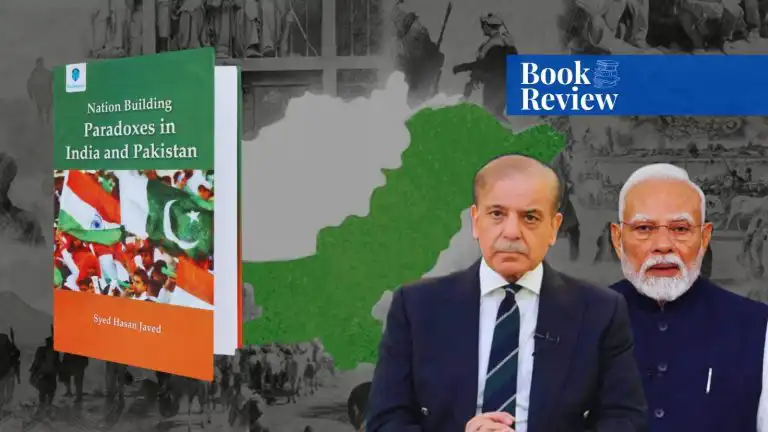
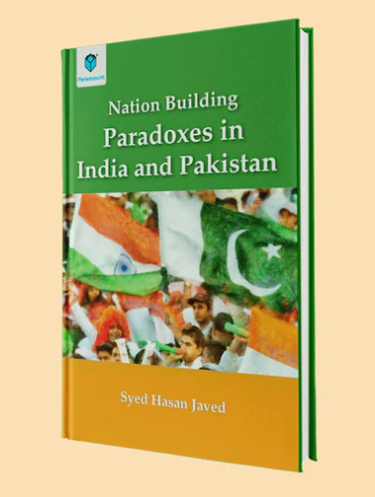
Syed Hassan Javed’s Nation Building Paradoxes in India and Pakistan (2024), published by Paramount Books (Pvt.) Ltd., presents a comparative and experience-driven examination of the nation-building trajectories of South Asia’s two principal postcolonial states: India and Pakistan. A seasoned diplomat—former Ambassador of Pakistan to Germany and Director of the Chinese Studies Center at NUST—and a recipient of the Chinese Special Book Award as a Sinologist, Mr. Hassan brings scholarly depth as well as practitioner insight to his writing. In this book, categorized into eight chapters, he identifies the major issue of the nation-building process in both postcolonial states. He primarily focuses on ‘Leadership Crisis’ as the triggering element behind the crumbled situation of nation-building in both states.
In the first chapter, ‘Nation Building Paradoxes in India,’ the author labels India as a ‘Cleft State’ with the mindset of coercive diplomacy. India, being the most populous state in the world, holds a diverse population with Hindus as the majority and Muslims, Sikhs, and Christians as minorities. Brahimi’s sect of Hindus, who are just at 7% of the total population, holds dominance in the Indian government, judiciary, businesses, and society. While minorities, especially 15% Indian Muslims, face the threat of extreme alienation from the overall national socio-economic system.
The author discusses the “Hindutva” ideology, which is widely adopted by the current Modi regime and places Hinduism before Indian statecraft. Indian leadership is a victim of ‘balance of power syndrome,’ which, according to the author, has prompted New Delhi to support non-state actors in the neighborhood, including Pakistan, Nepal, Sri Lanka, the Maldives, and Bhutan. From raising Mukti Bahini in East Pakistan during the 1971 war, to supporting Baloch insurgency in contemporary Pakistan, from facilitating Tamil Tigers in Sri Lanka to backing Maoists in Nepal, India has traditionally sought regional dominance by exploiting fault lines in the neighboring countries to cause instability. The author further argues that following the collapse of the Soviet Union in 1991, India has attempted to achieve a higher status in international politics by deepening relations with the West, presenting itself as a reliable counterbalance against rapidly rising China.
In the second chapter, ‘Nation Building Paradoxes in Pakistan,’ the focus shifts from India to Pakistan’s internal dynamics. The author identifies ‘Elitist Capture’ and ‘Leadership Crisis’ as the foundational issues behind the stagnant development of Pakistan. Brain Drain and never-ending national crisis are the subsequent by-product of bad governance. Extending his argument further, the author presents a reform-oriented perspective about Pakistan by claiming that if the country effectively harnesses its social capital and soft-power potential, then it can undertake a revival of 1960’s economy phase and grassroots level development to ensure macro-to-micro level stability.
In the third chapter, ‘Pakistan: Foreign Policy- Challenges and Opportunities,’ the author examines the structural imbalance between a strong military establishment and comparatively weak civilian institutions. This causes institutional erosion and a gradual decline of political and judicial systems. For recovering from this situation, he advocates a “mix of strategies” in which defense preparedness is complemented by constitutional governance and clearly defined institutional boundaries. The author also exposes the dual-standard and short-term partnership mindset of the West, which often undermines the prospects of progression for a country like Pakistan. However, opportunities are also developing for Islamabad. The author tags Pakistan as ‘Euro-Asiatic heartland’ with China as an ‘All Weather Strategic Partner.’ In his view, this alignment could reshape Pakistan’s development trajectory.
The fourth chapter, ‘Restoring the Pakistan Dream,’ provides a detailed overview of Pakistan’s political history, starting from 1947. However, the hope of progress gradually shattered amid a bad governance system across all domains. Factors like the demise of Quaid-e-Azam and the murder of Mr. Liaqat Ali Khan in the early years weakened the foundation of nation-building. Afterwards, the military dictators came to power with indifferent policies, like the decision of General Ayub to transfer the capital from Karachi to Islamabad, which caused serious ramifications on the development of the country. Then the famous trio of General Ayub Khan, General Tikka Khan, and Zulfiqar Ali Bhutto acted as a major architect of the 1971 war, leading to the creation of Bangladesh. Then the inception of Civil Servants Conduct Rules 1973, Civil Service Reforms, Quota system, and nationalization by the Bhutto administration crumbled the civil service and industry to ruins. Later, the popularization of ‘Islamization’ by the General Zia administration gave birth to the elements of extremism and fundamentalism within the country as well as in neighboring Afghanistan. All these inconsistent policies periodically eroded the overall governing structure of Pakistan.
In ‘Pakistan’s Opportunity,’ the fifth chapter, the author positively projects Pakistan by portraying its strategic location as a ‘jewel in Asia’s crown,’ linking its enduring geographic relevance from the ancient Silk Route to its contemporary significance as a gateway to Central Asia and the immediate strategic hinterland of Pakistan. He also explains the importance of mineral resources and agrarian economic prospects, terming Pakistan as an ‘Orchard of Asia.’ The author further argues that if Pakistan’s government starts working on structural reforms rather than just feeding elites, then this significant land will be included in the list of prosperous nations.
The sixth chapter, ‘Preparing the Diplomats for the Future,’ reflects the author’s professional background. He characterizes diplomacy as “dancing with devils but knowing when to leave,” stressing that Pakistan’s diplomats must master the art of adroit and timely diplomacy. In the chapter, the author suggests some recommendations in the Civil Services training syllabus to avoid another Himalayan Blunders as did in the past through center-transfer, quota system, dismemberment of East Pakistan, and nationalization.
The final two chapters, “Life of a Diplomat” and “My Life,” depart from analytical discourse and adopt a memoir-style narrative. Mr. Hassan Javed explains his real-life experiences as a diplomat of Pakistan. He discusses his services in China, Germany, Mauritius, and Singapore, and how he played a crucial role in the progress of Pak-China relations, along with many other diplomatic negotiations. In sum, the author of this book provides a comparative and experience-driven analysis of nation-building paradoxes in Pakistan and India. The core argument of the book is that leadership failure—rather than structural deficiency alone—lies at the core of stalled nation-building in both countries. He successfully blends historical analysis, strategic thought, and practitioner insight to expose how ideological rigidity in India and elite capture in Pakistan have produced persistent governance, diplomatic, and societal distortions. While the argument presented in the book occasionally reflects a normative tone, the book aptly links domestic political decisions with foreign policy behavior and regional instability. By integrating diagnosis with reform-oriented prescriptions—particularly regarding civil-military balance, institutional stability, and diplomatic clout—the book contributes meaningfully to the debate about state functionality, geopolitical vs geo-economic policy frameworks, and leadership accountability in South Asia, making it a valuable read for scholars and policymakers.
If you want to submit your articles and/or research papers, please visit the Submissions page.
To stay updated with the latest jobs, CSS news, internships, scholarships, and current affairs articles, join our Community Forum!
The views and opinions expressed in this article/paper are the author’s own and do not necessarily reflect the editorial position of Paradigm Shift.