
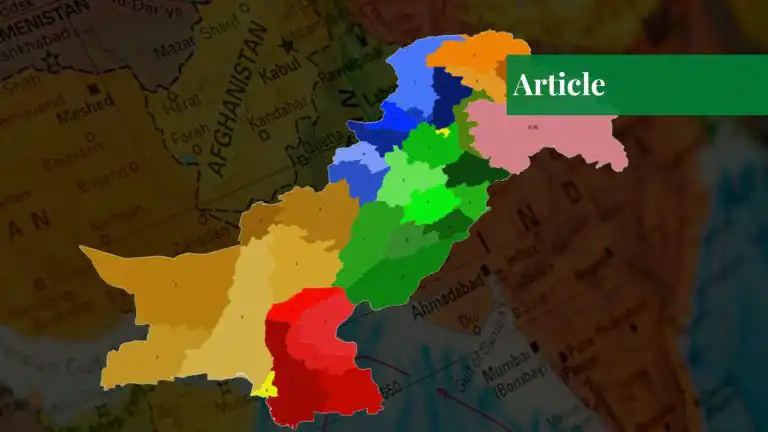

Why the Debate of a New Province Keeps Returning to Pakistan
In Pakistan, a similar debate is repeated on a regular basis every few years: the establishment of new provinces. South Punjab, Bahawalpur, Hazara, Karachi, and suggestions about Gilgit-Baltistan adverts are portrayed as long-overdue redress to regional poverty and administrative overlooking. The ideology behind it is very straightforward and politically appealing: small provinces will be more efficient, and their growth will be faster. However, this opinion avoids a more fundamental economic truth. The solution to the difficult governance or development performance of Pakistan will not be achieved by creating new provinces unless the nation first corrects its fiscal federalism.
Pakistan’s Centralized Fiscal Architecture
The key issue in Pakistan is not administrative geography, but a seriously misplaced revenue and expenditure appointment system. The tax system is one of the most centralized tax systems of large federations operating in the country. An annual report released by the Federal Board of Revenue reveals that over 90 percent of the total tax revenue is raised at the federal level, that is, in large part through income tax, sales tax on goods, and customs duties. The provinces, on the other hand, collect less than 10 percent of the entire revenues of their own organizations, even though they are constitutionally obliged to provide most of the public services.
This disparity has been embedded in the form of the National Finance Commission Award. The existing distribution of the federal divisible pool is that the provinces share 57.5 percent. These transfers are mostly unconditional, formulaic, and have weak connections with performance. The provinces are encouraged more through the size of their population as opposed to tax effort, service delivery results, and productivity gains. This can be expected to deliver the following outcome: provincial governments are opting to maximize transfers at the expense of growing their own tax bases.
Why New Provinces Don’t Change the Arithmetic
This is not the only fiscal weakness that is peculiar to smaller or poorer regions. Even the most economically advanced and biggest province of Pakistan contributes a modest portion to its spending. According to the budget documents of Punjab, provincial tax revenues are about 12-15 percent of total spending in recent years, with the rest financed by federal transfers and borrowing. Smaller provinces do not depend on the federation even less. Bisecting another province out of Punjab does not change this arithmetic; it merely forms another government that is under the control of Islamabad.
Getting the Sequencing Right
The redrawing of the provincial boundaries in Pakistan requires re-drawl of the fiscal boundaries of authority first. The autonomy of provinces that is provided without substantial revenue-sharing necessities has already created an unhealthy federation. It would only increase this malfunction by copying this structure to more provinces. Administrative reorganization should not, therefore, come last but should be followed by fiscal autonomy.
It is first necessary to empower and force the provinces to mobilize their revenues, to allocate their development priorities, and internalize the political cost of spending choices. It is only then that the argument of new provinces can be considered on an economic, but not political basis.
Cities as the Missing Fiscal Link
A more sensible reform agenda would start with the empowerment of local and city governments, which is the weaker fiscal link that Pakistan has. Cities are the places where the concentration of economic activity can be found, as well as where land values are increasing, and the public services are most evident to citizens. However, the local governments in Pakistan practically lack the authority to raise independent revenue. The urban property taxation is the foundation of local finance internationally; it is politically evaded and under-administered in Pakistan.
New developments like the PULSE (Punjab Urban Land Systems Enhancement) project and land digitization initiatives across the board provide a rare chance to undo this distortion. Digitized land records, GIS-based valuation, and better cadastral mapping can offer tremendous expansion of the urban property tax base without the need to raise rates. It should not be punitive taxation but should focus on coverage, correct valuation, and compliance. A low rate, mass-based property tax is not only economically efficient, but also politically justifiable, particularly when revenues are reinvested in local services, which people can see.
There should be a wider system of municipal revenues to supplement property taxation, betterment levies, developer charges, parking charges, congestion pricing in big towns, user charges on utilities, and rationalized local charges. These tools not only increase income but also enhance efficiency in the urban areas by selling the limited resources appropriately. Without these reforms, the cities will still be reliant on provincial transfers, strengthening the centralization and undermining accountability.
Provincial Taxes Are Still Avoided
Even reforms which have long been shunned at the provincial level are forced to be addressed. A constitutional provincial issue, agricultural income tax is seemingly merely symbolic even though it is a major contributor to GDP and elite incomes. On the same note, services taxation, albeit being devolved to the provinces, is not evenly enforced and has a fragmented administration. It is not the issue of tax rates but political desire and administrative ability. Expanding the tax net, that is, increasing the number of taxpayers paying moderate rates, should be of higher priority than increased taxation of a small tax base.
How New Provinces Distort NFC Incentives
The fiscal template that Pakistan currently has promotes exactly the opposite incentives. The provinces will rationally not tax constituencies that are politically strong and will rather lobby to receive more transfers from the federation. Formation of new provinces in this structure would add more pressure to them. New provinces, without developed sources of revenue, would obviously require increased NFC apportionments, strengthening the incentives to narrative inflation, exaggeration of poverty, backwardness, and population susceptibility to secure a larger portion of the divisible cake.
A Viable Alternative Path
The alternative is clear. Pakistan needs to develop a plausible structure whereby provinces and cities would contribute an appreciable share of their expenditure before any administrative division is made. The transferring of NFC should slowly change to entitlement-based sharing into performance sensitivity, whereby improvements in tax effort, service delivery, and urban governance are rewarded. Provinces that are mobilizing more own-source revenue ought to be rewarded and not punished.
It is only after this fiscal discipline that the emerging argument of the new provinces makes economic sense. The smaller provinces would then be sovereign units whose income cannot be mixed up with other units and whose expenditure must be liable, and that they have a better social contract with their people.
Fix the Fiscal Foundation First
In the absence of this sequencing, the division of provinces is dangerous in that it will not result in development, but in administrative chaos. More governments would be established that would not possess money of their own, which would put pressure on the federation, as it would destroy the motivation to expand the economic pie. Splitting power and not decentralizing responsibility would be a disintegration of power in Pakistan.
To put it briefly, fiscal federalism is not a sort of technical appendix to the debate on provinces–it is its pillar. Fix the revenue system first. Give power to tax the cities and provinces. Make transfers based on performance and not on pleading. It is only then that Pakistan can make up its mind as to whether new provinces are the solution, or a new coat of the same old wine.
If you want to submit your articles and/or research papers, please visit the Submissions page.
To stay updated with the latest jobs, CSS news, internships, scholarships, and current affairs articles, join our Community Forum!
The views and opinions expressed in this article/paper are the author’s own and do not necessarily reflect the editorial position of Paradigm Shift.

Dr. Ghulam Mohey-ud-din is an urban economist from Pakistan, currently based in the Middle East. He holds a PhD in economics and writes on urban economic development, macroeconomic policy, and strategic planning.