
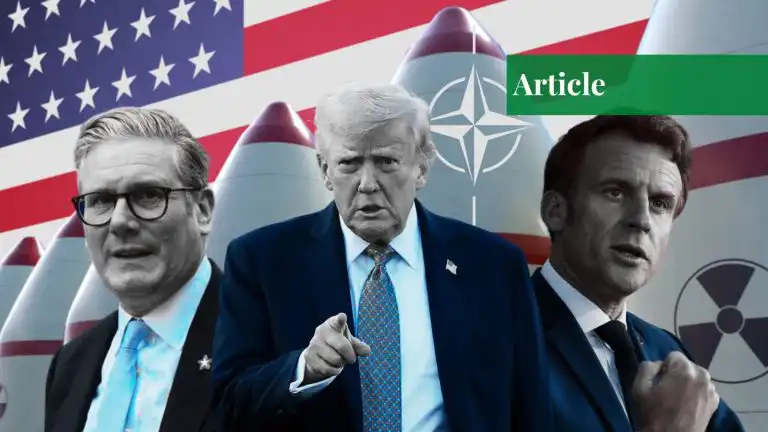

With the transatlantic alliance once again on the rocks, the question of how to guarantee Europe’s security without America has once again returned to the top of the agenda. One idea that gained prominence last year and has once again become a hot topic in Brussels is the concept of nuclear sharing. The thought that the two nuclear powers in Europe, namely France and the UK, might extend their nuclear deterrence to other European nations, thus replacing the long-standing nuclear umbrella of America over the continent.
So what is the concept of a nuclear umbrella? A nuclear umbrella is a type of security guarantee where one nuclear-armed state agrees to use its nuclear weapons to defend a non-nuclear country or countries from attack. Since the 1950s, most of Europe has been covered by the US’s nuclear umbrella, a large and sophisticated framework that includes intercontinental missiles, nuclear-armed submarines, strategic bombers, and an estimated 100 tactical nuclear bombs deployed at air bases in five European countries: Aviano and Ghedi in Italy, Büchel in Germany, Incirlik in Turkey, Kleine Brogel in Belgium, and Volkel in the Netherlands.
However, the reliability of the US’s nuclear umbrella has been put into jeopardy by Trump’s isolationist foreign policy and general disdain towards NATO, as well as his overt threats towards other NATO members, including his repeated refusal to rule out using military force to annex Greenland, a semi-autonomous territory of fellow NATO member Denmark. In the words of NATO’s former deputy secretary general Rose Gottemoeller last week, “Everything the United States is doing to raise doubts about its support for the NATO alliance will raise doubts about its willingness to extend a nuclear deterrent guarantee to NATO Europe.”
European Responses and the Revival of Nuclear Deterrence
If the US does actually withdraw or scale back its commitment to European security, particularly in nuclear deterrence, then France and the UK, the other two nuclear powers in NATO, will presumably become responsible for the nuclear security of NATO’s other European members. As such, early last year, analysts and policymakers began considering responses to a possible ending of the US nuclear umbrella. In March, French President Emmanuel Macron signaled that he would be open to expanding France’s nuclear deterrent to other European countries, which Poland’s then-President Andrzej Duda also supported.
Germany’s Chancellor Friedrich Mertz also expressed support for a European nuclear umbrella using French and British arsenals while stressing the importance of maintaining the US nuclear umbrella for as long as possible. Interestingly, all of this echoes a similar debate from way back at the start of the nuclear era. In the late 1950s, France, Italy, and West Germany tried to create a joint European nuclear force. But the plans collapsed when France, led by General Charles De Gaulle, who had been distrustful of the US during World War II, viewing it as self-interested, decided to pursue its own independent nuclear program.
In 1963, De Gaulle actually said, “Nobody in the world, in particular, nobody in America, can say whether, where, how, or to what extent US nuclear arms would be used to defend Europe.” Obviously, De Gaulle’s comments now sound rather prophetic as European countries begin to seriously consider their defenses without US support. So, what might a European nuclear umbrella look like, and what are the pros and cons?
Models for a European Nuclear Umbrella: Options, Challenges, and Feasibility
Well, as it has already been mentioned, there are only two countries in Europe, France and the UK, with their own nuclear weapons. So any arrangement almost definitely has to involve them. There are then really two options for creating a European deterrent without the US. Either a UK-French nuclear umbrella over Europe under the watch of NATO or a pure Euro deterrent that’s independent from NATO.
On the former, France and the UK have already taken significant steps towards creating a French-British nuclear umbrella over Europe. In July 2025, the two countries signed the Northward Declaration, a joint nuclear statement acknowledging that there is, quote, “no extreme threat to Europe that would not prompt a response by our two nations.” This suggests that in the event of a nuclear crisis, France and the UK will offer a form of joint protection to Europe rather than just to themselves, almost like an Article 5-style nuclear guarantee for Europe.
It also states that national nuclear forces, while still independent, i.e., ultimately controlled by each country’s leader, can now be coordinated. This is a very notable shift. The UK had only previously ever mentioned coordination of its nuclear forces with the US, at least publicly. France has never publicly stated that it will coordinate its nuclear forces with any other country.
Then in December, the UK-France nuclear steering group met for the first time to discuss Euro-Atlantic security issues, and coordination of their respective independent deterrence and closer cooperation is likely to continue throughout 2026. The second option for building a European nuclear umbrella, though, is what we might call a Euro deterrence. A nuclear umbrella for Europe, specifically. This would probably be based around the French nuclear program, not least because letting other European countries get their own nuclear weapons would be a violation of the nuclear Non-Proliferation Treaty, but would involve the cooperation of other European countries who might be involved in stuff like nuclear weapons policy, training, and maintenance or even allow France to deploy their nuclear weapons on their territories.
This wouldn’t necessarily be organized under the watch of the EU, but it would probably be organized outside of NATO, given neither the US nor the UK would be involved. This could potentially offer more flexibility compared to the French-British umbrella, which relies on both countries’ continued cooperation and feels like a bit of an ad hoc fix to America’s retreat from NATO. It would also be more independent from the US, given that the UK’s nuclear program still relies on the US for the maintenance of its missiles and elements of the nuclear warheads.
Nonetheless, building a Euro deterrent outside of NATO would be a pretty massive undertaking and would require an unprecedented degree of inter-European integration on security matters. Ultimately, as things stand, an expansion of the current French-British umbrella that allows other European countries to participate, for instance, by participating in a joint nuclear submarine force or providing escort aircraft to France’s or Britain’s nuclear fleet, seems like the most feasible option for building a European nuclear deterrence that’s independent from the US.
Although France and the UK can’t replace the US’s nuclear umbrella in terms of size. The combined French and British nuclear arsenals amount to roughly 500 warheads, far less than the US’s 3,700 and Russia’s estimated 4,380, but at least 500 warheads still feel like more than enough to function as a deterrent.
If you want to submit your articles and/or research papers, please visit the Submissions page.
To stay updated with the latest jobs, CSS news, internships, scholarships, and current affairs articles, join our Community Forum!
The views and opinions expressed in this article/paper are the author’s own and do not necessarily reflect the editorial position of Paradigm Shift.

Muhammad Haseeb Sulehria is a student of Defense and Strategic Studies at Quaid-i-Azam University, and a former internee at Pakistan’s Ministry of Defense. With a keen interest in national and international affairs, he actively explores issues of security, strategy, and global politics, aspiring to contribute to policymaking and peacebuilding.