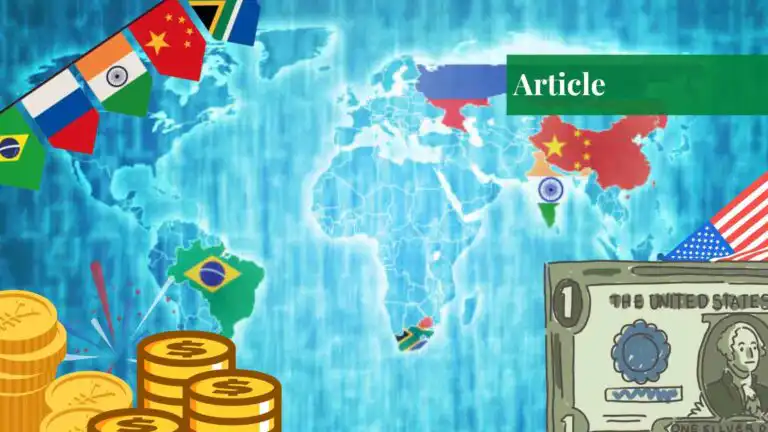

The 15th BRICS summit convened in Johannesburg, South Africa, on August 23, 2023, attracting widespread attention as global partnerships and alliances continue to shape geopolitical dynamics. Originating from the vision of economist John O’Neill at Goldman Sachs in 2001, BRICS initially comprised Brazil, Russia, India, and China, later expanding with South Africa’s inclusion in 2010, leading to its rechristening.
Goldman Sachs had forecasted that these emerging market economies would command global economic dominance by 2050. Since its inception, BRICS has become a significant economic and political force, influencing international affairs. The recent BRICS summit made headlines globally as it delved into the prospect of introducing an alternative unified currency for intra-member trade, potentially challenging the dominance of the US-led financial system.
With a combined GDP surpassing the G7 nations, BRICS economies collectively contribute over 26 % of the global GDP. Furthermore, encompassing 41% of the world’s population, these member states wield considerable influence, holding 15 % of the voting power at the International Monetary Fund (IMF).
To reshape the prevailing world order and amplify the voices of the Global South, BRICS seeks to expand its influence by welcoming six new members—Egypt, Saudi Arabia, the United Arab Emirates (UAE), Iran, Argentina, and Ethiopia —during its 15th summit. This move signifies a strategic shift towards inclusivity and diversification. The growing interest from 40 other nations in joining BRICS underscores the organization’s burgeoning significance on the global stage.
At the core of BRICS’ mission lies the principle of fostering “South-South” collaboration and amplifying the influence of emerging economies globally. However, tensions have surfaced within the group, particularly between China and India, regarding the expansion of BRICS.
India’s stance on Pakistan wanting to join the BRICS group has become a focal point, with policymakers wary of the implications it might hold for India’s strategic interests. Despite Pakistan not formally applying for BRICS membership, the specter of such a request looms large due to its potential ramifications, particularly in exacerbating existing tensions between India and Pakistan. India’s reluctance to entertain Pakistan’s inclusion stems from concerns over its strategic positioning within BRICS, particularly in countering China’s growing influence within the organization.
The delicate balance within BRICS underscores the complexities of navigating geopolitical dynamics among member states with diverging interests. This highlights the challenges inherent in achieving the group’s overarching collective goals.
Implications of Pakistan’s BRICS Membership
Pakistan’s leadership and policymakers carefully weigh the potential economic benefits against the diplomatic implications of joining BRICS. The decision carries significant weight despite the latter’s serious deliberation, considering economic and diplomatic factors. While the economic advantages of BRICS membership for Pakistan are considerable, including the opportunity to reduce reliance on the United States for trade, the diplomatic ramifications cannot be overlooked.
Tackling Monetary Challenges
After joining BRICS, Pakistan would be offered access to new trade avenues, enabling diversification and potentially reducing dependency on traditional economic partners. Moreover, BRICS has established vital institutions such as the Contingent Reserve Arrangement (CRA) and the New Development Bank (NDB), which hold substantial economic importance. With a capital base exceeding $100 billion, the CRA aims to support member states in addressing short-term balance of payment challenges. Meanwhile, the NDB provides funding to members without imposing stringent conditions typically associated with institutions like the IMF.
For Pakistan, the lure of economic stability and autonomy, coupled with the opportunity to strengthen ties with influential emerging economies, presents a compelling case for BRICS membership, notwithstanding the diplomatic intricacies it entails. Pakistan’s fervent advocacy for a multipolar world finds resonance in its potential membership in BRICS, aligning itself with states sharing similar ideological inclinations.
Partnerships within BRICS
For Pakistan, forging alliances with emerging economies is advantageous and imperative for its economic prosperity and geopolitical standing. The country maintains amicable relations with several BRICS member states, setting a solid foundation for deeper collaboration.
The robust partnership between China and Pakistan, epitomized by the China-Pakistan Economic Corridor (CPEC), underscores the strategic importance of their alliance within the broader framework of the Belt and Road Initiative (BRI). Furthermore, Pakistan’s reevaluation of its foreign policy towards China and Russia reflects shifting regional and global dynamics, presenting opportunities for enhanced cooperation, particularly in accessing Central Asian markets and addressing defense and energy needs.
Saudi Arabia’s supportive investments and bilateral relations contribute to Pakistan’s economic stability, while the prospect of BRICS membership promises to bolster these ties further. Additionally, access to the markets of Brazil and South Africa through BRICS membership offers lucrative opportunities for trade expansion.
Despite potential objections from India, Pakistan’s prudent foreign policy approach toward its neighbor aims to foster an environment of mutual benefit and cooperation. Pakistan seeks to advance its interests within BRICS by navigating diplomatic intricacies with caution while promoting regional stability and economic prosperity.
A substantial share of Pakistan’s trade connected within the BRICS framework underscores the bloc’s critical importance for the country’s economic landscape. With approximately 35.2 % of total imports sourced from BRICS countries and 11.1 % of exports directed toward these nations in 2021, Pakistan stands to significantly benefit from deeper integration into the bloc.
Embracing BRICS aligns with Pakistan’s foreign policy goal of transitioning from geopolitics to geoeconomics, offering numerous avenues for economic diversification and growth. Moreover, amidst ongoing global perceptions of extremism and terrorism, BRICS membership presents an opportunity for Pakistan to enhance its international image through trade-based relations with member countries, thereby fostering a narrative of economic cooperation and stability.
Conclusion
Pakistan can chart a more independent foreign policy course through BRICS membership by reducing reliance on Western institutions and the United States. However, overcoming potential obstacles requires adept diplomacy to address the concerns of existing members, particularly India, while maintaining balanced relations with Europe and the United States.
Strategic measures such as broadening the tax base, implementing governance reforms, and increasing exports are essential to bolster Pakistan’s candidacy for BRICS membership. Joining the bloc promises economic prosperity and well-being, given its projected role as a significant driver of global growth in the future. Serious deliberation on the prospects of joining BRICS is imperative for Pakistan, as it stands to leverage the expanding clout of the bloc to advance its economic interests and enhance its standing on the global stage.
If you want to submit your articles and/or research papers, please check the Submissions page.
The views and opinions expressed in this article/paper are the author’s own and do not necessarily reflect the editorial position of Paradigm Shift.

He is a current affairs writer.