
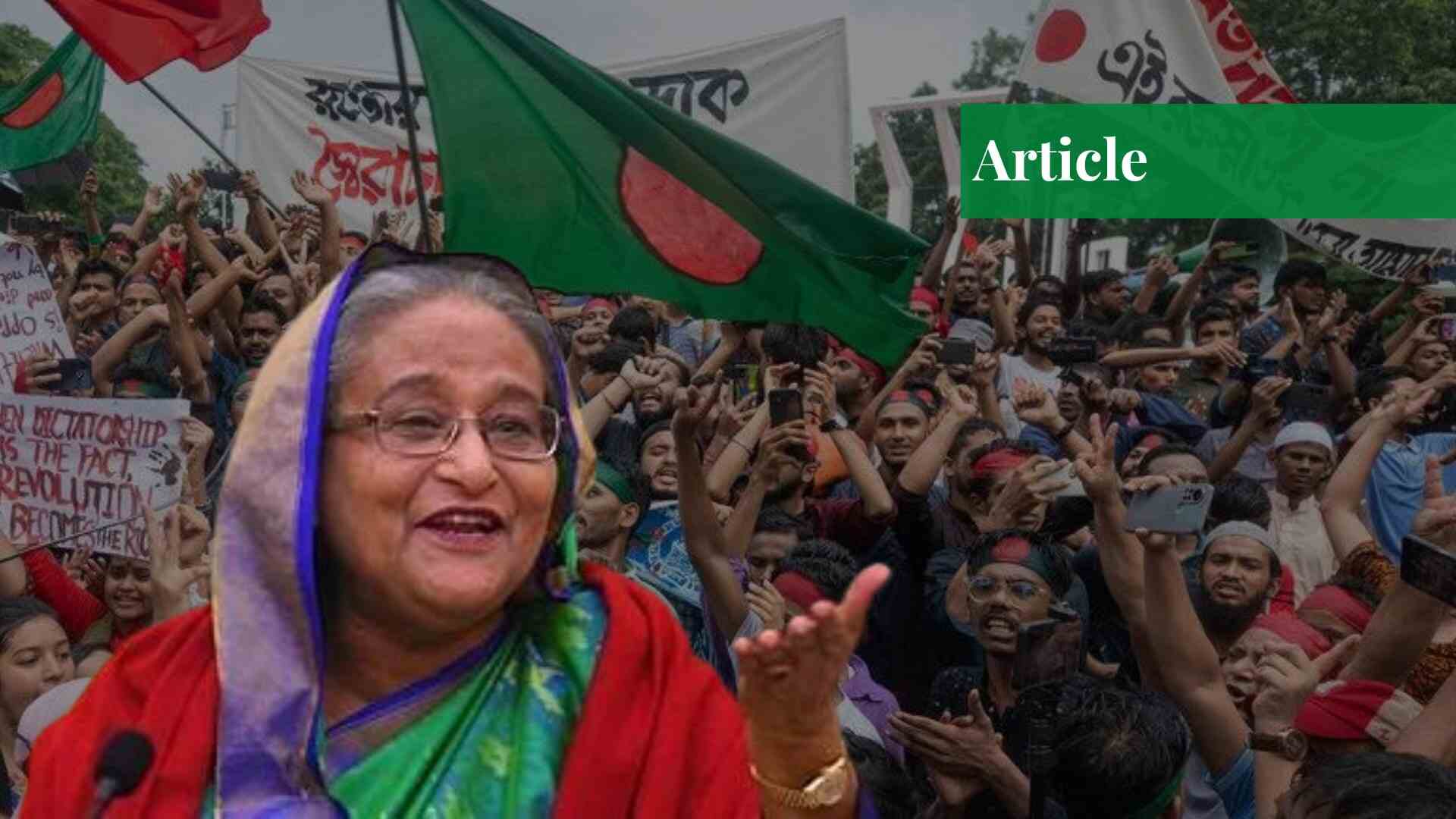

The turmoil stirring in Bangladesh since June finally culminated in the resignation of the Bangladeshi Prime Minister Sheikh Hasina.
Her resignation was demanded when peaceful protests started in June as the Supreme Court ruling against quota reforms was brutally put down by the authorities, leading to more than 100 deaths in the first two weeks of the instigation and around 300 in total. Eventually, Sheikh Hasina resigned and fled from office into exile to neighbouring India.
4th August—a single day saw around a hundred lives lost to the ensuing police crackdown. The brutality levelled by the authorities against the protestors and demonstrators (mostly students) resulted in the Awami League losing the support of its main student base, the BCL (Bangladesh Chattra League), who mobilised against the protestors at first but later joined in.
The Supreme Court tried to salvage the deteriorating situation and rolled back on their decision, introducing a revised quota system on 21st July, but this was a case of too little too late, and even the interception of the army, imposition of curfew and internet shutdown could not tame the tiger. The initial demand of the public evolved from quota reforms to a wider political stance and the immediate ouster of Hasina Wajid. Finally on 5th August, after listing the loss of public support as a reason for removal, Sheikh Hasina was granted 45 minutes by the army to step down, during which she resigned and fled the country in a helicopter and landed in Agartala, before heading towards Hindon Airbase, near Delhi, according to Indian media reports, resurfacing remnants of a past conspiracy.
What is noticeable in this historical episode is the dominance of students in the political arena. The biggest blow for Hasina Wajid was when her forces attacked and killed student demonstrators, subsequently losing her main political support base, the BCL, without whose support she never stood a chance. This rise of student power in Bangladeshi politics can be attributed to a culture of violent youth activism largely invoked during the struggle for independence (1971), and more specifically, because of “The Language Movement (1948-56),” which positioned student politicians and groups as key actors in the formation of national culture and ideology.
This claim was solidified on 21st February 1952, when authorities gunned down several student protestors, providing the Bengali nation with martyrs for the cause of preserving their mother tongue. A monument called the Shaheed Minar was built in their honour at Dhaka University. Moreover, students were always the first to answer calls for mass mobilizations.
Most movements, protests, or shows of political strength in Bengali history have originated from the campus of Dhaka University. Case in point, during the final year of independence, on 2nd March 1971, a resident of Dhaka during the war, Jahanara Imam, describes in her memoir Ekattorer Dingulee (The Days of Seventy-One), the centrality of students in the ensuing political upheaval after President Yahya had postponed the inaugural session of the newly elected parliament, “… I glanced through the newspapers. All the students, labor, and political parties have called for meetings today. The East Pakistan Student League and the Dhaka University Central Student Union have called a joint meeting under the banyan tree at the University at 11 o’clock and at 3 o’clock at the Paltan. The NAP will hold a meeting at the Shaheed Minar … [it] enjoys the support of the East Pakistan Student Union … the newly formed Forward Students Block will also hold a meeting at Baitul Mukarram at 4 o’clock. All the meetings will end in protest marches. By postponing the parliament session, President Yahya has disturbed a hornet’s nest.”
While the violence that occurred in the war was by no means isolated to students, there was a particularly transformative effect on students’ political identity as a result of the violence. Eventually, the events of 1971 and the battle for independence firmly established students as the self-appointed representatives of the people of Bangladesh, and the infrastructure of the new nation was established by student leaders and heroes of the armed struggle, filling the spaces of murdered intellectuals at university positions and in political offices, an exercise in practice till now.
One of the bones of contention in the current climate was the reserved job quotas for families of heroes of the 1971 armed struggle, many of whom were student politicians, further illuminating the student-political dynamic.
The failure to disarm the student forces after independence lead to their increased role in politics, providing muscle power and attracting students towards their political affiliation, either through persuasion or coercion. The rise in armed clashes between student factions on university campuses can be attributed to this cause. A research study shows that during the period 1991-2018, students played a part in over 25% of all political violence, and as high as 50-60% in certain cities like Rajshahi and Sylhet.
The years after independence have seen different governments, either democratic or martial, shuffling between student groups, banning one and co-opting another. This conformity of students with politics, however, also allowed for political expression even during the martial law regimes, when leaders would use the cover of the student groups to engage in political activities. The overthrow of H.M. Ershad, the country’s longest-sustained martial law regime, through anti-regime street demonstrations is a testament to the strength of this system of political expression.
While some have raised speculations insisting involvement of opposition parties, particularly BNP, in the cultivation of the recent unrest, which may be true to some extent, to say that the revolution was brought on solely due to the efforts of relatively small forces would be a gross overstatement. However, this new development might allow other student factions to breathe, or even gain strength, which were previously marginalized by the Hasina and the Awami League government.
What Happened After Sheikh Hasina Gave Her Resignation?
The Army Chief General Waker-uz-Zaman announced the setting up of an interim government with immediate effect, led by Muhammad Yunas, a Nobel laureate. It is still unclear whether the army will keep to its word since the release of former Prime Minister Khaleda Zia, Sheikh Hasina’s longtime political rival has also raised eyebrows regarding the future direction of the country.
If you want to submit your articles and/or research papers, please check the Submissions page.
The views and opinions expressed in this article/paper are the author’s own and do not necessarily reflect the editorial position of Paradigm Shift.

He is currently pursuing a Masters in Broadcast Media from the Communication University of China, Beijing. He is a journalist by profession, currently independent, and has previously reported for Dunya News and Express News.