
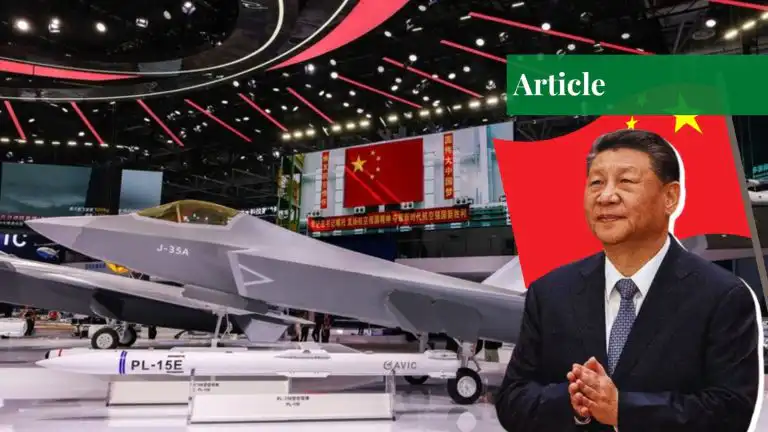

In November 2024, on the grey runway of the Zhuhai Airshow in southern China, the world got its first direct glimpse of an aircraft that had been making the rounds in satellite imagery and rumours for years. The Shenyang J-35A taxied onto the runway in full People’s Liberation Army Air Force colours. With the serene assurance of something that knows it has already altered the discourse, its structure caught autumn’s light. What defence analysts who were watching were most impressed by was not the aircraft’s stealthy shape, its twin-engine setup, or the internal weapons bays that made it look smooth and unbroken; it was something more interesting: the J-35A looked almost exactly like an American F-35 Lightning II on the outside. That similarity, whether it was caused by industrial spying, engineering convergence, or an awkward mix of the two, would become the most important question about a machine that China plans to use not only to protect its own skies but also to change the rules of the global arms market.
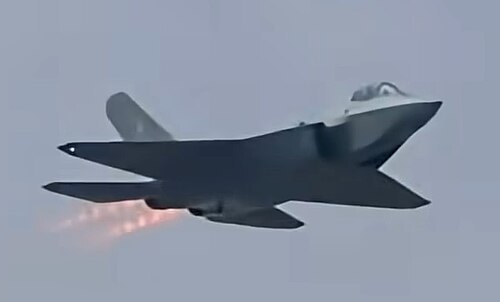
The J-35A didn’t just show up out of nowhere. The FC-31 Gyrfalcon, a privately funded prototype made by the Shenyang Aircraft Corporation that first flew in October 2012, is its ancestor. The Shenyang Aircraft Corporation originally planned to sell it as an export product after losing the domestic competition for China’s main stealth fighter to the Chengdu J-20 Dragon. For a long time, the FC-31 was in a grey area where it was too advanced to be abandoned but not good enough to get serious government funding. The Chinese Navy saved it. The PLA Naval Air Force realised that it needed a stealth fighter that could carry a carrier, so they took the design and paid for its conversion. A new version of the naval variant flew in October 2021. It had folding wings and stronger landing gear. The J-35A came out in September 2023. It was designed to perform better on regular runways by removing the extra weight that carrier design adds to the structure. China became the second country, after the United States, to have two operational fifth-generation stealth fighter types at the same time when the PLAAF officially adopted it in late 2024.
China has not officially said much about what the J-35A can do. What open-source assessments and state media reports have shown analysts is a picture of a medium-weight multirole platform that really works. The plane is about fifty-five feet long and has a wingspan of thirty-seven feet. It has two domestically made WS-19 turbofan engines that each produce about twenty thousand pounds of thrust, giving it a top speed of about Mach 1.8. It can fight for about 600 miles, which is not very far compared to the F-35’s operational range, but it is good enough for the regional missions the PLAAF has in mind. Chinese state media claimed in September 2025 that the aircraft’s radar cross-section had been shrunk to the size of a human palm using only Chinese metamaterial technologies. Western analysts were skeptical of this claim, but they couldn’t completely rule it out because the underlying shaping and radar-absorbent material technologies are actual engineering achievements rather than. The aircraft is equipped with the PL-10 short-range infrared missile, the PL-15 beyond-visual-range missile with active radar homing, and more recently, the LD-8A anti-radiation missile for suppression of enemy air defences. If the avionics meet the stated specifications, this weapons package would seriously deter any adversary.
American officials no longer pretend that the origin of the J-35A’s design is unclear. “It’s still fairly new,” US Air Force Chief of Staff General David Allvin told Air and Space Forces Magazine, “but yes, it’s pretty clear, you could put it side-by-side and see, at least, where we believe they got their blueprints from, if you will.” There is a documented legal basis for the accusation. A Los Angeles grand jury indicted Chinese national Su Bin with aiding the theft of over 630,000 files about the F-35 and other vital American aircraft between 2008 and 2014. Performance specifications, design schematics, and comprehensive engineering data were among the stolen materials. It is still up for debate whether that information influenced the J-35A’s airframe directly or if it only sped up some aspects of its development. According to some analysts, the two aircraft’s visual resemblance indicates aerodynamic convergence, which means that twin-engine stealth fighters with similar sizes and mission profiles will inevitably come up with similar solutions for V-tail configurations, diverterless supersonic inlets, and stealth shaping. There are similarities between the Indian AMCA and the South Korean KF-21.
When the J-35A is positioned within China’s larger military structure, its strategic rationale becomes more apparent. The J-20 Mighty Dragon is a heavy, long-range air superiority fighter specifically developed to contend airspace over Taiwan, the South China Sea, and the second island chain. It is intended for deep penetration and electronic warfare. It is difficult, costly, and produced in small quantities. The J-35A is unique in that it is lighter, less expensive, simpler to produce in large quantities, and intended for tactical multirole tasks such as strike, air denial, and air defence suppression that are won by numerical saturation rather than individual aircraft prowess. China has explicitly modelled this two-tier structure on the American pairing of the F-22 and F-35, the former for air superiority at the high end, the latter for reasonably priced mass. By extensively relying on three-dimensional printing, a manufacturing innovation that also significantly increases production throughput, Shenyang reportedly decreased the number of structural components in the J-35A by fifty percent when compared to the J-20. In late 2026 or early 2027, serial production is anticipated to start in earnest.
China and Pakistan have always been very good friends, not only in the diplomatic sphere but in business too. The purchase talks between Beijing and Islamabad are where the J-35A has caused the most diplomatic upheaval and concentrated geopolitical significance. China was reportedly accelerating J-35A delivery to the Pakistan Air Force in the weeks after the Pahalgam incident in April 2025 and the brief but intense military conflict between India and Pakistan that followed. The numbers were striking, up to forty aeroplanes with delayed payment terms reaching two to three billion dollars, given at a discount of almost fifty percent on the typical unit price of $55 to $70 million. On Pakistani television in late June 2025, Pakistan’s Defence Minister Khawaja Asif appeared on Pakistani television and categorically denied that any deal had been signed. He added that the claims were more helpful for Chinese defence sales than for Pakistani operational planning. “It’s only in the media,” he said; the denial was strong enough to quell the rumours.
The J-35A’s effects on South Asian security go far beyond the documentation of a single purchase. There are currently no fifth-generation aircraft in service in India. Although its frontline ones, like the Rafale F3R, Su-30MKI, and Mirage 2000, are competent fourth-generation fighters that have proven themselves in recent missions, they do not have the sensor fusion architecture and low-observability features of a true stealth aircraft. The Rafale has true competitive capability thanks to its Spectra electronic warfare suite and Meteor beyond-visual-range missiles. However, in a contested environment against a J-35A armed with PL-15 and PL-17 missiles, the latter of which are said to be able to engage targets at up to 400 kilometres, even the Rafale is at risk of being detected before it can retaliate. The HAL Advanced Medium Combat Aircraft, India’s homegrown response, is not anticipated to be operational until at least 2030. In the coming years, the PAF with significant J-35A purchases would have a generational edge in stealth capability. The protracted procurement schedule will determine whether or not that advantage materialises, but Islamabad’s strategic incentive is still strong and will not go away.
The J-35A’s strategic relevance extends beyond South Asia to the global arms industry. Since going into service, the F-35 Lightning II has operated as something of a monopoly product for nations looking for fifth-generation capability. If you wanted stealth, you needed Washington’s approval, export controls, data-sharing agreements, and end-use monitoring. The J-35A presents an alternative. With an estimated unit cost of between $55 and $70 million, or roughly a third to a half of the flyaway price of the F-35A, it presents itself as a cost-effective stealth alternative for countries that are either politically excluded from the F-35 program or unwilling to accept the sovereignty restrictions that come with American arms sales. At the Singapore Airshow in February 2026, in order to send a clear message to air forces around Southeast Asia, the Middle East, and Africa that China was prepared to offer cutting-edge technology without the political conditions that come with Western options, it positioned a large-scale J-35A model at the center of the exposition. Egypt, Saudi Arabia, and several countries in the Global South, which have observed the F-35 program’s $1.7 trillion lifetime cost with a mixture of wonder and financial vertigo, are potential clients.
In all honesty, the J-35A has yet to find the global market it seeks. Western analysts note that the aircraft’s sensors remain inferior to the F-35’s AN/APG-81 AESA radar and Distributed Aperture System, which provide a qualitative situational awareness advantage that is difficult to replicate and easy to underestimate. The F-35’s operational range of 1,100 kilometres is greater than that of the J-35A. For now, the J-35 simply lacks the worldwide support infrastructure that makes the F-35 sustainable across eighteen partner countries, including its logistical networks, training programs, maintenance networks, and upgrade channels. Some prospective buyers are uncomfortable with the degree of reliance on Chinese assistance that comes with purchasing a J-35A today, especially those who have seen Beijing’s propensity to use economic pressure as a diplomatic tool. Since the aircraft is still relatively young, its actual operational capability has not yet been established. The day someone attempts to shoot one down will provide a clear answer to the question of whether its stealth is indeed palm-sized or rather golf-ball-sized.
Regardless of its ultimate export success, the J-35A has already changed the nature of the strategic rivalry between China and the United States. American air power dominance for most of the post-Cold War era was based on the structural fact that only America could develop fifth-generation stealth aircraft in operational quantities. That monopoly was broken by the J-20. In addition to widening the hole, the J-35A may offer to sell the key to nations that Washington would rather keep outside. In this way, the aircraft serves as both a military and a diplomatic tool. It is a concrete sign that the age of unquestionable American technological dominance in the air is coming to an end and that the architecture of international security will need to be adjusted correspondingly. The Gyrfalcon has sprung to life. For the time being, its true capabilities are still strictly classified. However, the J-35A has already made its first blow in the calculus of great power competition, where perception and capabilities are frequently interchangeable.
If you want to submit your articles and/or research papers, please visit the Submissions page.
To stay updated with the latest jobs, CSS news, internships, scholarships, and current affairs articles, join our Community Forum!
The views and opinions expressed in this article/paper are the author’s own and do not necessarily reflect the editorial position of Paradigm Shift.

Abdul Basit | MS International Relations | Researching soft power, cultural diplomacy and global politics | Writing on geopolitics, foreign policy and defence affairs.