
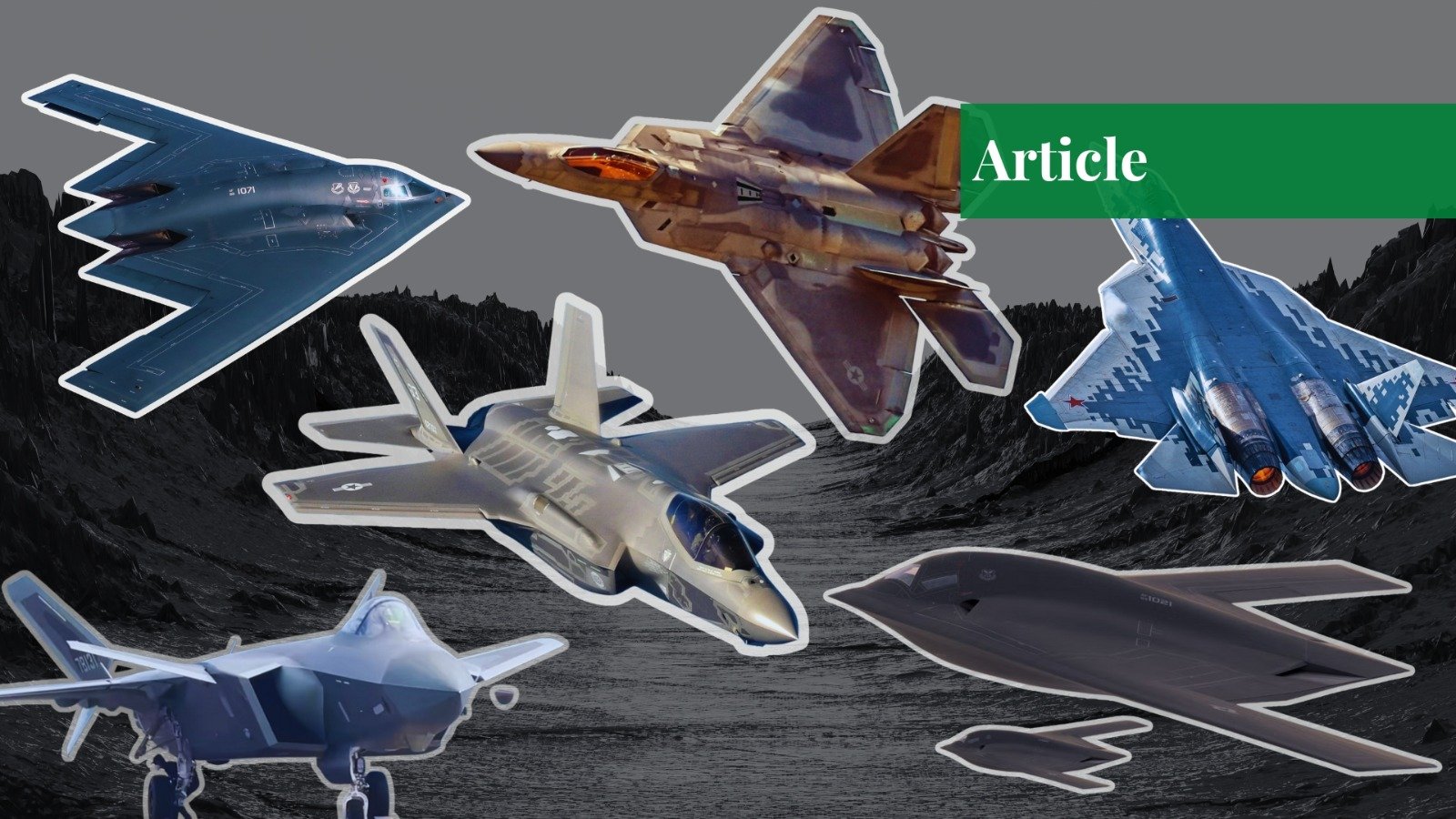

Modern military strategies and doctrines revolve around the concept of air superiority. It is often considered in strategic circles that the one who controls the air controls the land and sea. Air superiority simply refers to the capability to control airspace during a conflict or a war. This leads towards unrestricted aerial operations, joint force operations, deep strike campaigns, and ensuring deterrence. In this article, we will extensively discuss key features and technologies used in the world’s top 10 modern stealth aircraft.
B-21 Raider Stealth Bomber
Designed for the US Air Force, it is technically the world’s first sixth-generation stealth bomber. It is designed to dominate in future warfare. It made its first test flight in 2023 after being formally unveiled in 2022. The B-1 Lancer and B-2 Spirit will be gradually replaced. Its title pays tribute to the legendary “Doolittle Raiders” of World War II, which really captures its aggressive long-range attack capabilities. With its composite materials, radar-absorbent paints, and smaller infrared signature, the B-21 is a ghost for today’s air defense systems.
At its very center, there is its digital-first design, meaning it has open-system software that can be updated perpetually. In addition, it can carry both conventional and non-conventional loads. The cost of one B-21 Raider unit is $700 million. Compared to stealth fighters such as the F-35 or other aircraft such as Russia’s Su-57, the B-21 stands alone as a strategic stealth bomber. Its nearest rival is China’s upcoming H-20 stealth bomber.
B-2 Spirit Bomber Stealth Aircraft
The B-2 Spirit, rolled out in 1997, is the most renowned fourth-generation stealth aircraft to have ever existed. It can carry conventional as well as nuclear bombs. The B-2’s unique flying wing design is actually what makes it unique. It has no tailpiece, which keeps it out of radar. This is a smart idea that allows it to sneak through even the strongest enemy air defenses. It can accelerate to around Mach 0.95. It can travel more than 6,000 nautical miles on a single run without refueling. Its primary job is deep penetration into enemy territory. The B-2 has participated in many conflicts, such as Kosovo (1999), Iraq (2003), Afghanistan, Libya (2011), and Iran in 2025, as well. Every unit costs $2 billion. The B-2 Spirit is still the gold standard for stealth bombers of all time.
F-22 Raptor
Considered the fifth-generation combat jet, the F-22 Raptor is outfitted with radar-absorbent paint and smart edge alignment that significantly reduces its detectability on different sides. It’s like attempting to detect a ghost on traditional radar. It has the AN/APG-77 Active Electronically Scanned Array (AESA) radar, along with some advanced electronic warfare equipment and sensor fusion.
The Raptor is also referred to as the ‘God’s-eye view’ of the battlefield. With a speed of 2.25 Mach, its internal bays can carry a range of precision-guided bombs, ideal for ground attacks. The noteworthy fact is that it has not been sold to other nations, primarily due to the fact that there is a lot of concern for the safeguarding of its state-of-the-art technology. To date, the Raptor has not engaged in high-level peer warfare, yet it has seen combat in regions such as Syria and the Middle East. Its price tag stands at $60 billion. The F-22 rivals include the Su-57 and J-20.
F-35
The F-35 Lightning II is tailored to remain off enemy radar, thus making it more likely to survive in more challenging airspaces. It has a blended wing-body single engine that enhances its aerodynamic efficiency while maintaining its minimum radar signature. One of the most impressive aspects of the F-35 is its sensor fusion technology. Additionally, it has a Distributed Aperture System that gives pilots a complete circular view of their surroundings. It has a speed of Mach 1.6, and its combat radius is approximately 1,200 kilometers. Israel has already used the F-35 in Syria without being detected by enemy radar. Each jet costs anywhere from $80 to $100 million.
Chinese J-20 Stealth Fighter Aircraft
China’s fifth-generation stealth fighter aircraft, the Chengdu J-20, boasts a long body, delta wings, and those canards at the front that truly distinguish it from Western stealth fighters. With its sensor fusion capability, it provides pilots with quite a good picture of what’s going on out there in the battle. It has a speed of Mach 2. Its PL-15 long-range air-to-air missiles can strike targets over 200 kilometers away. There are also PL-10 short-range AAMs for close-in dogfighting. As opposed to the F-22, with all its emphasis on dogfighting, the J-20 is more focused on the “first look, first shot, first kill” strategy, which entails detecting and destroying enemies before they even realize what happened. According to analysts, the cost of each unit ranges from $100 to $120 million. It is usually compared to the F-22 and F-35.
Su-57
The Sukhoi Su-57 is considered the first Russian fifth-generation aircraft. While Western stealth aircraft focus on being nearly invisible to radar, the Su-57 takes a different track. It is made with a symmetrical layout in mind, having radar-absorbent materials, a wide fuselage, and internal weapon bays to maintain its low radar cross-section. The Su-57 boasts a cutting-edge avionics package. It can attack at around Mach 2, and it even has super-cruise capability, which means it has the ability to maintain supersonic flight without the use of afterburners. Reports have claimed that it has been tested in combat environments in Syria and Ukraine. In terms of cost, it is said to in between $35 million and $50 million per unit. That is really quite a cheaper cost compared to Western designs like the F-35.
J-35 Fighter Jet
The J-35 is a Chinese fifth-generation stealth fighter jet. It was developed in 2012. It has a twin tail and a large fuselage, all designed to maintain its radar signature as low as possible. It could reach approximately Mach 1.8 speed. It is built for increased maneuverability, so it is excellent for dogfighting and strike missions alike. It can carry sophisticated weapons like precision-guided munitions, long-range air-to-air missiles, and possibly even anti-ship missiles. It can carry PL-15 long-range missiles and PL-10 short-range missiles, among other guided munitions for those strike runs. Now, although the J-35 has not yet had any actual combat experience, it has already undergone a number of test flights and sea trials, including over China’s newest aircraft carriers, such as the Type 003 Fujian. Each of the units costs $70-$85 million.
Turkish Kaan
The TF-X Kaan is Turkey’s indigenous fifth-generation stealth fighter. It was officially revealed in March 2023 and signifies Turkey’s quest to become defense independent and compete with advanced Western and Eastern stealth fighters. Named ‘Kaan,’ meaning ruler or sovereign, the name emphasizes its symbolic significance as a symbol of national power projection. It has an open architecture system that enables future enhancement without extensive redesigns. The plane aims to match or surpass the agility and endurance of other fifth-generation aircraft, having been developed for Mach 2+ speeds and high agility.
It will be the backbone of the Turkish Air Force to replace the old F-16 fleet, in addition to supporting drones and other local systems. While the Kaan has not yet come into active combat service, the first flight was conducted in February 2024, being a historic moment for Turkey. Full operational status is anticipated in the early 2030s following intensive testing and production periods. The estimates are around $100–120 million per unit based on export packages. Its competitors in the market are the F-35, Su-57, and J-20.
Korean Boramae
The KAI KF-21 is South Korea’s ambitious effort to develop a 4.5-generation stealth fighter jet, in partnership with Indonesia in 2021. Referred to as the ‘young hawk,’ it copies the F-22 and F-35 in design, which quite effectively showcases South Korea’s ability to incorporate proven designs with its own work. The KF-21’s two General Electric F-414 engines allow it to reach a combat range of almost 2,900 kilometers and cruise at a maximum speed of Mach 1.8. It can carry out a variety of tasks, including deep strike, maritime patrol, and interception. The Republic of Korea Air Force (ROKAF) plans to introduce at least 120 units by 2032, and Indonesia will be joining as an operator and investor. Each unit will cost about $65–70 million. Its rivals are the F-35, J-35, and Turkey’s TF-X Kaan.
F-117 Nighthawk Stealth Jet
The 1980s marked the development of the F-117 Nighthawk aircraft. Designed to launch precise attacks, it was a stealth attack jet. Its distinctive diamond appearance had come from early computations in the 1970s. It made the Nighthawk invisible against the night sky, which gave it its nickname, “Black Jet.” It has a max speed of Mach 0.92. This placed it in the subsonic range, which is actually slower than many conventional fighters.
It had two internal weapons bays, ideal for carrying such precision-guided munitions as laser-guided bombs (the GBU-10 and GBU-12) or even a heavy GBU-27 ‘bunker buster.’ It was a key player in missions such as Desert Storm in 1991, striking important Iraqi targets with eyeball-dropping accuracy. And it played a crucial role in the Balkan War in Operation Allied Force in 1999. Although it has a stealthy reputation, one F-117 was destroyed over Serbia in 1999, which is the sole combat loss in its lifetime. It costs $42 million for each single unit at that time.
If you want to submit your articles and/or research papers, please visit the Submissions page.
To stay updated with the latest jobs, CSS news, internships, scholarships, and current affairs articles, join our Community Forum!
The views and opinions expressed in this article/paper are the author’s own and do not necessarily reflect the editorial position of Paradigm Shift.

He is pursuing a BS in International Relations programme from International Islamic University, Islamabad and has a keen interest in research works, policy analysis, defence and strategic studies and conflict resolution.