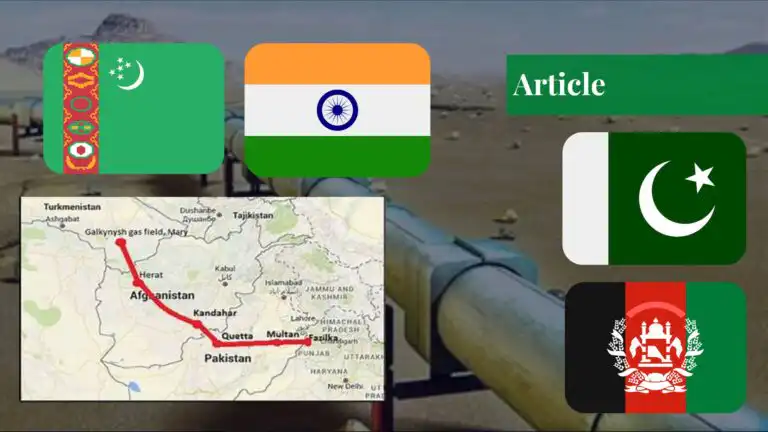

The TAPI gas pipeline project was signed in 1991. Geographically, it is a trans-country natural gas pipeline that crosses 4 countries—Turkmenistan, Afghanistan, Pakistan, and India. The estimated cost involved was $10 billion. The construction of an 1127-mile (1814-kilometer) long pipeline with a 56-inch diameter, able to pass 3.2 billion cubic feet per day from Turkmenistan’s Galkynysh gas field with deposits amounting to 27.4 trillion cubic meters, started in 2018.
The gas transportation route was supposed to start from Turkmenistan’s Galkynys gas field, cross Herat, Qandhar, Chaman, Zhob, DG Khan, Multan, and finally end in Fazilka in India at the Indo-Pak border. 70% of its shares will be from an international donor—the Asian Development Bank (ADB), while a 200 million dollar share is from Pakistan.
It will supply 33 billion cubic meters of natural gas to the three countries annually. Pakistan and India have an even share of 42% of total volume and Afghanistan will be given 16%.
Timeline
Initially, this project had to be completed by 2019. It was envisaged that approximately a 214 km long section would run through Turkmenistan, 774 km through Afghanistan, and 826 km from Pakistan to Fazilka. 1.34 billion cubic feet of gas were to be delivered to Pakistan daily and therefore, for Pakistan, the TAPI pipeline was a solution for persistent energy shortfalls.
This project was funded by the ADB and had to restart in December 2022. However, due to a precarious security situation, the work halted yet again.
A glance at its timeline will show that in 2008, negotiations regarding this project started. In December 2015, a stone laying down ceremony was held in Turkmenistan. The beginning of construction was marked by a ceremony held in February of 2018. It was assumed that in October 2019 construction had to be started in Pakistan and by the year 2020, it would be completed, but it could not commence as the internal disturbances in Afghanistan had also increased. Especially since the US withdrew its forces from Afghanistan and the Taliban took over.
However, the Taliban had announced in January 2022 that they wanted to resume this project. Afghanistan requested an intergovernmental loan from Turkmenistan and Turkmenistan agreed to this. It was decided that Afghanistan would repay the loan through the revenue earned by transit fees. In September 2022 construction work restarted.
Afghanistan
This gas pipeline framework will enable Afghanistan to increase employment opportunities and add to the economic development there. It will give an added advantage to Afghanistan to improve its ties with India and China and prove its credibility as a trustworthy partner. Afghanistan as a transit fee will get $500 million per year from this project along with a share of 500 million cubic meters of gas for the first ten years and afterward, this share will increase to 1.5 billion cubic meters per year. TAPI may encourage trade between Kabul and Delhi, along with allowing Afghanistan an independent source of revenue.
Turkmenistan
The TAPI gas project will play a pivotal role in providing Turkmenistan’s gas to South Asia. It is not only a gas transit initiative connecting energy-rich Central Asia with energy-starved South Asia, it is a trailblazing project for regional economic collaboration and integration as was enunciated by the then Prime Minister Nawaz Sharif during a groundbreaking ceremony joined by regional leaders on December 14, 2015. He also emphasized that such projects make energy-deficient countries join hands with energy-rich countries to pursue the common goal of prosperity in the region and also serve the purpose of regional connectivity. The pipeline project will address the energy crisis that is at present being faced by countries like Pakistan, India, and Afghanistan.
Till now Turkmenistan used to export gas to Iran, Russia, and China. Russia and Iran have decreased their imports considerably because they want to increase their output and move towards self-reliance. In China, the manufacturing slowdown caused a decrease in demand, leading Turkmenistan to establish close ties with South Asia.
The benefits for Turkmenistan include the fact that this will reduce its dependence on China—which is its biggest customer—and may stride further towards a journey to self-reliance as it has already made progress in exploring prospects for a trans-Caspian Pipeline for the supply of gas to Europe. It doubled its gas exports to Russia in 2021 and also signed a trilateral gas swap deal for 2 billion cubic meters per year with Iran and Azerbaijan and is further thinking of exploring other opportunities.
Pakistan
Pakistan has been facing a gas shortage, for the past several years. The textile industry of Pakistan is a major enterprise and has been facing a huge energy crisis due to the scarcity of gas. That is why many textile manufacturers shifted their units to Bangladesh.
Between 2008 and 2012, 40% of Pakistan’s textile sector migrated to Bangladesh. The dearth of gas is also linked with an increase in financial deficit. The overall circular debt in the energy sector in 2024 is 5.4% of Pakistan’s GDP. This gas pipeline can finish one-third of the gas shortage in Pakistan. As a result of this project, transit revenues for Pakistan may encourage the state to renegotiate with Beijing on the China-Pakistan Economic Corridor.
It is important to mention here that the “Foreign Investment (Promotion and Protection) Act (2022)” has been implemented in Pakistan. Hence no interference from provinces, related to such projects, would exist. This act is for bigger projects involving the funding of $500 billion or above: “Provided that no investment shall be notified as a qualified investment unless the amount to be invested (whether in the form of equity or debt) is not less than US$ 500 million (or its equivalent in Pak Rupees).”
For Pakistan, the use of gas for generating electricity will also lead to climate-friendly measures and will add to an increase in trade volume for Pakistan with other countries and also facilitate grounds for diversifying its energy market.
India
India is the world’s 3rd largest energy consumer and fulfills its 8% demand from solid biomass, coal, and oil. For India, TAPI will add to its energy mix and improve its economic development. India, too, needs to set its targets as per the Climate Summit and Glasgow Summit. India is supposed to go for aggressive carbon emission reduction. This will be made possible if this gas pipeline becomes operational and achieves the desired set targets. It will enable India to mitigate coal usage and help it meet the goals of COP-26.
It is a thirty-year agreement. This implies that once completed, for the next 30 years the pipeline network will continue its operation.
The Turkmenistan-Afghanistan-Pakistan-India natural gas pipeline project has suffered a delay of more than 15 years since its inception. It’s important to note that the initial cost estimates are outdated, and the actual cost may have increased significantly since then.
Challenges that may impede its development include the security situation at the Indo-Pak border in Fazilka. Secondly, the US may also sanction TAPI partners as the Taliban are yet again, in control in Afghanistan.
Ultimately, the pipeline will be helpful for energy-starved countries and would pave the way for regional peace and stability and boost economic activities by meeting the energy requirements. It will serve as a win-win solution. 1.5 billion people will benefit through this pipeline so it is in the mutual interest of all countries. There is also an aspect of social and environmental significance as natural gas offers a safe substitute for coal and diesel-fired power generation. Knowledge of modern hi-tech equipment and new technologies for the people in the region would become possible because of this project. Industrialization and investment will boost.
If you want to submit your articles and/or research papers, please check the Submissions page.
The views and opinions expressed in this article/paper are the author’s own and do not necessarily reflect the editorial position of Paradigm Shift.

Ghazala Anbreen's work spans energy, journalism, and advocacy; making her a multifaced contributor to important discussions.