
“And whoever saves one—it is as if he had saved mankind entirely.”
Surah Al-Ma’idah (5:32)
Rising Tide of Road Accidents in Pakistan
Article 9 of the Constitution of Pakistan states that “no person shall be deprived of life, liberty, and property.” The scope of this article encompasses all factors that threaten human life, thereby paving the way for a prosperous and stable life for all citizens of the country.
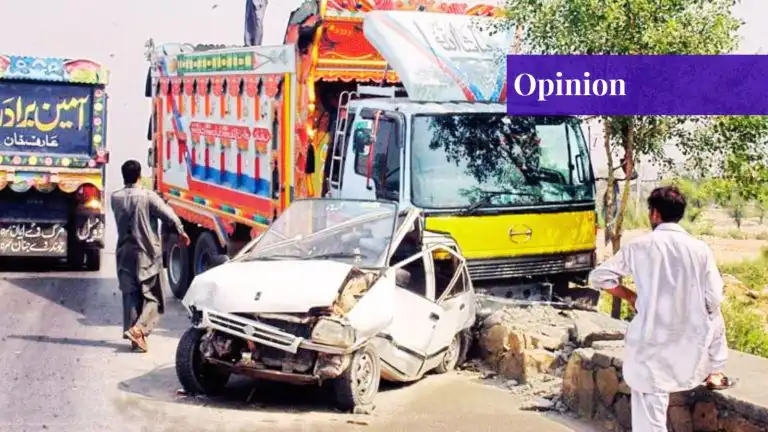
The rising road accidents leave a trail of dead each year, turning thousands of dreams into ashes. According to the official data, 15,000 to 16,000 people die annually in road accidents in Pakistan; to demonstrate it further, take the example of Karachi, where 857 people lost their lives, and 12,188 were injured in 2025, as reported by the rescue officials. Therefore, it is imperative to analyze the root causes of increasing road accidents and explore effective solutions to combat them.
Research data and post-crash investigations underscore that three major categories of factors—human errors, environmental conditions, and vehicle-related mechanical failures—are responsible for road carnage; however, carelessness stands at the heart of the problem, underscoring the dire need for societal awareness. In-vehicle mobile phone use, which leads to inappropriate driving behaviors and is greatly responsible for fatal highway accidents. Similarly, approximately 59 percent of accidents are associated with motorcycle operators, primarily driven by reckless driving and inadequate safety measures. The most effective, easy, and efficient strategy to curb the deadly crashes can be the promotion of education and awareness among the masses.
What Can Be Done?
Firstly, vulnerable road users should be given adequate awareness regarding black spots, safety measures, and traffic rules. Pedestrians, for instance, should strictly use footpaths instead of wandering in the middle of the road, and if roads lack footpaths, people should walk on the edge of the roads. According to the World Health Organization (WHO), pedestrians make up 41 percent of total fatalities occurring due to road crashes in the country. The media, family, and educational institutions can educate children to walk with great care and caution to come to their destinations safely. They should also follow traffic rules while crossing the busy roads.
Most importantly, two-wheeler riders, the most vulnerable community, should take all safety measures and avoid reckless driving. According to the Journal of Asian Development Studies, in 2021, 59 percent of victims of road accidents were associated with two-wheelers. To address the very crisis, safety measures should be strictly ensured; for example, the helmet alone can shield from deadly head injuries, significantly saving thousands from death.
However, it is also crucial to ensure a certified helmet as per international standards, as most helmets are like paper tigers, protecting only from fines and pushing towards devastation. The government, in this regard, should assist people to buy helmets at subsidized rates because durable helmets are inaccessible for the majority of impoverished people.
Last but not least, three institutions, including media, education, and transport departments, should collaborate for collective, coordinated actions. They should share data and disseminate awareness among the masses. For this purpose, the curriculum should be revised to have a dedicated section on road safety measures and current driving behaviors for students’ awareness; moreover, regular seminars should be held to encourage positive change in driving behaviors.
The government organizations can provide research-based data and distribute their booklets/pamphlets for people’s awareness, and the media can assist educational institutions and organizations to effectively serve the purpose at the grassroots level. In a nutshell, this multi-pronged strategy can reduce accidents, replenish public trust in state institutions, and raise awareness, leading to a safe, secure, and smooth journey for all passengers.
Positive developments in this perspective, both at the national and provincial levels, should be encouraged. The improving road infrastructure, as under the CPEC projects, the increasing role of road safety agencies, and the efficient working of rescue teams are a ray of hope for reduced road accidents in the near future. The Punjab Government initiated the first road safety agency named “Punjab Road Safety Authority (PRSA)” in 2023, which is collaborating with the rescue, police, and construction departments for data sharing, post-crash investigation, identification of black spots, and driver training. Such measures should be appreciated; in addition, all stakeholders should synchronize to avert the shadow of deadly road crashes, responsible for thousands of broken journeys, and educate citizens adequately. I want to leave the discussion on Victor Hugo’s timeless words:
“If a soul is left in darkness, sins will be committed. The guilty one is not he who commits the sin, but he who causes the darkness.”
If you want to submit your articles and/or research papers, please visit the Submissions page.
To stay updated with the latest jobs, CSS news, internships, scholarships, and current affairs articles, join our Community Forum!
The views and opinions expressed in this article/paper are the author’s own and do not necessarily reflect the editorial position of Paradigm Shift.