

Mehvish Arif is a writer and a recent graduate from SZABIST, Pakistan, with a degree in international relations. She has experience in policy-oriented writing, content development, digital PR, and strategic research. Her work critically explores how geopolitical narratives, information flows, and power structures shape global security outcomes.
Introduction
The crown jewel of the world is notorious for its global policemanship and, quite recently, for its shifting alliances. The term “alliance” is ironic for a global system that functions in the absence of morality—a system where you keep your friends close and your foes even closer.
In today’s core liberal structure, bilateral trade and “dirty politics” among nations have maneuvered the international realm towards multipolarity. Yet, there remains a clear distinction between posing a challenge to unipolar dominance and actually overthrowing a hegemon that has sustained the global system for decades. The order of the world is claimed to be operating on strategy and deterrence rather than outright action. Unfortunately, this assertion holds true only in theory. In practice, the system that you are a part of today survives on violence, power maximization, and selective accountability.
The Middle East is, and has always been, a quagmire of political tension. Its conundrum has been shaped largely by proxy networks, authoritarianism, generational militancy, and frequent armed invasions. Yet, despite the presence of political dysfunctionality, the US has frequently found itself mired in the regional unrest. While past administrations remained determined not to get entangled in the Arab world’s never-ending political blaze, Trump’s policies, in contrast, have been transactional in nature. This new era of US foreign policy has blurred the line between diplomacy and commerce—exactly how the Gulf elites like it.
The US and the Arab Black Sheep
Following the end of WWII, when a quarter of the world had to come to terms with a new economic giant, the rest finally had a friend to rely on—a portion of this pie was Israel. For Israel, this dominance translated into an envisaged strategic partnership and security. Historically, Israel emerged as a counterbalancing power to impede the expanding Soviet sphere of influence. Notwithstanding Israel as a crucial geopolitical asset to the US, global concerns grew when no halt to Israeli territorial and military assertions was observed, even after the Cold War.
The events of 9/11 further deepened the US-Israel ties. The War on Terror solidified their strategic alignment, particularly as Washington reassessed its dependence on traditional regional partners such as Saudi Arabia. Israel increasingly appeared as a reliable ally sharing overlapping security interests. Ironically, the frequently cited narrative of shared democratic values between the US and Israel remains deeply contested. The strategy also serves US interests in ensuring firsthand involvement in the Middle Eastern crisis by stabilizing forces that could otherwise threaten its access to the region’s most vital asset: black gold.
With interests largely shaped by energy security and strategic chokepoints, a global power such as the US had to have one foot dipped. This asserts that while the demand for peace may be a moral wish, it is not a virtue for states yearning for power maximization. Machiavellianism functions as a doctrine for global powers such as the US, but for the rest of the world, it only manifests as a curse.
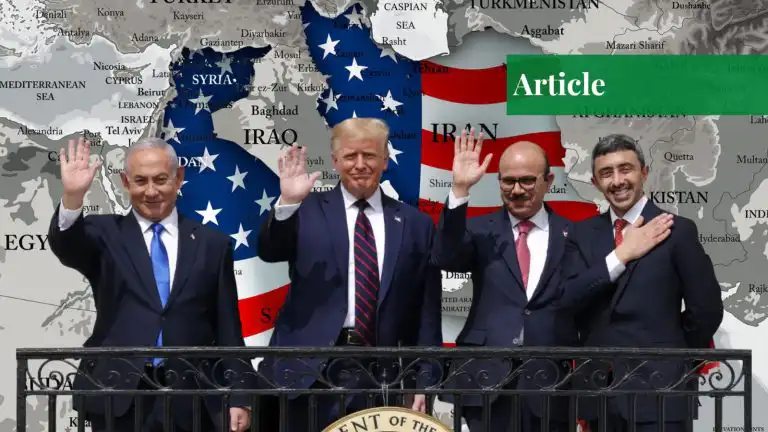
The US is known for perplexing diplomatic moves, though often at the cost of downplaying the agency of involved actors. While maintaining unwavering ties with Israel, Washington has simultaneously deepened bonds with Arab nations that appear, at least publicly, anti-Israel. However, the US-Middle East relations should not be confused with neutrality—they are strategic. Part of this strategy is the Abraham Accords, which is widely broadcast as a multilateral effort towards peace.
However, it arguably represents and serves as a catalyst for wider change in the Middle East rather than a resolution to the longstanding injustices. This raises a moral question: what is worse, passively witnessing injustice or institutionalizing support for those who perpetrate it? Clarity is often blurred in this geography-based game, as are the US interests embedded in the Middle East. The US facilitation of talks between Israel and other Muslim-majority states is portrayed as an attempt to “stabilize” the region and form a united front against a common enemy that openly funds Hamas: Iran.
Consequently, the shifting rivalries, active proxies, networks of hybrid warfare, and nuclear brinkmanship have fashioned the Middle East into a geopolitical red zone. Amid this volatility, the objective that is dear to the US is the containment of Iran’s rising popularity among the proxy groups across the destabilized zones.
Assuming the role of a mediator between clashing nations—Israel and Palestine—the US fails to conceal its deepened ties with Israel. Several events demonstrate this relationship. The Six-Day War of 1967, for example, resulted in fostered security cooperation between Israel and the US. Ties deepened further during Reagan’s leadership, with Israel declared as an official US ally in the Middle East. Not to forget, the recent 12-day war between Israel and Iran, which brought an uninvited visitor with its munitions to reinforce deterrence and signal dominance.
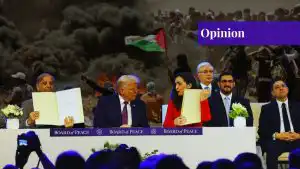
Taking into account the recently proposed reconstruction plan, an apolitical committee chaired by Trump illustrates the transfer of transnational authority from the affected population, masked as peacekeeping. In other words, the fate of Palestinians lies in the palms of those who supported the genocide. However, the question remains: if peace is a dire need, why is it selective?
Over time, the US became a cause of the war’s prolongation, vetoing 83 UN Security Council resolutions between 1970 and 2019. This undermined US credibility as an impartial mediator. Trump’s administration has repeatedly illustrated this contradiction with its overt pro-Israel policies, such as relocating the US embassy to Jerusalem and recognizing it as Israel’s capital. While these actions prompt global condemnation, they also highlight the fragility of the liberal international system and the selective adherence to international norms by the very architect that once established them.
Final Words
Today, the world resembles a stack of divisible red zones where alliances shift swiftly, and moral considerations remain rare. The evolving US–Saudi relationship under Crown Prince Mohammed bin Salman illustrates this pragmatism. The abrupt US policy shift toward Saudi Arabia, previously labelled a “terrorist breeder,” has been reintegrated into Washington’s strategic framework. It should be noted that none of these developments signal a pathway to restoring stability in the Middle East—at least not by intention.
Rewriting the playbook of US foreign policy, Trump has commenced an unconventional approach to the Middle East, where it does not propose change in a democratic sense but rather accepts politics without discernment. As with Israel, it continues flirting through AIPAC and military settlements. Corruption and instability are what sustain the power-lustful elites of the region. This shows that the Middle East holds no place for idealism; instead, it’s an arena where realism wears the crown.
If you want to submit your articles and/or research papers, please visit the Submissions page.
To stay updated with the latest jobs, CSS news, internships, scholarships, and current affairs articles, join our Community Forum!
The views and opinions expressed in this article/paper are the author’s own and do not necessarily reflect the editorial position of Paradigm Shift.