
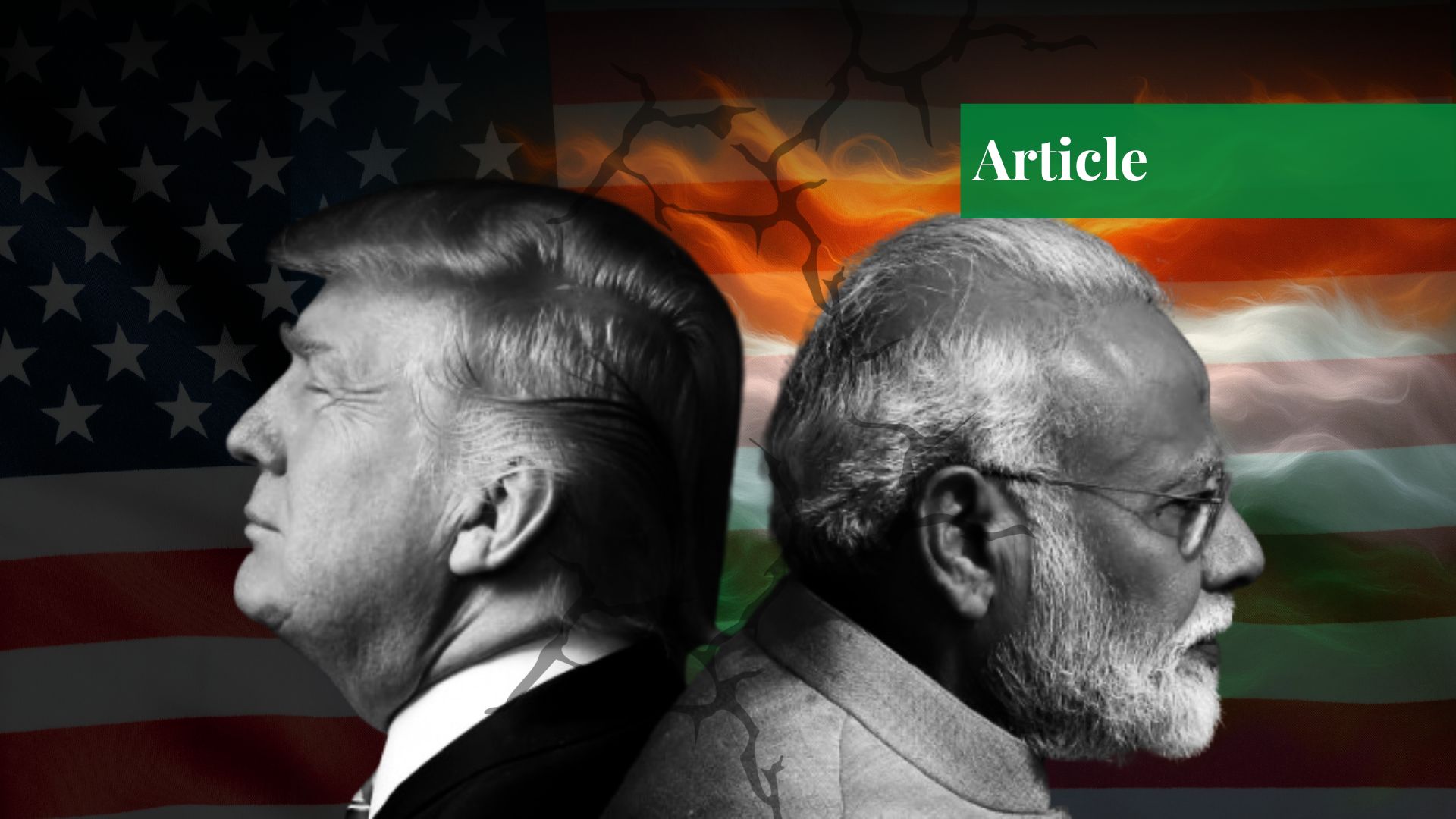

Trump’s Re-Election: A Turning Point in US–India Relations
Since the re-election of Donald Trump as the 47th US President, relations between India and the United States have deteriorated to an unprecedented level. The two sides enjoyed cordial relations during the first tenure of the US President Donald Trump. The Indian Prime Minister, Narendra Modi, and the US President, Donald Trump, enjoyed fraternal relations during that era. Their relationship was based on their mutual rivalry towards China. The latter’s rapid rise as a global superpower has posed a significant threat to the US hegemony.
India and China share a historic rivalry over territorial issues. The two sides even fought a brief war in 1962. In a recent development, Beijing has officially changed the names of various regions in Arunachal Pradesh, a territory currently administered by India. China has irredentist claims over this region. Both countries have been involved in several border clashes over the issue in the past.
Therefore, the United States considers the most suitable regional ally for countering China. For the past few years, the defense and strategic ties between the two countries have strengthened. In 2016, the US Congress designated New Delhi as a “Major Defense Partner,” reflecting increasing defense cooperation between the two sides. The United States has been providing India with modern military equipment. Moreover, it also provides financial aid to New Delhi.
In the fiscal year (FY) 2024, the US committed $157.9 million in aid to India. In May 2025, the US State Department $131 million in military hardware and logistic aid for India. Prime Minister Modi was one of the first few leaders who visit Washington to congratulate President Trump after his re-election in his second non-consecutive term as the US President.
Pakistan’s Resurgence and Changing US Strategic Priorities
However, shifting regional and global geopolitical and geostrategic dynamics have changed the US strategic tilt in the region. Pakistan’s victory in the recent India-Pakistan war was one of the major catalysts in this strategic alignment. Pakistan emerged as the new regional military power after this war. The war also shunned the Indian media’s propaganda about Pakistan’s diplomatic isolation. No regional or global power, except Israel, showed diplomatic support for India during this war, exposing the Modi government’s diplomatic failure.
Pakistan’s economic and geopolitical issues obliged it to re-engage with the United States. On the other hand, Islamabad’s rising regional and global significance also coerced the Trump administration to re-evaluate the US policy towards the country. President Trump even appreciated the role of Pakistan’s civilian and military leadership in establishing a ceasefire during this war. In recognition of Pakistan’s military and diplomatic power, he invited the Army Chief, Syed Asim Munir to an official dinner in Washington, where the two officials discussed regional and global issues. Many analysts and observers hold that this visit of the Army Chief of Pakistan led to the ceasefire between Iran and Israel.
Trump’s Ceasefire Diplomacy: A Diplomatic Gamble That Backfired
While President Trump’s ceasefire diplomacy was praised in some circles, it sparked outrage in India. The BJP followers blamed Prime Minister Modi for selling India’s pride to Trump. This rising public pressure led to the denial of Trump’s role in establishing a ceasefire between the two sides by the Modi government. However, it remains silent on Trump’s repeated claims of his role in the peace process between the two South Asian nuclear powers.
India’s increasing anti-US policies have further offended the Trump administration. The US government has imposed 50 percent trade tariffs on India. President Trump blamed India for supporting the Russian war in Ukraine by purchasing Russian oil. Along with gaining trade and economic concessions, the US government also sought to exert diplomatic pressure on Russia by sanctioning its allies. The Trump administration also threatened India with more sanctions before the Alaska summit. However, after the summit between the Russian President and Donald Trump, the US administration showed restraint in imposing further sanctions on Russia and its allies.
The Reliability Question: Is the US a Trustworthy Ally?
These developments have once again proved the United States to be an unreliable ally. It has further tarnished the US diplomatic stature around the world. Unlike in the past, Pakistan is also cautious in its relations with the United States. Historically, Pak–US relations have experienced significant ups and downs, much like a roller coaster. The bilateral relations between the two countries were based on the regional ambitions of the United States. Once its regional ambitions were achieved, it tilted towards India and other regional powers. The US-India relations also followed a similar trend.
This has raised serious concerns about the US’s loyalty among its allies. In recent few months, India has learnt a significant lesson about its engagement with the US. The Trump administration’s punitive measures are not only facilitating the rise of the Eastern bloc, but are also pushing India and other third-world countries towards Russia and China. Due to the recent US betrayal, the Indian government is vying to establish cordial relations with China.
India’s Recalibration: Turning Eastward
In July 2025, Indian Foreign Minister S. Jaishankar visited Beijing. He met with the Chinese officials and signaled the Indian government’s intent to improve relations with China. During his visit, he noted that the bilateral relations between the two Himalayan neighbors are improving “steadily”. He also stated, “I am confident that my discussions in this visit will maintain that positive trajectory.”
He also stressed on the need of an open dialogue between the two sides by stating, “The international situation, as we meet today…is very complex,” and as neighboring nations and major economies, “an open exchange of views and perspectives between India and China is very important.” Indian President Narendra Modi also visited China for the SCO summit on August 31, 2025. During the visit, he stated, “We are committed to progressing our relations based on mutual respect, trust, and sensitivities.”
Moreover, India is also playing a pivotal role in BRICS, an organization posing a significant threat to the US hegemony. India is also set to host the BRICS summit 2026. India’s increased participation in BRICS has also aggravated the United States. However, the Trump administration’s stance towards New Delhi will further enhance the latter’s alliance with the Eastern bloc.
China’s recent support for Pakistan has shown the world that it is a more reliable ally than the US, further eroding Washington’s credibility. President Trump is doing irreparable damage to his country. However, India’s dual policies and its historical rivalry with China and Pakistan will increase its isolation, as was observed during the recent Tianjin summit.
If you want to submit your articles and/or research papers, please visit the Submissions page.
To stay updated with the latest jobs, CSS news, internships, scholarships, and current affairs articles, join our Community Forum!
The views and opinions expressed in this article/paper are the author’s own and do not necessarily reflect the editorial position of Paradigm Shift.

Muhammad Hamza Tanvir is a political analyst specialising in South Asian and Middle Eastern affairs. His work focuses on religious nationalism, regional security, and minority rights. He has been featured in Stratheia, Pakistan Today, Pakistan Observer, and the Asian Mirror. He is also working as a research analyst and political commentator for Paradigm Shift and contributes to the monthly magazine of Nearpeer