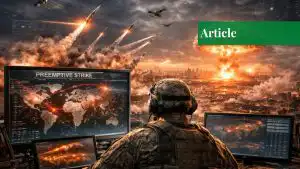
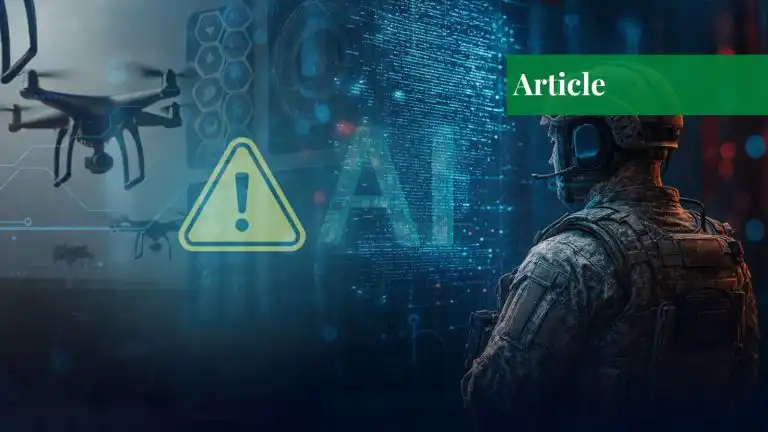

Oded Ailam, who had previously worked in the Mossad’s counterterrorism division, commented on the rapid operation against Iran that led to the assassination of the Supreme Leader, Ayatullah Khamenei. He mentioned that the operation took only sixty seconds. He also noted that the contemporary battlefield is more dependent on data than on tanks and aircraft. A former CIA veteran and writer, David McCloskey, disclosed that data and information today are multilayered. He explained that individuals always leave behind a trail. However, a major breakthrough in the contemporary US-Israeli and Iran conflict has showcased how artificial intelligence (AI) is being integrated into intelligence, surveillance, and reconnaissance (ISR) capabilities to amplify information-gathering capabilities.
US-Israel AI Integration
The US has integrated AI into its military capabilities by launching the Maven system in 2017, in which contracts have been signed with data mining companies such as Palantir and Anthropic. In the recent strikes, Maven was powered by Claude AI (a tool launched by Anthropic) in identifying hundreds of possible targets, categorizing them in terms of their importance, and providing precise coordinates. This allowed Iran’s adversary to obtain a heightened awareness of the battlefield, significantly compressing the kill chain, i.e., the time required for recognizing a target and executing a strike against it. A similar scenario was observed during the abduction of Venezuelan President Nicolás Maduro, where Claude AI was reportedly used by the US. Israel’s use of the artificial intelligence decision support systems (AI-DSS) known as the “Lavender” system to identify low-level Hamas operatives in Gaza is another case where AI is being leveraged to process large data sets combined with on-ground intelligence-gathering capabilities.
Data as a Part of Warfare
In this entire scenario, data has emerged as a crucial strategic asset that is enabling states to achieve increased battlefield awareness. Modern ISR systems are designed to collect intelligence from land, air, sea, and space to achieve superiority in the information domain. Technologies that enable these data-gathering practices include ground, maritime, and space-based surveillance systems, along with unmanned aerial systems for low-cost surveillance. This data is then used to make informed and rapid decisions, and superior ISR ability allows adversaries to outpace each other in the data warfare domain.
With the arrival of AI, states are leveraging it to process large data sets instantaneously and provide recommendations for targeting, along with their exact locations. Issues associated with AI remain, such as the black box paradox, where the reason behind AI arriving at a particular decision remains ambiguous, or the automation bias, where on-field military commanders would associate AI decisions as better than their own thinking processes. However, these issues have not deterred states from using AI to achieve an advantageous position in data collection practices. To shift the balance of this asymmetry in terms of rapid data collection and processing, states at the deficient side of this spectrum could adopt a strategy of localizing data.
Data Localization
“Data localization” refers to the practice employed by states to gather, store, and process data within the territorial realm, i.e., a localized area of the state. With the discovery of the Internet of Things (IoT), the world became strongly interconnected due to the flow of data beyond borders with limited restrictions. Data, due to the nature of its usage and flow in cyberspace, cannot be administered similarly to other assets such as oil, water, population, military, economy, etc. A state’s national security is dependent upon its ability to exercise its power over its resources without interference, resulting in the maintenance of its sovereignty.
Therefore, to ensure data sovereignty, states must exercise precautions in handling their data, giving precedence to data that is sensitive and whose exploitation could result in a national security threat. Several cases have emerged over the years related to how data infrastructures and systems are being used for global surveillance purposes. Prominent ones include the Snowden Leaks in 2013, where a former National Security Agency (NSA) contractor leaked thousands of documents affiliated with surveillance activities using big data. Another major scenario included the one revolving around the Cambridge Analytica scandal, where the data of millions of Facebook users was harvested and used to influence the general public perception in favor of Donald Trump in the 2016 elections.
Data Localization Practices
The above scenarios, along with the ongoing US-Israel and Iran war, indicate that big data algorithms, which were previously recognized by humans and computer networks, are now shifting towards pattern recognition, threat detection, and decision-making through the use of AI. However, the main difference is the compression of the kill chain, where the decision-to-time ratio has significantly decreased.
This would allow states equipped with advanced missile technologies and the ability to rapidly gather and process data a major advantage against states that are susceptible to such tactics due to their dependence on globalized data networks. For example, Iran has adopted a total internet blackout to stay out of these globalized networks, where data from Open Source Intelligence (OSINT) could be used by adversaries to identify targets and carry out precision strikes.
The arrival of AI in identifying the above-mentioned patterns will push states to adopt data localization practices following the recent war in Iran. Rather than going for total data localization, which would result in economic repercussions and global isolation (as seen in North Korea), states could adopt strategies such as geopatriation, where a strategic relocation of digital assets in line with national and geopolitical interests would be observed.
Similarly, a conditional form of localization can also be adopted where a balance is struck between maintaining digital sovereignty and avoiding economic repercussions. This would include sharing data, which is required for global interdependence, while restricting data that could be a threat to a nation’s national security, such as seen through China’s Cyber Security Law (CSL) 2017, India’s Digital Personal Data Protection Act (DPDP) 2023, and Russia’s “On Personal Data” in 2016.
While these are strategies that equip states with a superior advantage against their adversaries, the repercussions of adopting AI-powered data processing tactics in military operations, as well as the practice of localizing data to counter former strategies, would be too large for states to re-establish diplomatic ties. This would ultimately result in a scenario where a technologically advanced state, such as the US, equipped with AI-powered weapons and fueled by tech giants and military-industrial complexes, would be confident enough to secure its global interests, a scenario not observed since the 2003 Iraq War. In comparison, technologically lacking states such as Iran would resort to strategies of strict data governance, which carries with it risks of economic strain, global isolation, and human rights abuse.
If you want to submit your articles and/or research papers, please visit the Submissions page.
To stay updated with the latest jobs, CSS news, internships, scholarships, and current affairs articles, join our Community Forum!
The views and opinions expressed in this article/paper are the author’s own and do not necessarily reflect the editorial position of Paradigm Shift.