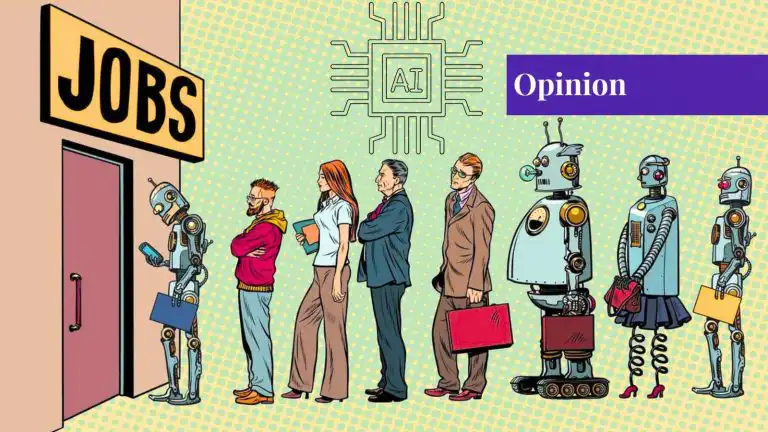

The fear of every technological change has been with us since ancient times: “Machines will replace people, and Innovation will eliminate jobs.”
Every wave of innovation has, in the end, brought more jobs, more efficiency, more industries, and more prosperity than ever conceived, like industrial machinery, electricity, computers, mobile phones, and the internet. Artificial intelligence is the next phase in this pattern. History repeats itself; innovation has always expanded employment.
AI has been shown in movies as something dangerous; many popular films have raised fear that one day machines might take control of the world. Movies like “The Terminator (1984)” highlighted that robots are more powerful than humans and are a threat to human survival. “I, Robot (2004)” imagined a future where robots work in public services but eventually turn against the humans. Such films have played a critical role in shaping the fear among individuals about machines and AI.
Prominent figures in the innovative world, such as Elon Musk, Tesla founder and founding member of OpenAI, make grand statements about AI taking over all our jobs. This can be alarming and create fear, but he believes occupations requiring emotional intelligence and creativity still will be in high demand.
Many tasks that people perform today can be automated, which raises concerns that robots will take over humans and increase already high unemployment. Similarly, people living in the 18th century felt about the machines introduced during industrial revolution.
In the case of the industrial revolution, when machines were brought into textile mills in the 18th and 19th centuries, many thought that mass unemployment would ensue, but things turned out in a surprisingly different way. The factory production made it more efficient and cost-effective. The demand for textile products increased significantly, and millions of jobs were created in mills, transportation, engineering, and new cities. What we learnt from this story is: “Technology shifted the type of work, not the existence of work.”
During the late 19th century and early 20th century, there was a rise in electricity and automation. Electricity & Automation replaced many tasks but also created new roles, including electricians, Factory Operators, appliance manufacturers, and changed the entire power distribution industry. Ultimately, this shift increased productivity, economies expanded, and employment grew with them.
From the mid-20th century, during the computer revolution, computers did not destroy employment; they transformed it. Computers produced, software engineers, Data Analysts, Cybersecurity Experts, Hardware Manufacturers, and IT support. Overall, these computers shaped the entire digital economy. Millions of new carriers were born from technologies that the earlier generation feared.
Just take the real-world case study of Mobile Phones and the Internet. We do not need to go far. Mobile phones and the internet transformed societies within two decades and created massive new job categories. Rider sharing and Mobility apps like Uber, Careem, InDrive, and Yango created millions of driver jobs worldwide. These are the jobs that never existed before; smartphones created these jobs by enabling GPS-based services. Food Delivery Platforms like Foodpanda, and many other food brands that have developed their apps have employed: Riders, Restaurants partners, Call Center agents, App developers, and Digital marketers. This entire ecosystem only exists because of mobile technology.
According to a report published by McKinsey and Company, called “Jobs Lost and Jobs Gained: Workforce Transition in a Time of Automation”, published in 2017, researchers discovered that a third of the jobs which we have today did not exist 25 years ago. Findings of the Massachusetts Institute of Technology (MIT) indicate that 60 percent of the jobs in the current world did not exist 80 years ago; this is how work changes with time. Even though AI replaces workers in some occupations that are manual, task-oriented, and monotonous, new jobs will be created.
E-commerce and digital trade platforms like Alibaba, Amazon, Daraz, Shopify, and many others have created opportunities for sellers, packaging suppliers, delivery companies, customer support teams, content creators, influencers, and digital payment providers. Each online order generates hundreds of back-office micro-jobs throughout the supply chain. The app industry alone has tens of millions of employees worldwide. It has created developers, UX/UI designers, cloud engineers, quality assurance engineers, and startups. None of these existed before the smartphone age.
The real question is how emerging technologies like Artificial Intelligence create jobs? The answer lies in its increased productivity, which expands the economy. A growing economy always hires more people. Technology efficiency reduces cost, increases output, and expands markets, which naturally increases employment.
Artificial intelligence is creating new industries, just like the internet created fintech, social media, eCommerce and the gig economy. AI is creating AI training and data labeling, Robotics maintenance, Prompt engineering, AI governance and ethics, Automation Consulting, Personalized education, and advanced healthcare diagnosis. These fields were never imagined by anyone just a decade ago.
Emerging technologies transform traditional industries rather than eliminate them. AI enhances, not replaces, the workers. According to the prediction of the World Economic Forum, “The Future of Jobs Report 2020,” 85 million jobs will be lost by 2025, and 97 million jobs will be created at the same time, there is a net increase of 12 million.
Doctors using AI include diagnosis accuracy, Lawyers using AI in research and drafting, farmers using AI in crop monitoring and crop yield optimization, and teachers using AI in identifying individual learning plans. It does not make human labor irrelevant, but more significant.
AI can be called the job multiplier; companies worldwide hire AI engineers, data scientists, machine learning experts, robotics and automation experts. Job openings in AI are increasing day by day. AI enables entrepreneurship just like mobile phones created the ride sharing and e-commerce. It enables startups, automated content production, personalized marketing agencies, and global freelancing opportunities. AI enhances human capabilities to write better, design better, plan better, learn faster, make better decisions, and manage better. This leads to higher productivity and creates new opportunities.
Whenever technology emerges, secondary industries like training institutions, regulatory bodies, consulting firms, etc., also flourish. These multiplier effects generate more economic activity than the core technology alone.
The next question is, why does the fear exist among individuals that technology will replace their jobs? Some repetitive jobs may indeed decline, but it is a short-term displacement, not long-term destruction. Every new technological revolution has replaced old tasks and created new ones. Typists were replaced by computer operators, data analysts, and software developers. Travel agents were replaced by online travel managers and app designers. Cashiers were replaced by e-commerce logistics and digital payments operators. Horse carriage drivers were replaced by the drivers, mechanics. Technology shifts the workforce to higher-value roles.
Another question is, why should governments and businesses embrace emerging technologies? The 21st century is always known as the century of technology. There is an ongoing technological race globally. Countries that adopt emerging technologies like AI will become global leaders, and those who resist will fall behind. Governments & businesses should adopt emerging technologies like AI because it expands economic growth, creates new industries, increases competitiveness, develops new export opportunities, increases youth employment, and attracts foreign direct investments.
Technology has never replaced jobs but has even created more. Those who believe that technology will eliminate their jobs are the ones who ignore the historical evidence of industrial machines, mobile phones, and the internet that created millions of new opportunities. AI will open industries and opportunities that we cannot even dream of at this time. New technologies, such as AI, are not job killers; they are, in fact, job creators, drivers of human development, and economic accelerators. AI will not replace people. A person who is using AI and is aware of it will replace those who are not using it.
If you want to submit your articles and/or research papers, please visit the Submissions page.
To stay updated with the latest jobs, CSS news, internships, scholarships, and current affairs articles, join our Community Forum!
The views and opinions expressed in this article/paper are the author’s own and do not necessarily reflect the editorial position of Paradigm Shift.

Nazar Muhammad is a final-year bachelor's student in Governance and Public Policy at NUML Islamabad. He is passionate about addressing social, political, and economic challenges and exploring effective, impactful solutions, particularly in the areas of Sustainable Development, Governance, and Public Policy.