
Introduction
Bangladesh is at its crossroads in politics today, and the situation is marked by chaos, doubt, and the revival of mass mobilization. This has sparked new waves of protests country-wide and exposed the weakness of interim governance in the country, with the assassination of Sharif Osman Hadi, a leading youth leader and activist, in December 2025, casting serious doubts on the credibility of the forthcoming February 2026 elections. It is not just the tragic loss of a young leader but a symbolic moment in which negative feelings between the state institutions, civil society, and foreign forces are bound together.
Protests that were held after the death of Hadi have also shown that unrest in Bangladesh has a multi-dimensional nature. On one hand, there is domestic dissatisfaction with the rules, corruption, and instability of the institution. Alternatively, they emphasize the local aspect of politics, and the anti-India slogans and diplomatic relationship conflicts stress how external forces are seen to shape the internal politics of Bangladesh. This article investigates the reasons, the symptoms, and the effects of the unrest within the framework of the broad historical and regional backgrounds.
Historical Roots of Political Unrest
The political history of Bangladesh is strongly connected with student-driven activism that has been perceived as the catalyst of change since the beginning. Political mobilization based on youth activism was founded by the Language Movement of 1952, under which students protested to maintain the state language, which was Bengali. This movement not only formed national identity but also evidenced the federal power of the students to question the state authority.
Student groups were instrumental in overthrowing military regimes and pushing electoral reforms in the future in the 1980s and 1990s in the so-called pro-democracy movements. The 2024 uprising was a continuation of this legacy. Protests against the government of Prime Minister Sheikh Hasina were held in the form of mass demonstrations by students and young activists that pointed the finger at the government because of authoritarian rule, corruption, and suppression of journalists. This mobilization eventually saw Hasina resign despite being in power for over a fifteen-year tenure, reinstating the importance of youth movements in politics in Bangladesh in both forming the identity of a nation and a democracy.
The Assassination of Sharif Osman Hadi
On December 12, 2025, Sharif Osman Hadi, a youth leader and activist who gained fame, was shot by masked men in Dhaka during the run-up to the forthcoming elections. He was airlifted to Singapore to undergo further medical care, but he died six days later due to the injuries sustained. His killing was a shock to the country, which led to riots in Dhaka and other cities. The killing of Hadi came at a very crucial time, only a few weeks before the first election in Bangladesh after the 2024 uprising.
Anti-India slogans dominated the streets, and media houses like Prothom Alo and The Daily Star were attacked by demonstrators as culprits of being pro-India biased. His assassination was seen as a politically related event by now, which developed the fear of targeted violence against opposition personalities. To most of his supporters, Hadi turned into a martyr of the young generation in resisting the deteriorated elites and foreign pressure. Hadi became a martyr who raised the anger of people and shattered the already uncertain interim government.
Youth Movements and Mobilization
The leadership style demonstrated by Hadi in the 2024 confrontation was an effective demonstration of what youth movements can do to overthrow established elites. His influence as a mobilization power among students and young activists showed how youth will always have a long-term impact on political discussions. After his death, students in Dhaka and other cities staged demonstrations that called upon justice, accountability, and protection of democratic rights, which proves the strength of youth mobilization, which has not yet ceased to exist as a counterbalance to state authority.
The experimentation in the field of politics has historically been at the center stage of political transformation in Bangladesh, and hence their vigorous resurgence to activism after the assassination of Hadi serves as the key to the role of agents of change. The generational gap in Bangladeshi politics is also evident through the protests, where the younger citizens are becoming disillusioned with the propagation of corruption and dictatorship. The revival of youth activism highlights the long tradition of students as a way of transforming politics in Bangladesh.
Governance Challenges and Institutional Fragility
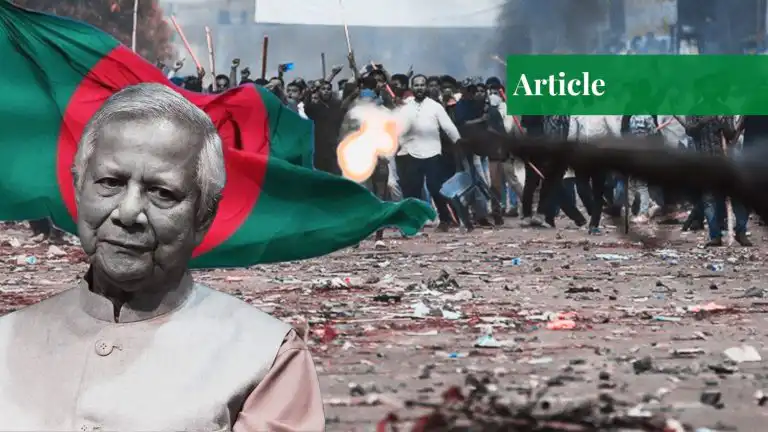
The interim government under the leadership of Muhammad Yunus is increasingly experiencing challenges in keeping order. Riots, assaults on media stations, and anti-government slogans demonstrate a sense of disappointment with the system of government. Police forces are unable to restrain riots, and in many cases, they use violent methods of action, which only undermines the confidence of citizens.
Trust in the elections on February 12, 2026, is tarnished. There is a fear that voter confidence and international legitimacy will be lacking due to political violence and institutional weakness. The incompetence of the interim government in safeguarding opposition leaders has been realized in the case of the assassination of Hadi, and there is doubt as to whether the democratically established governance can be sustained.
Diplomatic Dimensions: Bangladesh–India Relations
The turmoil has led to a bad relationship between Bangladesh and India, which is an important regional power. Protesters alleged that India was meddling in internal politics, and Dhaka suspended the high Indian consular services in New Delhi following threats on its high commissioner. Accusations that the killers of Hadi had gone on the run in India only added to the already existing nationalist fervor in Bangladesh. Such developments underscore the role that domestic unrest can play in regional diplomacy.
India, in the past, has traditionally played a big role in Bangladesh’s political life, yet the increasing resentment of the youth activists implies a change in the way people view the matter. This crisis has driven the Bangladesh-India relations to an all-time low, and this may have implications for trade, security cooperation, and regional stability. The crisis shows that domestic unrest may be extended into the regional diplomacy, and the relations between Bangladesh and India have reached an unprecedented low.
Media and Civil Society Under Pressure
The protest also targeted media outlets that were seen to be pro-India, as people blamed them because of their perceived bias. Journalists were intimidated, and their offices were vandalized, which questioned the freedom of the press. Civil society organs are urging them to exercise restraint, yet polarization is still high, with many groups being chipped along political lines. The possession of media houses shows how instability suppresses the freedom of expression and the discourse of democracy.
To the extent of the political crisis, civil society is effective in conflict mediation and dialogue fostering. Nonetheless, the present instability has demonstrated the weakness of these institutions that find it hard to stand credibly in the face of accusations of prejudice and external pressure. Vulnerability of civil society in the political crisis is seen through the attack on media institutions.
Conclusion
The assassination of Sharif Osman Hadi is a monumental event in modern Bangladesh politics, revitalizing anger among students and youth activists as well as revealing the instability and failure of governance and the interim government to handle unrest. The uprising has highlighted the perennial strength of youth mobilization and made the legitimacy of democratic institutions questionable, with assaults against media organizations, anti-government rhetoric, and violent protests threatening the plausibility of the 2026 elections.
In addition to domestic politics, the crisis has affected the relationship between Bangladesh and India, with claims of outside influence and consular discontinuation demonstrating how unrest may pass into regional politics and compromise South Asian stability. The United Nations and other international observers have cautioned that significant violence will lead to the radicalization of the youths and the destabilization of the region even more.
Hadi’s death, in the end, is not only a tragedy but also a hotspot of the democratic process in Bangladesh. It is clear that there is a real need to have an inclusive dialogue, reformulate their institutions, empower their civil societies, and to establish greater cooperation between different regions to prevent further destabilization and to make the youth continue to focus as the core of the democratic processes.
If you want to submit your articles and/or research papers, please visit the Submissions page.
To stay updated with the latest jobs, CSS news, internships, scholarships, and current affairs articles, join our Community Forum!
The views and opinions expressed in this article/paper are the author’s own and do not necessarily reflect the editorial position of Paradigm Shift.

Manahil Tariq Manj is a student of defence and strategic studies at Quaid-i-Azam University, Islamabad. She has previously interned at the Ministry of Defence (MOD) and is currently interning at the Ministry of Foreign Affairs, Islamabad. Her research interests include conventional and hybrid warfare, strategic deterrence, military diplomacy, regional conflict dynamics, and evolving doctrines of modern warfare.