

He is pursuing a BS in International Relations programme from International Islamic University, Islamabad and has a keen interest in research works, policy analysis, defence and strategic studies and conflict resolution.
From the very first day of his presidency, President Donald Trump has been portraying himself as an ‘ambassador of world peace.’ His 2024 election campaign was orchestrated with slogans of ‘no more wars’ and ‘Make America Great Again.’ As of now, President Trump claims to have ended nearly eight wars worldwide. However, the question of the longevity of these peace agreements is still intact. The Israel-Palestine war was one of the most significant of them, as it resulted in genocide in Palestine, particularly in the Gaza Strip.
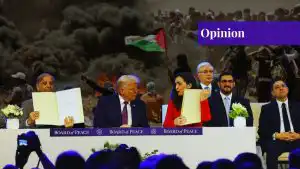
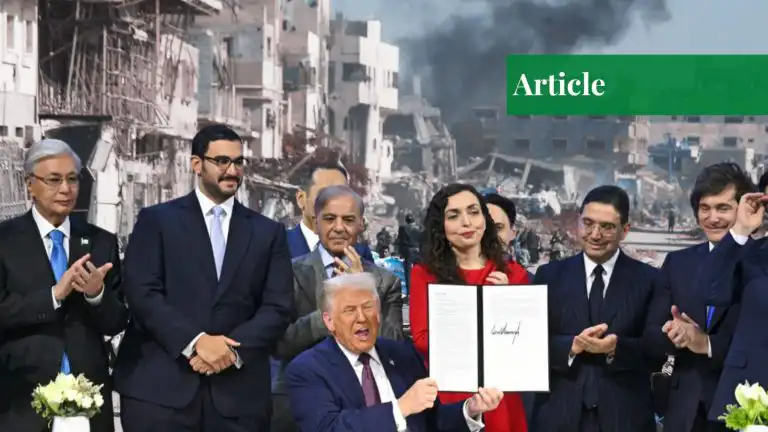
On 15 January 2025, a three-phase ceasefire deal was announced between Israel and Hamas to end the war in Gaza. These three phases aim to peacefully shift power from Hamas to a somewhat undefined authority – be it Israel or the US itself. In October 2025, political leaders from around the world convened in Sharm al-Sheikh, Egypt, for a ceremony to sign a ceasefire deal in Gaza, led by US President Donald Trump and mediating partners such as Egypt, Qatar, and Turkiye. This marked the so-called end of Israeli genocide in Gaza.
Gaza Peace Plan: Key Phases
The 20-point peace plan put forward by the Trump administration is folded into three major phases:
- Ceasefire and Hostage Exchange
A ceasefire was declared between Israel and Hamas this year. Later, Hamas stated that it had given the Israelis all the bodies of the hostages it had been able to retrieve in Gaza and that much more work had to be done to find the others. As a result, the first stage is now complete.
- Demilitarization and Governance
For this, the US has put forward ‘Project Sunrise.’ According to the Wall Street Journal, the project a groundbreaking $112 billion project that will take 10 to 20 years to complete, according to the Wall Street Journal. Trump’s plan to turn Gaza into the ‘Riviera of the Middle East’ is reflected in this newly published 32-page article. This phase is further divided into four major stages, amongst which the first two will be part of phase two of the 20-point peace plan:
- Stabilization – creation of an international stabilization force made up of US, Arab, and European personnel to dismantle or disarm Hamas and maintain security in Gaza.
- Infrastructural reconstruction – restoring normal civilian life and basic governance capacity.
- Post-Conflict Reconstruction
This is the final phase of the peace plan. This phase is marked by the creation of the Board of Peace to oversee the governance and reconstruction of Gaza. The last two stages of Project Sunrise are an integral part of this phase:
- Economic Development – helping Gaza to attract investments and employment opportunities.
- Urban Riviera – transforming Gaza into a high-tech Riviera of the Middle East.
Gaza Board of Peace
The Board of Peace was proposed by President Trump in September 2025 and was approved by the United Nations Security Council. On 15 January 2025, the Trump administration formally announced the establishment of the Gaza Board of Peace, or, if not exaggerated, ‘Trump’s Board of Peace.’ The creation of this board raises numerous questions. Without the completion of the second phase, how could the US implement the final phase? Neither has Hamas been disarmed, nor has debris been removed, and Muslim countries have not confirmed the participation of their forces in the Gaza International Stabilization Force. Without resolving these issues, how would a peaceful transfer of power – from Hamas to ISF – be possible? Moreover, the Board of Peace is itself presenting so many challenges.
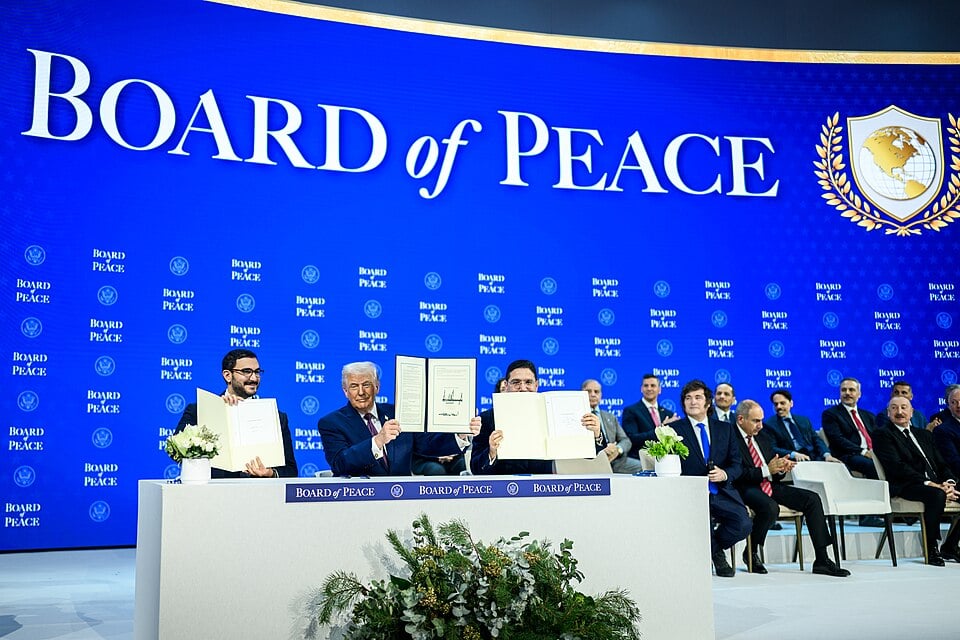
Let’s critically analyze these.
The Board of Peace is divided into two major parts:
The Main Board of Peace is comprised of eight founding members. These include President Trump as Chairman, US Secretary of State Marco Rubio, Special Negotiator Steve Witkoff, Trump’s son-in-law Jared Kushner, former UK Prime Minister Tony Blair, President of the World Bank Ajay Banga, Billionaire businessman Marc Rowan, and policy advisor Robert Gabriel. From Marco to Tony Blair, all are pro-Israel figures. Rubio is a long-standing supporter of Israel, Kushner was the leading figure in the Abraham Accords, Witkoff is a pro-Israel Middle Eastern envoy of the US, Blair was an honorary patron of the UK branch of Israel’s Jewish National Fund, and Rowan has referred to himself as a proud supporter of the State of Israel. More than 60 states, including Russia, China, Israel, India, Pakistan, Turkey, the Arab world, and European nations, have been formally invited to join the main board of peace.
On the other hand, the Gaza Executive Board is comprised of a bridge team and an operational team. The Bridge Team is composed of four founding members of the main board of peace, including Witkoff, Kushner, Blair, and Rowan. While the operational team is comprised of Turkish Foreign Minister Hakan Fidan, Qatari Diplomat Ali al-Thawadi, UAE Minister Reem al-Hashimy, Egypt’s Intelligence Chief Gen. Hassan Rashad, European Diplomat Nickolay Mladenov, and the Israeli billionaire Yakir Gabay.
Israel’s Objection
The complete structure of the Gaza Board of Peace is comprised of a majority of the pro-Israeli figures, in one way or another. The board seems like a Jewish colonial committee to govern the Palestinian land. Despite all this, Israel has raised serious objections to this structural arrangement. Israel’s Foreign Ministry stated that the announcement regarding the composition of the Gaza Executive Board, which is subordinate to the Board of Peace, was not coordinated with Israel and runs contrary to its policy.
Moreover, the board is no doubt comprised of pro-Israeli figures, but not a single Israeli government official has been made part of it. Instead, Turkey and Qatar – the staunch supporters of Hamas and the Palestinian movement – have been included in the executive board. However, the Trump administration is of the point of view that Turkey and Qatar have played a vital role in Israel-Hamas mediation, and they would further play a very influential role in stabilizing the Gaza Strip, dismantling the tunnels, and returning the final body.
Board of Peace – A Rival to the UN
The Board of Peace is not just limited to the Israel-Palestine conflict. Rather, the Trump administration has declared the board as an international organization meant to bring peace throughout the world. The peaceful resolution of the Israel-Palestine conflict would be its first accomplishment. The US has officially launched a complete charter of the board, comprised of a preamble and thirteen chapters – similar to the UN. The preamble said, “maintaining that lasting peace depends on practical judgment, common-sense solutions, and the courage to abandon methods and institutions that have repeatedly failed; reiterating that lasting, results-focused cooperation, rooted in shared responsibilities and obligations, is the only way to bring peace to areas where it has been elusive for far too long.”
President Trump has always been a sharp critic of the UN and has declared several times the failure of the UN in resolving disputes in the international arena. Analysts are of the view that Trump’s Board of Peace could become a rival of the UN, undermining its efforts. To become a permanent member of the board, every state has to pay one billion dollars to the US, while states can enjoy non-permanent membership for three years. As of now, approximately 25 nations have accepted the invitation. Along with Israel, Kosovo, Belarus, Hungary, and Canada, nearly ten Muslim nations have jointly announced their intention to join the board. These include Turkey, Egypt, Indonesia, Jordan, Pakistan, Qatar, Saudi Arabia, the UAE, Morocco, and Azerbaijan. This number will increase in the near future. China and Russia haven’t yet issued any formal statement. Most of the European countries, including France, Germany, etc., have declined to accept the invitation due to heightened tensions over the matter of Greenland. Just like China is creating an alternative institutional arrangement, i.e., BRICS, SCO, etc., President Trump has now established the Board of Peace – a parallel system to the UN and that of Chinese institutions.
Future Options
- Palestinians will be either expelled from their land or confined to their territory under Western restrictions.
- How Muslim states would deal with Hamas remains a mystery. The joining of ten Muslim nations unveils the fact that they completely align with the American demands in Palestine.
- Russia and China may join the board for Gaza peace-building, but most probably will not opt for an alternative to the UN.
- If Trump makes a deal with Europe over Greenland, most probably the European nations would soon join the board of peace.
- If successful, the Board of Peace would formally initiate an era of bounded orders, provided by the US and China – a Cold War 2.0.
- The UN would be undermined, and a decades-long structure of a rules-based international system would diminish.
Criticism
The Board of Peace seems more like Trump’s zero-sum project than a peace-making body. The board is comprised of friends and foes under a single authority – the US. With countries like Turkey, Qatar, etc., which Israel considers a threat, how they will together execute the Gaza peace plan is a million-dollar question. As of now, the situation is quite ambiguous, and the success of the board will largely depend on whether China and Russia will join it or not. The board seems more like a coalition of the willing than an alternative to the UN. In case of the UN, countries have given mandates to the body under the umbrella of international laws, while, in the Board of Peace, all rules would be created or annulled by just one person – President Trump.
The UN Charter has provided an equal status to all states, whether small or large. Here, the case is opposite. All member states will dedicate their sovereignty to President Donald Trump, which seems questionable. Moreover, the allocation of one billion dollars for permanent membership is another major blunder made by President Trump. It seems quite impossible that states would pay to surrender their sovereignty to a single person. Last but not least, the future of the board is uncertain. If Democrats win the next election, will the board survive? The rest depends on the evolving geopolitical dynamics.
Conclusion
The establishment of the Board of Peace serves more to the projection of President Trump’s image as a peacemaker to the world than to the resolution of the Palestine issue under international law. The current events are evident that wherever President Trump has claimed to make peace, those countries have either started a war again or are sitting at the brink of collapse. As President Trump enjoys gaining tactical fame, it wouldn’t be exaggerated to predict that Gaza might meet the same fate, as the establishment of the board of peace is quite ambiguous and full of doubts and overconfident claims.
If you want to submit your articles and/or research papers, please visit the Submissions page.
To stay updated with the latest jobs, CSS news, internships, scholarships, and current affairs articles, join our Community Forum!
The views and opinions expressed in this article/paper are the author’s own and do not necessarily reflect the editorial position of Paradigm Shift.