
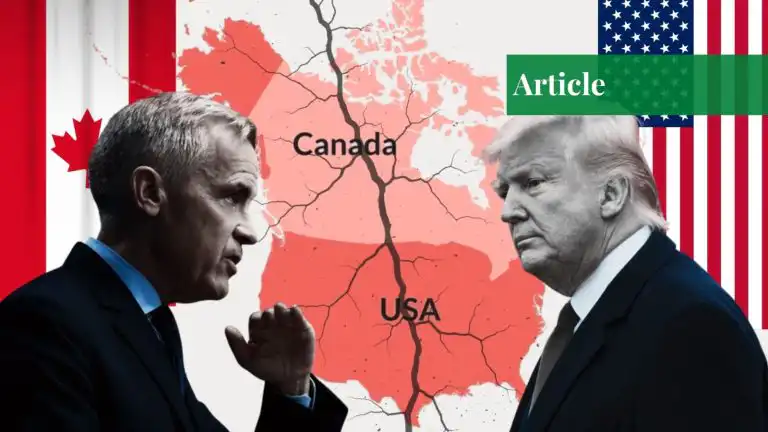

The diplomatic tussle between Canada and the US under President Donald Trump has passed beyond the history of intermittent policy differences, a challenge that has become symbolic of an underlying geopolitical rupture. Canada-US relations had once been characterized by President John F. Kennedy as “Geography has made us neighbors. History has made us friends. Economics has made us partners, and necessity has made us allies,” but now they are on the verge of deteriorating into hate speech due to the increasing number of cancellations of the perceived aggressive diplomatic maneuver by Washington. In the case of countries in the Global South, this unveiling is by no means disgusting. It is familiar. The difference is that a Western ally such as Canada is getting a firsthand experience of what it is like to be subject to selective rules and conditional sovereignty.
This continuous war of words has served to identify the actual character of the modern world order. Over the years, portrayed as a purely rules-based system on the foundations of sovereignty, law, and mutual respect, the modern international system is clearly becoming conditional upon power, distance to the West, and utility. The opposition of Canada to the rhetoric of Trump, especially the discourse of the 51st state, the conflicts surrounding Greenland, and the US’s actions in Venezuela, have shown inconsistencies that Global South states have had to deal with for many years, but rarely has the diplomatic right to openly question.
What is interesting about the pushback of Canada is not its ethical uprightness, but its geographical location. Canada has a history of being a beneficiary and custodian of the Western-dominated order. Prime Minister Mark Carney was not really offering a radical Global South critique when he commented that the old World Order is not returning and said no one should mourn over this, but he was merely recognizing the reality long known by much of the world, that the old World Order was unpredictable and was selectively applied and frequently violated by the very people who were supposed to defend it. This is not a contentious assertion, as it is experienced in Africa, in South Asia, the Middle East, and in Latin America.
Over the years, the Global South has been lectured by states that flouted global law when it suited, disregarded U.N. resolutions, and claimed that sovereignty only applies to them. Political theorist Noam Chomsky noted this subsequent imbalance in a few words when he noted that world politics consistently seem to work on a simple formula, “the strong do as they can, and the weak suffer as they must”. It is not surprising that the system operates in this manner, but it appears that sometimes the designers of the system are so shocked that they are surprised when the same logic gets turned on them. This exposure can be summarized by the fact that Trump proposes that the United States should make Canada its 51st state. Regardless of whether it was an invitation to attack or a bargaining point, the comment was taken in Canada as an insult to sovereignty. Canadian authorities dismissed it wholeheartedly, and Prime Minister Justin Trudeau pointed out that it was not a joke, but a boundary that was crossed.
The Greenland case also shows how easily the rule language can be replaced by the power language. The reaction of European leaders to Trump when he insisted on having the US enjoy complete access to Greenland in the name of security was unusual, though this was caused by his insistence that Denmark would not govern Greenland and the autonomy enjoyed by the region. Canada was actively backing Denmark, presenting the matter not as a strategic but a principled issue. However, there was one unmistakable teaching: as soon as security can be used as an excuse to exert pressure on Greenland, it can also be applied to other places.
In Canada, it is not merely theoretical. Being a country that is in the Arctic, Canada realizes that when sovereignty is bargainable at the expense of security, geography is not much of a shield. The Arctic, which was once ruled by cooperation and treaties, is becoming another paradise where might makes the difference between what rules can be followed and what cannot. This is an old tale about the Global South. Strategic interests often do not give resource-laden areas the same amount of luxury of having inviolable borders as they are discussed.
The US’s attitude towards Venezuela is evidence of the trend. Information released by various news channels like AP news and Reuters includes criticism of Washington by analyzing its action of circumventing international consensus, which might have been accompanied by a democratic concern instead of democratic concern itself.
This is no new way of doing things. The interesting part is the openness of how the expressions of legality are marginalized when results are more important than the means. Edward Said once cautioned that imperial actions do not tend to announce themselves honestly and, rather, they develop, acquiring more acceptable reasons as they maintain hierarchy. Venezuela is no exception- that is, it is a manifestation of continuity.
Combined, these episodes do not augur the fall of the world order, but rather its unveiling. The system has not collapsed; it has been operating, as ever. The narrative of its being unbiased is what is failing. The rules-based order was never a fair referee. It was a controlled process that rewarded others and punished others. The uncomfortable feeling being experienced by Canada nowadays is reminiscent of a lasting sense of uncertainty of weaker states over generations.
The most famous statement of Italian philosopher Antonio Gramsci says that a crisis is a situation in which the old world is dying, and the new world struggles to be born. To the Global South, the crisis seems not to be that chaotic but rather like recognition. The discomfort that is now obvious to the capitals of the West does not represent the termination of order, but the termination of the inalienable power to dictate who it is.
Ultimately, the fact that Canada is resistant to the America-first stance adopted by Trump is relevant not due to its unprecedented feature but due to its revelation. This rhetoric of the 51st state, Greenland, debate, and unilateral acts against Venezuela all demonstrate the selective reservation that the existing World Order was built on lays bare. It is not that positions are shifting so much as it is now more difficult to deny the contradictions present in the system, which is the real rupture, as seen in one of the Global Souths. The future is not to recreate a soothing illusion but to envisage an international system in which the rules apply upwards as dependably as they apply downwards. The mask, ending then, and to most of us, it was never fitted on in the first place.
If you want to submit your articles and/or research papers, please visit the Submissions page.
To stay updated with the latest jobs, CSS news, internships, scholarships, and current affairs articles, join our Community Forum!
The views and opinions expressed in this article/paper are the author’s own and do not necessarily reflect the editorial position of Paradigm Shift.

Pakizah Parveen holds an MPhil in International Relations, with a strong academic focus on global politics, security studies, and contemporary international affairs. She is currently serving as a Visiting Lecturer at Bahria University and FAST (National University of Computer and Emerging Sciences).