
The question of castes among Muslims in India and Pakistan is complicated. It sits at the crossroads of religious belief and long-standing social hierarchies shaped over generations. Islam, in its essence, preaches equality and rejects the idea of caste, but the lived experience in South Asia often tells a different story. Caste-like divisions are still very much a reality for many Muslim communities.
People have different takes on it. Some admit caste exists, though they might use softer terms like baradari or zaat, which lean more toward family or ethnic ties. Others deny it altogether, insisting that Islam’s message of equality leaves no room for such divisions.
But here’s the thing: while Islam may not support caste distinctions, the way society functions on the ground doesn’t always reflect that ideal. In many cases, caste-based thinking still shapes who people marry, how they live, and how they’re seen.
The baradari system (clan-based affiliations that govern social interactions) reflects similar principles to the Hindu caste system, including endogamy, recruitment by birth, hierarchy of status, and occupational specialization. Despite using different terms, this social organization system functions similarly to caste systems, reinforcing social divisions.
The origins of caste among South Asian Muslims can be traced to the historical recruitment of many converts from the Hindu population. Ahmed (1967) argues that despite accepting Islam, many converts, especially from lower Hindu classes, were unable to get rid of their caste, resulting in the emergence of distinct social categories such as dalit-Muslims. Moreover, when Islam came, castes were already in the air. This interaction between Islam and the Indian civilization led to the emergence of distinctive Muslim classes of Ashraf (noble class) and non-Ashraf (commoners).
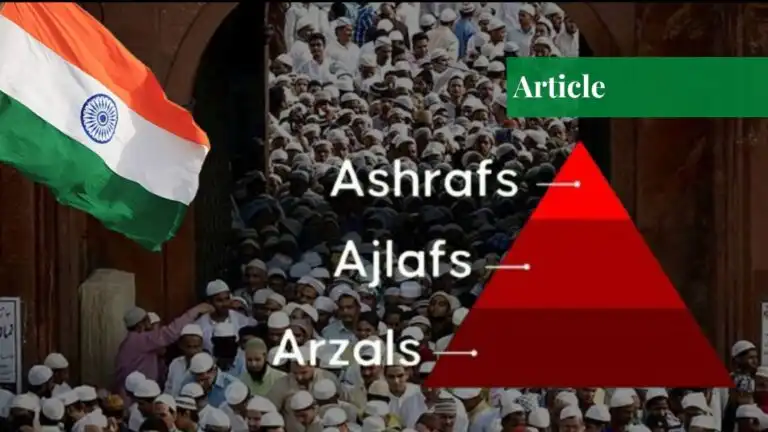
The Ashraf, considered the noble class, trace their lineage to Arab immigrants and include subgroups like Sayyids (claiming descent from the Prophet Muhammad [PBUH]), Shaykhs (typically descendants of Arab or Persian immigrants), Pashtuns (from the Pashto-speaking tribes), and Mughals (of Turkish descent, known from the Mughal Empire).
Conversely, non-Ashraf Muslims can be further divided into three tiers based on their Hindu caste backgrounds, reflecting a hierarchy that mirrors the Hindu caste system. The Ajlafs (the commoners) were converts from Hindu low castes, and the Arzals (the despicable) were said to be Dalit converts. In short, Ashrafs are the Brahmin equivalent, Ajlafs are the Vaisya and Shudras, and Arzals are the Atishudras or Dalit equivalents of Islam. This reflects a hierarchy that mirrors the Hindu caste system. Thus, it would be apt to say that while Islam may not have castes or caste-like groupings, the Indian Muslims do.
Often, it is argued that the Muslim zaat and the concept of caste cannot be treated similarly. Pervaiz Nazir (1993) analysed the stratification and social status symbols that existed in Punjab. Within localities, people were divided into 3 main groups. Populations are categorized into Zamindars (Landowning cultivators) and the Kamins, which include the Artisan/service castes, and landless agricultural labourers/tenants. These groups can also be classified as Ashraf, Ajlaf, or Arzal, with the landless labourers typically forming the majority. Power, izzat, and prestige were associated with the landowning class and the Kamins, which comprised various groups depending on their nature of job and were dependent on the zamindars. There was unequal sharing of purchasing power, and it was dependent on hereditary status. The landowners like Brahmins occupied the highest status ranking. The Punjabi term that was employed to designate these clusters of roles and the ranking position associated with them was zaat, and the system mentioned above can be seen as a caste system. Moreover, the Hindu notion of pollution, though is absent in Muslims, however hierarchical ordering and mutual separation of zaats were expressed in terms of different notions, notably those of honor, power, and prestige.
The castes system in India has transitioned from a religious practice to a cultural one. If someone converts to another religion without a caste system, their original caste identity persists due to cultural perceptions. While the formal caste system may have been abolished, informal caste-related issues persist due to cultural attitudes and social norms. The example of a Dalit woman moving to a Scandinavian country illustrates how being away from her native culture allows her to escape the constraints of the caste system. Therefore, it might be right to say that the main issue lies with the cultural practices and societal attitudes rather than the religious aspects of Hinduism itself.
Colonialism also played a huge role here. When the British came in, they brought changes—land reforms, legal shifts, and new ideas of ownership. In rural areas, especially, that messed with the old social order. Some families gained land and power; others lost both. Over time, those lines we now call caste—or zaat or biradari—started to harden for some, and blur for others. What used to be fixed roles based on family or job began to shift. People started seeing mobility—some could move “up” in society, others tried to break away from labels altogether.
Even the word zaat doesn’t mean the same thing to everyone anymore. For older generations, it might still carry caste meanings, but younger folks sometimes see it more as a marker of culture or background, not status. The legal system also changed, from older tribal customs to more formal Islamic law in many places. That, too, changed how people understood identity and belonging.
In more recent years, researchers have started talking about caste among Muslims not just as a leftover from Hindu influence, but as something with its shape and history. It’s not only about who someone marries or what work they do—it can also be about how society assigns value to people. Things like family background or even reputation can form invisible barriers.
If change is going to happen, it must start with naming the problem. Denying that caste exists among Muslims only keeps it alive. Policymakers, community leaders, and even everyday people need to face how deep these divisions go. Otherwise, there’s no real path to equality or inclusion.
To wrap it up, caste among Muslims in South Asia isn’t just a shadow of Hindu tradition or a contradiction of Islamic belief. It’s a social structure shaped by history, culture, and power—and it still impacts lives today. If we want a fairer society, we must be willing to challenge not just systems, but also mindsets that have been around for generations.
If you want to submit your articles and/or research papers, please visit the Submissions page.
To stay updated with the latest jobs, CSS news, internships, scholarships, and current affairs articles, join our Community Forum!
The views and opinions expressed in this article/paper are the author’s own and do not necessarily reflect the editorial position of Paradigm Shift.

The writer is a junior year student currently pursing bachelors in Public Administration from National University of Sciences and Technology. She writes on issues related to Social policies, geo-politics and public policy.