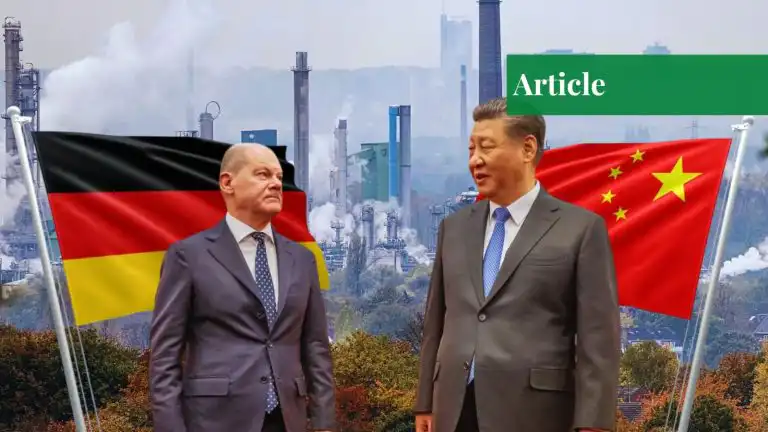

German Chancellor Friedrich Merz, on his visit to China, argued that Berlin will engage with Beijing on the basis of “principled realism.” During the Munich Security Conference 2026, Merz stated that a rights- and rule-based international order no longer exists. Countries are facing a dilemma due to sudden changes in global politics, especially since the start of the second term of President Trump. Writing in Foreign Affairs, Merz contended that Europe just returned from a long vacation from history. Now, it faces a stark choice between values and its interests, where it is required to balance its value-based foreign policy with one based on European national interest. Germany, being the leading European country, is also finding it hard to cope with new realities in international relations.
German Zeitenwende
When Russia invaded Ukraine in 2022, German Chancellor Olaf Scholz declared the event as Zeitenwende, a turning point, and started the rearmament of Germany. Under the commitments to align with NATO defense spending, Germany is determined to increase its defense spending to 5% of GDP by 2035. In 2025, Berlin increased the defense budget of its army, Bundeswehr, to around $101 billion. However, military power alone is not sufficient to have a great power status without a strong, independent economy. Germany’s economic dependency on other countries is its Achilles heel.
Germany’s Strategic Reorientation
Germany’s foreign policy aims to achieve three objectives under Friedrich Merz, which include strength, freedom, and security. To achieve these objectives, Germany’s economic independence is important. Due to economic reasons, Germany is engaging with China, and the German Chancellor is visiting Beijing to develop better economic relations. The rationale given by Merz is that it is important to have strong economic links with Beijing, as China is here to stay as a great power. He asserted that the unipolar moment that started after the fall of the Berlin Wall has ended, and the great power politics based on a zero-sum game has returned. In such a world based on realpolitik, freedom is not inherently granted to the states. Countries are required to ensure their freedom by reducing overdependence on any one great power.
Principled Realism: Balancing Values with Power Politics
In an era of great power politics, principled realism is guiding the German foreign policy toward China. It is based on the idea that not everyone agrees with your idea and values, and it is better not to change the values of others to make them align with yours. The transatlantic and European relations are important for Germany, but Berlin has come to terms with the fact that these relations are not sufficient to ensure German freedom. This necessitates reaching out to other countries with different politico-economic ideologies, such as China. As Chancellor Merz contends, states cannot have complete agreement on all values and interests with each other. This is driving Merz’s visit to China, where Berlin is aiming to derisk its economy rather than decouple completely from the Chinese economy.
From Lehrmeister to Competitor
Beijing and Berlin share historic economic ties going back to the late 19th century. German companies such as Siemens and BASF established industries in China in the 19th century. However, this industrial cooperation was enhanced further in the 1980s when German industrial giants like Volkswagen started investing in Chinese industries. They became Lehrmeister, teachers, for Chinese companies, and over time, trade increased between both countries. In 2016, China became the largest trade partner of Germany and started acquiring German companies such as Aixtron and Kuka.
This raised alarm in Germany because by that time, Berlin had started to see China as a rival. However, trade numbers showed a different reality, as trade between both countries had increased by 900 percent from $27 billion in 2001 to $273 billion in 2024. German exports to China stand at a mere $96 billion, while its imports have increased to $201 billion. This is the reason that Germany cannot completely decouple from China, and it is rushing to derisk its economy.
De-risking Without Decoupling
One of the aims of Merz’s visit to China is to engage Beijing to ensure fair and competitive markets for German companies. German companies are among the biggest investors in Chinese markets. Out of total investments by the European Union in China, German companies invest 57%, which indicates the level of industrial spending by German companies in China. German carmakers are the main stakeholders in these investments, as German companies like BMW and Volkswagen made profits of billions of dollars.
Recently, BMW stated that there are no plans under consideration to shift industries away from China and invested $4.4 billion in battery projects in Shenyang. However, Friedrich Merz warned German companies of their dependence on Chinese markets by stating that “if something goes wrong, then do not come to us.” Despite such warnings, it is difficult for German companies to leave China, as they are dependent on Chinese rare earth exports, where China holds a monopoly, as it controls 95% of the rare earth market.
German companies are facing issues of unfair trade practices by their Chinese counterparts, which leads to a decrease in German market share. In 2025, German machinery exports to China fell by 8.5%, while machinery exports from China to Germany increased by 12.5%. Due to this reason, a large delegation of German business executives is visiting China with the Chancellor. When Merz met with Chinese Premier Li Qiang, he conveyed that Berlin wants to revive the decades-old economic relationship with Beijing, but on the basis of open communication and fair cooperation.
Consequently, Berlin is aiming for some economic concessions from China, such as an increase in Germany’s share in Chinese markets. However, the Chinese are aware of the German dependence on their markets, and they will not be willing to grant much to Germany. It is due to the fact that before Chancellor Merz of Germany, French President Emmanuel Macron, and British Prime Minister Keir Starmer also visited China for better economic relations, and the Chinese are aware of this sudden desire in Western capitals to shift to China, owing to the transactionalist approach of President Trump.
Thus, the desire to develop better economic relations with China is based on the national interests of Germany. Despite disagreement with China on a number of issues, such as Taiwan, the Russia-Ukraine war, and human rights, Berlin is willing to cooperate with Beijing. It is in accordance with the idea of principled realism as stated by the German chancellor. The recent visit aligns with the statement of Lord Palmerston, who stated that “there are no permanent friends nor enemies; the only thing that is permanent is national interest.”
If you want to submit your articles and/or research papers, please visit the Submissions page.
To stay updated with the latest jobs, CSS news, internships, scholarships, and current affairs articles, join our Community Forum!
The views and opinions expressed in this article/paper are the author’s own and do not necessarily reflect the editorial position of Paradigm Shift.

Aresha Fatima Bukhari is a student of international relations at National Defense University.