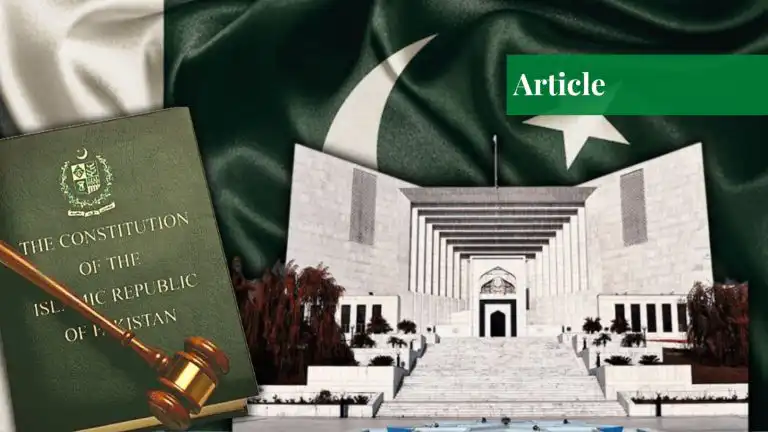

Whenever a nation attains independence and political existence with certain territories, its first requirement is to draft a formal constitution. For an emerging nation, a constitution is not just a written document; it is the backbone of statehood. It transforms civil society into a political community bound by law, rights, and responsibilities. Without a constitution, a new state risks instability, authoritarianism, and disintegration. With one, the way towards democracy, development, and stability becomes visible.
Following the independence of Pakistan, under the charismatic leadership of Jinnah, the initial milestone was the framing of a constitution. During this democratic struggle, a plethora of military interventions led the newly born nation to the brink of collapse. Since its birth, Pakistan has endured a vicious cycle of democracy. Nevertheless, the post-2008 era again revealed both democratic continuity and constitutional integrity.
The unforgotten past reflects a paradox: Pakistan exhibits one of the most dynamic constitutions in the developing world—the 1973 constitution—but it has failed to embed constitutionalism within its institutions. The constitutional manipulation by dictators and the inept attitudes of political elites have undermined democracy. The enigma of a constitution without constitutionalism remains at the heart of Pakistan’s democratic crisis. This article undertakes a thorough exploration of the multifaceted factors that have shaped and tested Pakistan’s constitutional framework.
Concept of Constitution and Constitutionalism
Both the constitution and constitutionalism refer to the legal and political framework of a state, yet they are unparalleled. A constitution is the written or unwritten supreme law of a country, whereas constitutionalism is a system of governance that confines the power of the ruling government, establishes the rule of law, and ensures the protection of rights.
According to Andras Sajo, “constitutionalism is associated with traditional nineteenth-century liberalism, which always escaped textbook definitions and resisted positive description.” Many states adopt constitutions through defined mechanisms following revolutions, independence, or political transitions. For instance, Pakistan and India formulated their own constitutions through constitutional assemblies after the partition of the subcontinent. Constitutionalism, however, is maintained gradually through political practice, institutional integrity, and judicial foresight.
To understand the bond between constitutionalism and the constitution and how they are intertwined, one may examine the constitutional frameworks of countries like the US (1787), Germany (1949), Canada (1867/1982), and the United Kingdom, where constitutionalism has been envisioned through conventions, the Magna Carta (1215), and the Bill of Rights (1689).
Historical Evolution of the Constitution
The constitutional history of Pakistan is a complex tapestry woven with threads of political upheavals, elitist hegemony, constitutional amendments, and prolonged military rule. Since its inception, nearly thirty-three years of Pakistan’s democratic struggle have been marred by military power struggles. Pakistan has endured multiple constitutions, though its political history has always remained turbulent. Although repeated disruptions staved off democratization and dashed institutional progress.
Pakistan, in its earlier days following independence, adopted the British India Act, 1935, under section 8 of the Indian Independence Act, 1947, with necessary adaptations. This prescribed framework, characterized by centralized power and limited representation, set an ominous tone. After independence, Pakistan’s Constituent Assembly was formulated, which paved the way for the future constitution of Pakistan. Four days before independence, the first session of the constituent assembly was held in Karachi. Jinnah, a shrewd politician and bold constitutionalist, realized the urgency of constitution-making and entrusted this task to the assembly. However, his untimely death created a leadership vacuum, and the constitutional process suffered from a leadership crisis.
On 12th March 1949, the then Prime Minister Liaquat Ali Khan approved the Objective Resolution, a constructive step toward a formal constitutional setup. After the adoption of the resolution, several committees were set up to reorganize the constitution. One such body was the Basic Principle Committee, which constituted two houses: the Upper House and the Lower House. The very first report of the Basic Principle Committee was opposed by East Pakistan, while the second report faced resistance from the Punjab side. These disagreements gradually eroded trust in democratic processes. The dissolution of the Constituent Assembly by the then Governor General Ghulam Muhammad on 24th October 1954 further worsened the crisis.
Although the last attempt made by the then PM Muhammad Ali Bogra to resolve the public grievances also failed. Contrary to both reports of BPC, the Bogra formula garnered considerable public support. Subsequently, in the constituent assembly for thirteen days, the proposal was debated, and on 14th November 1953, a commission was formed to draft the constitution. But before finalizing the constitution, Ghulam Muhammad dissolved the Assembly, and Pakistan lost yet another opportunity to be stabilized.
Unstable Constitutions and Their Abrogation (1956 & 1962)
After prolonged delays, the ray of hope finally appeared when, on 23rd March 1956, the first constitution was promulgated by introducing a unicameral legislature with a parliamentary form of government. There was a lot of euphoria across the country upon achieving the first constitution of Pakistan. But again, the leaders of truncated Pakistan missed the opportunity. For instance, after perceiving the threat, as the electoral campaign was gaining momentum, Sikandar Mirza paved the way for General Ayub Khan’s Martial Law. Sikandar Mirza abrogated the constitution of 1956 on 7th October 1958 and declared General Ayub Khan the Chief Martial Law Administrator.
In February 1960, a new constitutional commission was appointed to materialize the constitution of 1962 by the self-declared president. The 1962 constitution carried a unicameral legislature with a presidential form of government. This constitution reflected a stark departure from its predecessors in the way that provincial autonomy was curtailed, which instigated nationwide protests. In the end, the 1962 constitution was abrogated on 25th March 1969.
The 1973 Constitution: A Flawed Promise
The formulation of the 1973 Constitution stands as a landmark achievement in the constitutional history of Pakistan, as it was the first to be framed by the elected representatives, and hitherto, it remains the supreme law of Pakistan. This constitution reinvigorated parliamentary democracy, emphasizing federalism and provincial autonomy, and was far better than the previous drafts. However, the scars of the past lingered, and debates over the distribution of powers between the center and provinces persisted.
Moreover, then Prime Minister Zulfiqar Ali Bhutto also suspended fundamental rights after their enforcement—an early sign of the executive’s willingness to override the constitutional spirit. The 1977 coup of General Zia once again dismissed the constitution of 1973 for vested interests and dissolved all assemblies. It is now evident from the past that every time a civilian government enacted a constitution, often with democratic and rights-based provisions, that constitution was then suspended by a military figure who took power. This cycle demoralized constitutionalism in Pakistan.
Effects of a Constitution without Constitutionalism
A clear distinction exists between a state that possesses both a constitution and constitutionalism and one with a constitution without constitutionalism. The democratic struggle of Pakistan is emblematic of this dilemma: the constitution exists on paper, but constitutionalism — the core of democracy, accountability, and rule of law — remains elusive. Without constitutionalism, the constitution is like a rudderless ship in a stormy sea.
The erosion of constitutionalism in Pakistan is not merely a composition of historical events but also the outcome of key institutional players. In this sense of despair, powerful actors consequently entrench themselves within democratic processes.
- Military as the Arbiter
The absence of constitutionalism creates lacunae for military dictators to interfere in the political process. Military minds consider themselves well-disciplined and aptly fit for the country’s progress and prosperity. Since 1947, Pakistan has remained under a military period for over thirty-three non-consecutive years. The coups of 1958, 1977, and 1999 left permanent scars on Pakistan’s democratic image. Besides direct rule, the military also controls politics behind bars, sponsoring electoral processes and governance, positioning itself as the ultimate power broker.
- A Judiciary Complicity
A strong, impartial judicial institution can foster sustainable development in a country. In environments conducive to constitutionalism, judicial institutions could foster sustainability, prosperity, and the rule of law. The judiciary’s role in Pakistan has remained ambivalent and single-dimensional. While it has frequently legitimized martial law, it has also engaged in judicial activism against the same actors.
The judiciary’s role as the facilitator of martial law is evident from the infamous Maulvi Tamizuddin Khan case, which established the “doctrine of necessity”, allowing extra-constitutional acts to be legalized in the name of safeguarding national interests. This incident provided legal cover for subsequent military takeovers and set a damaging precedent for the judiciary’s role in political crises. Contrarily, the Judiciary’s role as the savior of democracy can be gauged from the famous “Lawyers’ Movement” against the Musharraf regime.
- A Fragile Legislature
Although the 1973 constitution of Pakistan clearly defines the limitations of the judiciary, executive, and legislature, the materialization of this process has eluded the nation. Undeniably, democratic institutions operate through the regular performance of the judiciary, executive, and legislative branches. Since independence, the executive has consistently dominated the other two branches with the backing of the military. From the Eighth Amendment (semi-presidential system) to the eighteenth amendment of 2010 (restoration of parliamentary democracy), the incessant power struggle has pushed Pakistan into its current instability.
Current Scenario of Pakistan
Contemporary Pakistan is going through a culture of vested interests, nepotism, flattery, bribery, and elite capture. Notably, all state institutions are operated by a few wealthy people and elitist tycoons. Ordinary citizens of Pakistan are being deprived of their basic rights. The culture of dishonesty and cronyism is prevalent across the country. At the heart of Pakistan’s instability lies a system of elite capture, where a small group of powerful families, cartels, and economic oligarchs control the country’s resources, policies, and institutions for their private interests.
In simple words, there is neither a constitution nor constitutionalism available; the only thing that persists is unjust law. This system is fostered by political dynasties that treat power as an inheritance and by a nexus of cartels that control key decision-making processes. This has created huge economic disparity, with the top 1% monopolizing more wealth than the bottom 70%. Moreover, 18% of the population was literate at independence, and even in contemporary times, about 42% remain illiterate. This evidence suggests a direct causal link between social factors and the failure of constitutionalism.
Political disengagement, coupled with illiteracy and poverty, allows the elite to maintain their grip, which in turn leads to further disenfranchisement and a lack of accountability. The public’s widening distrust and skepticism toward state institutions—including the judiciary, the Election Commission, and law enforcement agencies—are repercussions of this vicious cycle of instability and corruption. More recently, in the lead-up to the February 2024 elections, a major political party’s candidates were forced to run as independents, and its supporters were harassed and abducted. All these observations impede the operation and adoption of constitutionalism.
Future Prospects and Recommendations
This piece concludes with an exploration of profound solutions to the constitutional challenges faced by Pakistan. The following recommendations are offered to address ongoing issues and enhance the resilience of the constitutional framework.
- To wholly implement constitutionalism, constitutional reforms are significant for addressing the evolving requirements of society. The study advocates a holistic review of the constitution, enhanced safeguards for fundamental rights, and reinforcement of the principles of separation of powers.
- To promote democratic governance in Pakistan, there is a need to strengthen institutions such as the parliament, judiciar,y and the Election Commission.
- Initiatives aimed at educating citizens regarding the constitution and constitutionalism, the rule of law, and the protection of individual liberties, as discussed in the 1973 constitution, should be promoted.
- Legislative measures that actively protect the rights of religious and ethnic minorities should be pursued.
- The government should actively promote media freedom and work towards eliminating restrictions on journalists.
- Lastly, the availability of an independent judiciary is paramount for upholding the rule of law.
Conclusion
A political system, whether it has a formal constitution or not, would reflect the principles of constitutionalism only when its powers and institutions are confined under the umbrella of the constitution. In this manner, the constitution embarks on the role of higher law. The fact that a political system has a written constitution does not mean it meets the standard of constitutionalism. Under constitutionalism, governments themselves must be bound by the rule of law. Only through collective efforts and informed decision-making can Pakistan establish the foundation for a constitutional framework that stands firm in the face of evolving challenges while ensuring the protection of rights.
If you want to submit your articles and/or research papers, please visit the Submissions page.
To stay updated with the latest jobs, CSS news, internships, scholarships, and current affairs articles, join our Community Forum!
The views and opinions expressed in this article/paper are the author’s own and do not necessarily reflect the editorial position of Paradigm Shift.

Mr. Shahzil Khan Niazi is a student at Riphah International University, Lahore. He writes on National and International affairs and has a deep interest in social sciences.