
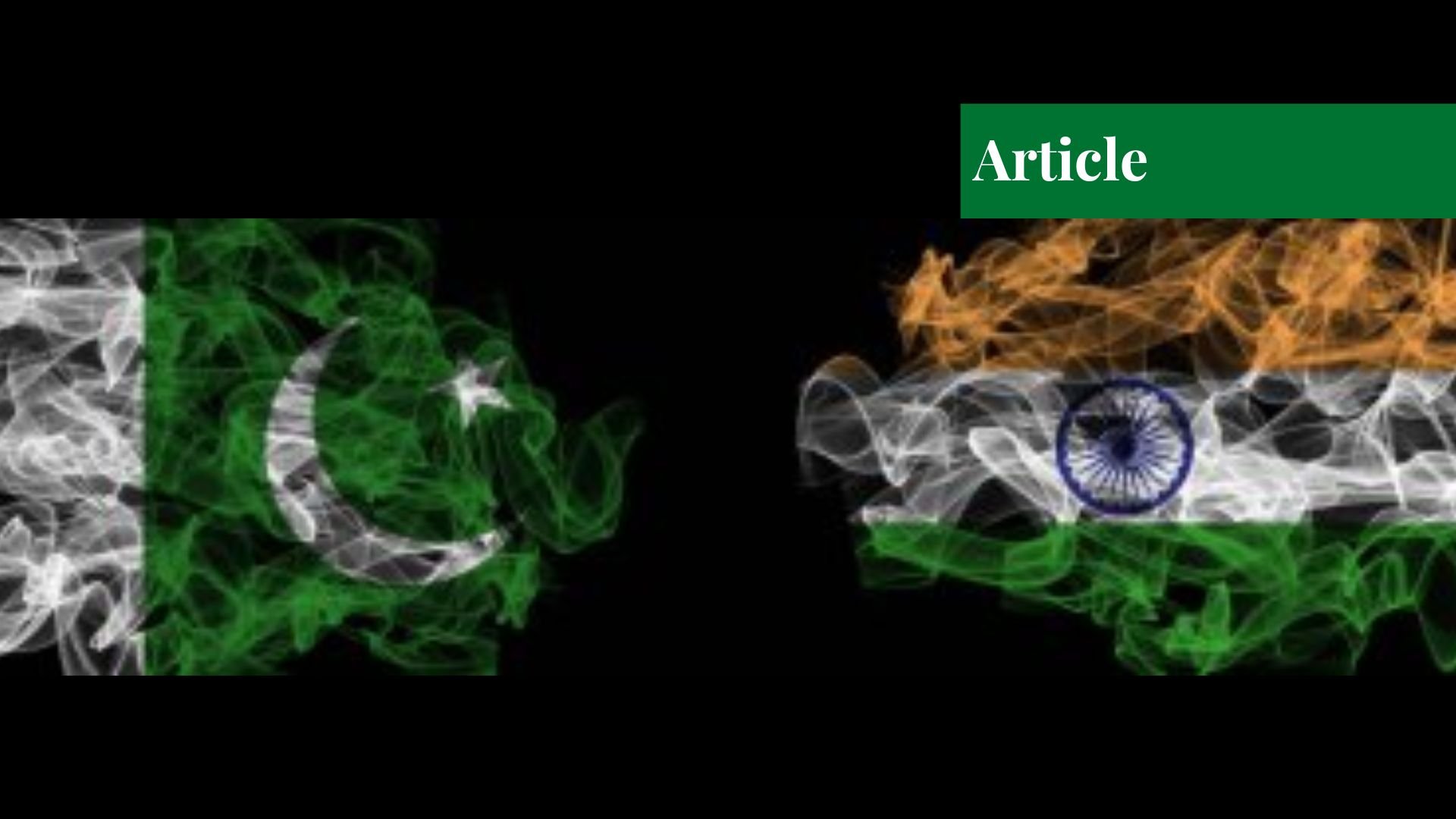

The more than 7-decade-old conflict between India and Pakistan can be understood differently with the help of various IR theories, such as realism or constructivism. The realist paradigm views it in terms of power politics, national interest, military security, and survival. For India, it is a matter of power politics; for Pakistan, it is a case of survival against a five times larger enemy. For India, it is a matter of getting itself recognized as a regional hegemon, but for Pakistan, it is a matter of protecting its sovereignty against frequent Indian aggression.
This perspective of the realist paradigm has guided leaders on both sides. Since their simultaneous birth in August 1947, their internal and external policies have been made in terms of strengthening themselves against each other in line with the realist model of statecraft. In their formative years, Pakistan’s search for allies and India’s showcase policy of non-alignment are a case in point. Even to this day, both states remain entangled in an unannounced but evident alliance system, one that China and the United States formulated. Hence, both countries’ foreign policies align with the realist paradigm. Through the realist view, we see a cycle of war and peace periods since 1947. However, the realist paradigm doesn’t provide any solution to their conflict. Rather, it maintains a status quo between them.
Apart from this, let’s try to understand how constructivism explains the India-Pakistan conflict.
Alexander Wendt, the pioneer of constructivism, challenged the very notions and concepts of the realist model of state behaviour. He criticized the very concept of anarchy. He does not see any actual existence of anarchy in inter-state relationships. Rather, ‘it is what states make of it’. He implies that it is the actions, policies, and establishment of such institutions by the states that hinder the execution and implementation of the norms, laws, and rules in their relationship, which creates a situation akin to anarchy.
If we apply this concept to Pakistan, we can observe that India’s actions in Kashmir, say, for example, the revocation of Articles 370 and 35A from its constitution, created an anarchic situation between the two neighbouring states. Similarly, recently, the Indian unilateral action to suspend the Indus Water Treaty in the wake of the Pahalgam terrorist incident made Pakistan unsure in terms of its water security. Because Pakistan perceived these actions of India as unilateral and provocative actions meant to undermine International law and the given solution of the UN to the Kashmir dispute. As a result, Pakistan felt insecure vis-à-vis Indian actions.
The second notion of constructivism is that it is shared history, shared experiences, and shared identities that make states look at each other as they see. Unlike realists, who reduce politics to fixed notions and unchangeable perceptions and try to follow an ahistorical approach to understand the behaviour of a state, Constructivists argue that politics cannot be separated from history, social interactions, and shared identities of the actors involved. This perspective of the Constructivists very aptly explains how Indian and Pakistani politics have been influenced by both nations’ shared history, shared society, and shared identities.
Before 712 AD, the ancestors of most of today’s Indians and Pakistanis were one nation. Until the Muslims were rulers of the Subcontinent, the Indian society was inclusive and considered one nation. In 1904, Allama Iqbal wrote, “sare Jahan se acha Hindustan hamara, hum han bulbulen iski ye gulastan hamara” (Better than the whole world is our India, we are its nightingales, and it is our garden). Even Quaid-e-Azam Muhammad Ali Jinnah advocated unity between Muslims and non-Muslims.
Until the Khilafat Movement, Indian politics was non-communal and secular, but when Gandhi mixed religion with politics and led the potentially destructive non-cooperation movement against the British Raj, Indian politics became increasingly communal. That was why, from 1920 onward, we find Indians’ political and social identities separating along religious lines. A sense of protecting separate identities based on religion rampantly grew in the society and political realms of Indians in the face of the evolving British parliamentary political system, characterized by the rule of the majority. Furthermore, the lack of genuine assurances and guarantees to constitutionally protect the legitimate rights of the Muslims from the majority (Hindus) compelled Muslims to organize themselves under completely separate identities, largely to gain political legitimacy and a role in the British Indian political system. From 1937 to 1947, Indians (Hindus and Muslims) expressed an excessive and bitter sense of separateness, which altogether erased their sense of shared history, shared values, and shared identities founded on norms of love, fraternity, and egalitarianism.
Later, the halfhearted approach of Indian leadership to accept the division of British India and the birth of Pakistan cemented the sense of separate identities of both nations. The post-independence large-scale communal violence committed on both sides of the newly drawn border made both nations stick to their view of distinctiveness in history, identities, and values. And that’s what, to this day, they have been doing.
Now, whether a Constructivist model provides a solution to the India-Pakistan lifelong problem or not. The answer is yes. Constructivists believe that by changing the process of socialization and reconceptualization of identities, states can change the images of each other. For instance, for centuries, European nations had remained enemies, but after World War II (1939-45), they integrated and underwent a process of socialization and reconceptualization of their identities, ultimately becoming friends. Now, they are economically, politically, and regionally integrated through new norms, values, regimes, and institutions. It implies that if people-to-people communications, trade, business, and interactions are allowed and enhanced between the two countries, they can develop shared identities once again.
SAARC is the best platform to reinvigorate for this purpose. It is rather the people of both nations who need to engage their politicians to follow policies in the best interest of the whole nation, not of the few, as is being done in India. The Indian nation should speak in favour of human values. They must ask their leadership not to tamper with the water resources of Pakistanis, as this directly impacts humanity. They must unequivocally speak in favour of the impartial resolution of the Kashmir dispute, especially the UN-brokered solution. Finally, on terrorism, they must think out of the BJP’s box and understand that no country supports this menace in the world. Pakistan itself is a victim of this monster.
To conclude, the India and Pakistan conflict is a construct of the divergence from their shared history and shared identities that their ancestors had constructed during the Muslim period (712- 1857 AD). The British parliamentary majority rule-based system was, no doubt, alien to Indians (both Muslims and Hindus), but it suited the Hindu majority. In their effort to rule with an absolute majority, they alienated the Muslims, who became compelled to reorient themselves with a distinctive Muslim identity, which paved the way for Jinnah’s demand for a separate homeland in the Lahore Resolution (1940).
If you want to submit your articles and/or research papers, please visit the Submissions page.
To stay updated with the latest jobs, CSS news, internships, scholarships, and current affairs articles, join our Community Forum!
The views and opinions expressed in this article/paper are the author’s own and do not necessarily reflect the editorial position of Paradigm Shift.

Ashique Hussain Abbasi has an Mphil in IR. He is from Ghotki, Sindh and is currently a teacher.