
Plato’s articulation of democracy was not merely a critique; it was a forewarning, but that’s an argument for another time. Emerged as the brainchild of the post-Cold War era, democracy has evolved, fragmented, and diluted itself to serve the global anarchic courtyard. While the distinction between autocracy and democracy remains ostensibly clear, what spirals modern-day politics is when the two converge, thereby giving birth to a democratic facade under the shadow of autocracy. Electoral authoritarianism is one of the many products of this hybridization.
Cognizing Electoral Authoritarianism
Schedler elucidates electoral authoritarianism as a regime that upholds autocratic ideals behind the institutional facades of representative democracy. In contrast to a conventional nondemocratic rule, this political system encourages elections at home and utilizes them as a blueprint to legitimize the extension of incumbency.
The precise modus operandi of electoral authoritarianism is environmental control and manipulation, in a political sense. Repression of dissent, censorship of media, electoral fraud, and voter intimidation are a few of the many tactics employed by regimes to keep oppositional competition at bay. However, one must not conflate electoral authoritarianism with illiberal democracy, as the former manifests solely through hardcore electoral measures. In the absence of civil rights, a political structure of this nature sustains an inescapable political paradox.
Catering to the illusion of multiparty democracy, these hybrid regimes entrench inequality, institutionalize violence, centralize power, and perpetuate widespread uncertainty. Notwithstanding mounting evidence of its blowbacks, the entrenchment of authoritarian power ultimately generates conditions conducive to resistance and political upheaval. Contemporarily, Bangladesh under Sheikh Hasina stands as a striking victim of electoral authoritarianism, the very system that was rigid but never immortal.
Sheikh Hasina’s Autocratic Weight
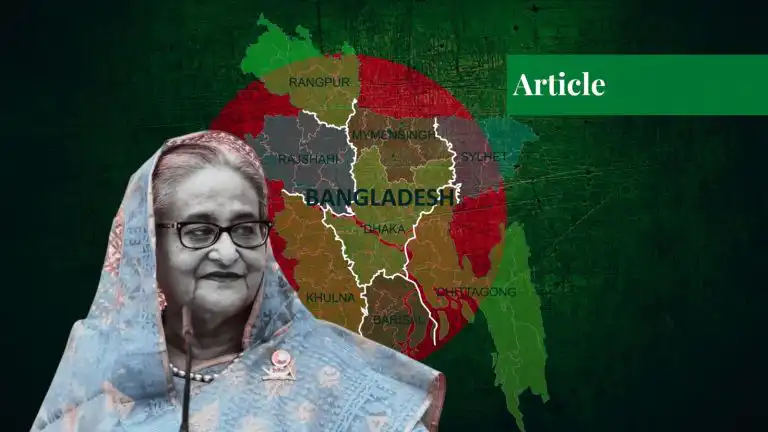
Once a pro-democracy leader, Sheikh Hasina, the daughter of Sheikh Mujibur Rehman, is currently in a self-imposed exile in India. Sheikh Hasina’s 15-year rule reconfigured Bangladesh both economically and autocratically. Her presidency witnessed a remarkable economic boom, with plummeting poverty levels and an augmented employment rate. At the same time, despite the glossy narrative of her “economic miracle,” the former secular heroine wrecked Bangladesh’s political landscape through corruption, nepotism, torture, enforced disappearances, and structural tampering.
As a result, a student-led resistance campaign began against her rule in July 2024, culminating in her deposition. The uprising escalated, causing a widespread telecommunication blackout, which ultimately prompted Hasina to signal a ruthless crackdown against the protestors. The UN documented a death toll of 1,400 civilians as a result of a state mandate that pushed for the use of lethal weapons. This “July revolution” marked the deadliest violence experienced by Bangladesh since its war of independence. Following the upheaval, Hasina was forced to flee and seek refuge.
in the neighboring state. While in absentia, a tribunal court in Dhaka found her guilty of crimes against humanity, sentencing her to capital punishment. Hasina, however, had an entirely different script; she pleaded not guilty, claiming the verdict was “politically charged.” What remains ironic is that the International Crimes Tribunal (the court that convicted her) was initially established by Hasina herself in 2010. While its founding purpose was to investigate the atrocities committed during the 1971 war of independence, it had been instrumentalized by Hasina for her political advantage.
Electoral Manipulation and Power Consolidation
In Bangladesh, challenges to electoral integrity have become the norm since 2014. The decline and deterioration of electoral integrity have been a product of unfairness, fraud, intimidation, and violence. In 2024, the incumbent won her fourth consecutive term, gaining 222 of the 300 contested seats in parliament. Sheikh Hasina leveraged administrative and electoral manipulation to achieve a de facto one-party rule in Bangladesh. This not only fortified her political ascendancy but also remained effective in sidelining the oppositional parties, such as the Bangladesh Nationalist Party (BNP).
Even so, despite the electoral success, her tenure has been marred by accusations regarding the enactment of repressive measures against her political rivals. Taking into account the 2014, 2018, and 2024 elections, we can observe pervasive anomalies. For instance, the 2014 elections recorded a low voter turnout due to voter suppression and opposition boycotts. This resulted in an uncontested win for the Awami League, allowing them to stay in power for the approaching five years.
The 2018 election, on the other hand, was widely castigated as a “mockery of democracy” based on the allegations that the ruling party was actively involved in the manipulation of results by smuggling in pre-filled ballots the night before the voting day. The Bangladesh Nationalist Party (BNP) also claimed that the ruling party operatives attacked parliamentary candidates and employed intimidatory tools to hinder effective political campaigning.
What do these examples illustrate? The inherent fragility of Bangladesh’s electoral processes and how it is beset by the rising systemic deficiencies. While there have been repeated calls for electoral reforms in the past to make the process more competitive and independent, meaningful action has been scant. The same troubling pattern resurfaced in the 2024 elections, which many decried as a sham that betrayed the state’s democratic ideals despite the claims of plurality. Fraud, intimidation, oppositional persecution, and false incarcerations of key political figures compelled the Bangladesh Nationalist Party (BNP) and other political parties to revolt.
Bangladesh’s reality encapsulates a remarkable turnout for a political figure who once advocated for multi-party democracy. Through the use of political patronage, state resources, and by controlling security forces, Hasina effectively secured her party’s hard grip over the country, enacting a rule based on terror. Additionally, despite the existence of an electoral management body, its independence and its integrity have been repeatedly questioned.
The International Institute for Democracy and Electoral Assistance’s (IDEA) published data on the Global State of Democracy (GSoD) ranks Bangladesh among the lowest quartile globally in three core areas: Representation, Rights, and Rule of Law. This unveils the veracity and raises concerns regarding judicial independence and its continued weaponization by political parties. This further elucidates that unless Bangladesh addresses its embedded electoral deficits, a protracted political stalemate such as this is likely to harm Bangladesh’s democratic values in unforeseeable ways.
Extrajudicial Killings, Enforced Disappearances & Restricted Expression of Media
Despite domestic and international condemnation, Bangladesh has consistently followed its syllabus of detention, extrajudicial killings, and abduction between 2009 and 2024. Most were ascribed to law enforcement agencies for both political gains and to keep political competition at bay. While Hasina has repeatedly denied these facts, reports reveal that there have been 1,772 cases of enforced disappearances since her ascent to power in 2009.
The security forces had been operating under tacit state sanction, targeting activists, journalists, and opposition parties. The mounting evidence raised global concerns over human rights violations, prompting the Biden administration to sanction Bangladesh’s paramilitary forces—Rapid Action Battalion—in 2021. Concurrently, Bangladesh’s military intelligence agency, the Directorate General of Force (DGFI), was linked to roughly 800 secret prisons, which they referred to as “Aynaghar” or “House of Mirrors.” Herein, they engaged in torturing, imprisoning, and exterminating political opponents, with their bodies allegedly discarded into rivers in cement bags, leaving no trace.
It should be noted that these violations were not only to thwart electoral competition but also to obstruct any critique of the government—a classic Big Brother move. Consequently, any arbitrary reports by human rights activists in respect to state-sponsored abuse and unnecessary use of force were met with their detainment and enforced disappearances. The Bangladesh Nationalist Party (BNP) witnessed persecution of around 2.5 million of its party members, orchestrated by the Awami League.
Other than this, the media industry has been operating under a pervasive fear of illegitimate legal action, job loss, and physical abuse at the hands of the ruling party. This fear has compelled most veteran journalists to practice self-censorship, withdrawing fully from public commentaries for their own safety. The operating media outlets were controlled by the Awami League-affiliated businesses, which, in turn, controlled the narrative. This entrenched impunity eventually resulted in Bangladesh being ranked as 165th out of 180 countries in the 2024 Press Freedom Index.
The systematic restrictions under the Awami League include partisan editorial policies, job dismissal, surveillance, physical attacks, and censorship. Amidst this, the Digital Security Act (DSA) operated as the primary mechanism for legal intimidation, stifling independent and investigative journalism, and enabling intelligence-controlled narratives to thrive. The reports illustrate that Bangladesh had been surviving under a culture of fear where concerns over personal safety remained paramount. Bangladesh’s political pattern mirrors a polarized-pluralist model in which media operations are closely intertwined with economic interests and power consolidation at large.
What Lies Ahead?
Spending her current days in exile, whether Hasina will be extradited anytime soon still remains unclear. At the same time, her exile has produced a power vacuum in Bangladesh—meaning that it requires the world’s attention now more than ever. Her dark legacy has dismantled democratic institutions and has weaponized them against dissent and in eliminating meaningful political competition. While her downfall has signaled a rupture in Bangladesh’s authoritarian trajectory, it has arrived only after an effective final blow to democracy.
There undoubtedly exists a need for electoral reforms to lift Bangladesh from the rubble; the success of these reforms hinges upon the political parties and their intention. The long-established political parties must overcome their differences by embracing dialogue, inculcating transparency, and working collectively to fix the persistent flaws of the electoral system. Through legal reforms, collective action, and political consensus, Bangladesh is likely to revive its democratic sphere. The restoration of justice and the reincarnation of democracy now reside in the hands of its people.
If you want to submit your articles and/or research papers, please visit the Submissions page.
To stay updated with the latest jobs, CSS news, internships, scholarships, and current affairs articles, join our Community Forum!
The views and opinions expressed in this article/paper are the author’s own and do not necessarily reflect the editorial position of Paradigm Shift.

Mehvish Arif is a writer and a recent graduate from SZABIST, Pakistan, with a degree in international relations. She has experience in policy-oriented writing, content development, digital PR, and strategic research. Her work critically explores how geopolitical narratives, information flows, and power structures shape global security outcomes.