
The Exclusion of Ethnic Nationalism
We’ve all heard it. Someone says, “This is our land,” or “Our people first.” And for a moment, it might even sound reasonable. But sit with it for a while, and you start to feel the weight of what’s really being said. It’s not about love for the land. It’s about shutting others out.
Ethnic nationalism is not new. It has always existed in some form or another. The idea that a nation must be defined by a single ethnicity, bloodline, or tribe seems comforting to some. It gives people a sense of belonging, a pride in their roots. But more often than not, it turns sour. Because the moment you define a country by one kind of person, you automatically begin excluding everyone else. And that never ends well.
When I wrote about this topic a few years ago, I was reacting. There was anger, urgency, and maybe even some immaturity. But now, I come back to this subject with a quieter mind and stronger belief. Ethnic nationalism is not just flawed. It is a slow, silent poison.
Take a look around. Look at Germany under the Nazis. Ethnic pride turned into mass murder. Jews weren’t killed because they did something wrong. They were killed because they were born different. All of it started with the idea that one race, one people, was superior.
Even in our own region, we have examples that don’t make headlines but still shape lives. I remember talking to a young student from South Punjab who told me he felt like a stranger in his own country. He didn’t speak Urdu like the television anchors. He spoke Seraiki. He wasn’t angry. He was just tired of being mocked, ignored, and treated like he belonged to a lesser version of Pakistan. And he’s not the only one.
Ethnic nationalism tells people like him that they are lucky to even be included. It makes them feel like outsiders, as if they’re tagging along on someone else’s national journey. But the truth is, they are Pakistan. Just like the Baloch student in Quetta, the Sindhi teacher in Khairpur, the Pashtun shopkeeper in Charsadda, and the Hazara poet in Karachi. None of them loves this land any less.
The answer isn’t to erase differences. It’s to respect them. Every group, every language, and every history within this country deserves to be heard. Not out of charity, but out of justice. When someone says, “We feel left out,” our first instinct should be to listen. Not argue, not deflect, just listen.
Civic Nationalism as a Solution
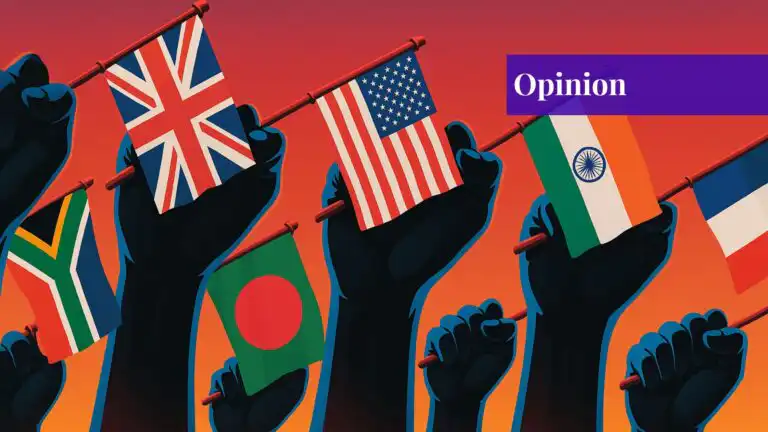
Civic nationalism offers a way out. It tells us that what binds us together is not race, not tribe, not language, but an idea, a shared purpose, and a mutual promise that we rise or fall together. It tells us that freedom, equality, and dignity belong to all, not just to a few who tick the right boxes. This idea is not new. The American and French revolutions were rooted in it. The word “nation” started to mean something more than ethnicity. It began to mean people who believed in the same cause. It meant a collective future built by choice, not blood.
Of course, that’s easier said than done. In places like Pakistan, where identity is layered and complex, people often fall back on what’s familiar, and what’s familiar is often ethnicity. But we have to be careful; ethnic pride is not always the problem. It becomes a problem when it turns into ethnic arrogance. When it tells others they’re less.
Even science won’t support ethnic nationalism anymore. DNA tests today show how mixed we really are. A man who proudly calls himself a pure Turk might discover that half his ancestors were from Greece. A Punjabi might have Baloch genes. A Kashmiri might be part Central Asian, part Indian. We are not as separate as we think. We don’t need to forget where we come from, but we do need to remember where we are going. And we’re going nowhere if we don’t go together. Any country that wants to move forward must make space for all its people, not just on paper, but in schools, in jobs, in stories, and in leadership.
The future doesn’t belong to the loudest tribe. It belongs to the people who build bridges. The ones who sit down and ask, “How do we make this fair for everyone?” It belongs to those who don’t claim superiority but seek solidarity.
I don’t write this as an expert. I write this as someone who wants to live in a place where no one has to prove they belong, where you don’t have to speak a certain way, look a certain way, or come from a certain place to be treated with equal respect. Maybe it’s idealistic but it’s better than staying silent while the old curses repeat.
If you want to submit your articles and/or research papers, please visit the Submissions page.
To stay updated with the latest jobs, CSS news, internships, scholarships, and current affairs articles, join our Community Forum!
The views and opinions expressed in this article/paper are the author’s own and do not necessarily reflect the editorial position of Paradigm Shift.
Mohammad Zain is an International Relations student at NUML, Islamabad. With an associate degree in English Literature and Linguistics and a BS in International Relations, he brings a unique blend of analytical and literary skills to his writing.