
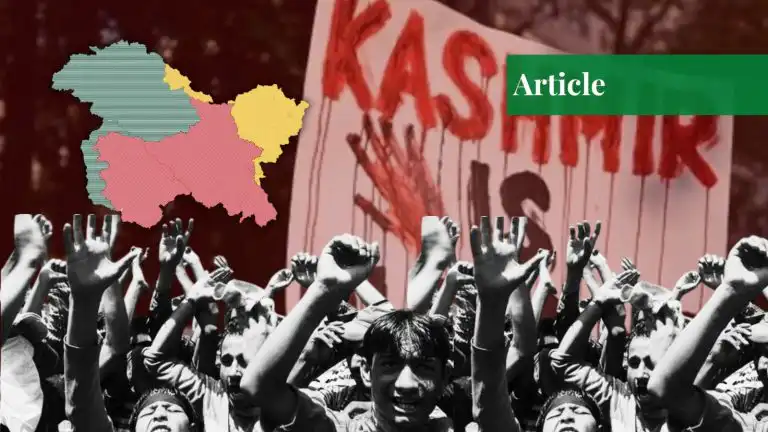
On September 29, an announcement came from Indian forces about a recent operation in Kashmir that leaves a dangerous yet old question. The question arises: “What is the effect of emerging contested security narratives at a time when the domestic political pressure in the country is intensifying?” Indian security forces pointed out a man they claimed was a Lashkar-e-Taiba militant as well as a former Pakistani soldier. However, Director General ISPR rejected the claims and just two days later presented former SSG Havaldar Muhammad Asif before the media in a press conference. Indian media continued to reject Pakistan’s stance and kept on claiming that the man killed was Muhammad Asif alias Hashim Musa.
The scenario created here requires proper attention because it depicts how a political narrative can be constructed due to a security claim. For a nuclearized region like South Asia, the process becomes highly dangerous.
Politics of Attention and Intensifying Domestic Pressure:
Currently, the situation in India is marching towards instability due to political controversy over the election commissions and voter-list revisions. The electoral authorities have been accused by the opposition parties of tampering with voter rolls; however, the BJP and the Election Commission have rejected the allegations. Nationwide protests have followed, in which the use of severe force in the form of water cannons and tear gas by police authorities on the demonstrators has been observed. Moreover, threatening nationwide mobilisation by the youth-led Cockroach Janta Party has intensified the political pressure even more.
The fact is that there is no obvious evidence that the Kashmir episode is created to divert public attention from ongoing civil unrest. However, the timing of the event raises a valid strategic question: “Can political attention be redirected towards national security due to an external security threat?”
We can track the importance of this question from historical aspects. The most recent example in this case is the India-Pakistan crisis of 2025 after the Pahalgam attacks, which demonstrates how a military escalation can be developed through disputed attributions. On May 7, strikes were launched by India on Pakistan that escalated into intense fighting for four days between two nuclear-armed states. The Stimson Center reported that extensive disinformation and misinformation tactics were used during the crisis, while the analysis regarding the escalation danger under the nuclear shadow was carried out by Carnegie’s. These facts do not claim that every crisis is manufactured or that security claims are often false. The point that should be understood here is that when a national security narrative is embedded by an allegation, it heightens the military and political pressure to such an extent that it moves faster than independent verification.
Narratives as Triggers:
The information space is the area in which modern conflict usually begins. Within a few minutes, an alleged personality, photograph, or even a military statement can spread across social media. Thus, in a short span of time, the allegation appears as an established fact due to repetition by political actors as well as television channels. The process happens so quickly that the independent verification process hardly catches up to it. Stakes are clearly demonstrated by the Asif case. The alleged militant was identified as a former Pakistani serviceman by Indian authorities. A man bearing the same identity was presented by Pakistan in a press conference, publicly, in which the man claimed that he was still alive and had retired from the military in 2023. Despite the competing claims and their eventual resolutions, the episode depicts why a military or political conclusion should be preceded by identity verification.
“In South Asia’s case, it is a crisis stability problem rather than a media problem”.
In the case of India and Pakistan, it is quite hard to maintain a political environment where retaliation can be triggered by unverified claims. Both states have large conventional forces and possess nuclear weapons, and most importantly, they have shown in the past how, within days, a military action gets escalated due to political confrontations. So it can be said that danger is not related to just a false statement, but it is connected to the further consequences erupting from these statements, including political pressure, public anger, media amplification, allegations, military response, and counter-response. The cycle has compressed significantly over the years, so it can be anticipated that future crises can move even faster.
Beyond the False-Flag Debate: A Dangerous Pattern Must Be Challenged
For South Asia, the emerging threat narratives due to politically driven agendas and whether adequate safeguards are developed by the authorities are more concerning than identifying certain incidents as false flags. When serious cross-border accusations are made, it is the duty of a government to ensure that verifiable evidence is provided. Facts that are established independently should be properly distinguished from official claims by journalists. Further, proper communication channels are required, especially during a crisis period, so that a diplomatic way can be agreed upon before public pressure urges leaders to go for confrontation. Here, the role of the international community is also very important. Rather than agreeing upon immediate competing national narratives, evidence-based investigations should be highly encouraged by the external actors.
As for the current incident, it shouldn’t be treated as another chapter in the India-Pakistan dispute. It should be considered as a warning regarding the politics of crisis. An external security threat can’t be explained by domestic unrest, but we can’t dismiss the possibility of strategic distraction without examining it. The 2025 crisis showed us how a military action can get hardened by contested narratives. So as far as 2026 goes for South Asia, another test arises: “whether crisis politics can be prevailed over by crisis management and whether we can move facts faster than propaganda”. It should be considered as a matter of regional security rather than just treated as an academic question.
If you want to submit your articles and/or research papers, please visit the Submissions page.
To stay updated with the latest jobs, CSS news, internships, scholarships, and current affairs articles, join our Community Forum!
Find our FREE quizzes and MCQs here!
The views and opinions expressed in this article/paper are the author’s own and do not necessarily reflect the editorial position of Paradigm Shift.

Syed Hamza Mahroof is an international relations graduate from the University of Azad Jammu and Kashmir, Muzaffarabad. He is a research intern at the Centre for International Strategic Studies (AJK). He has practical experience in research encompassing the evolving geo-economic and political dynamics of South Asia, with a particular emphasis on climate resilience and climate change.