
Defining Quantum Capabilities
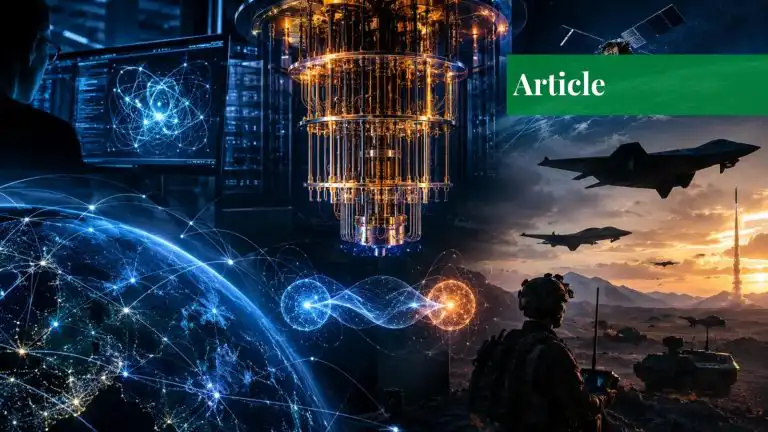
Quantum warfare is an easy phrase to overstate. Much defence research focuses on improving capabilities militaries already use, from sensing and navigation to computation and secure communication. The technologies draw on effects such as superposition, entanglement and quantum measurement. A 2021 review by Michal Krelina argues that these tools are more likely to strengthen existing warfare domains than create a separate one.
SIPRI’s 2025 primer reaches a similar conclusion. The main areas are computing; communications and cryptography; and sensing and metrology, with quantum imaging as a related field. Their value depends on the task. Better sensors can improve measurement, quantum computers may solve particular problems more efficiently, and quantum communication techniques can support the secure distribution of cryptographic keys.
Resilient Navigation and Sensing
Quantum sensors use atomic transitions and interference to measure acceleration, rotation, gravity, magnetic fields and time. Under some conditions, they can reach a precision conventional instruments struggle to match. Bongs and colleagues’ 2019 review surveys the field, while a Chinese research submersible demonstrated one application at depth in 2025 using a diamond nitrogen-vacancy magnetometer. Systems like these may eventually help with inertial navigation, gravity mapping and the detection of magnetic signatures. The challenge is taking reliable laboratory measurements and getting the same performance from equipment operating on a moving platform in difficult conditions.
The Post-Quantum Security Threat
Quantum computing raises a different security question: what happens to today’s encryption if a sufficiently powerful machine becomes practical? Shor’s algorithm can factor integers and solve discrete logarithms efficiently in theory, putting RSA and elliptic-curve encryption at risk. Grover’s algorithm offers a quadratic speed-up for brute-force search; under an idealised model, that roughly halves the effective security of symmetric keys. Quantum key distribution (QKD) approaches key exchange from another direction.
Measuring a quantum state can disturb it, a principle set out in Bennett and Brassard’s 1984 protocol. QKD can distribute cryptographic keys, but it does not by itself authenticate the parties or protect an entire communications system. The NSA explains this limitation and does not recommend QKD for national security systems in its current form. Post-quantum cryptography takes a more conventional route, using established computers and mathematical methods designed to resist quantum attacks.
Military adoption remains uneven. The most concrete progress so far lies in sensing trials and preparations for post-quantum cryptography; operational quantum computing is further away. The UK carried out a quantum navigation trial in 2024, and Australia tested quantum clocks under AUKUS in 2025. In 2026, the US Army Research Laboratory demonstrated a Rydberg quantum sensor able to detect radio-frequency signals and determine their direction in three dimensions.
The Army presented it as a possible aid to spectrum awareness and electronic warfare; it has not announced a fielded system. Meanwhile, NIST finalised its first post-quantum cryptography standards in August 2024, and the NSA set future quantum-resistant requirements for national security systems under CNSA 2.0. These steps are important precisely because governments can take them before a large, fault-tolerant quantum computer exists.
Published in January 2024, NATO’s first Quantum Strategy treats quantum technology as a set of capabilities that cut across sensing, positioning, communications, computing and cyber defence. Its emphasis is on coordination and preparedness. Other governments are building programmes around much the same range of needs. The US is backing sensing, navigation, radio-frequency detection and the move to quantum-resistant encryption through DARPA, the Army and national laboratories.
Australia has folded quantum positioning, navigation and timing research into AUKUS. The EU is funding defence applications through its European Defence Fund. China has invested in satellite-based quantum communications and reported a carrier-grade network extending more than 10,000 kilometres in 2025, described in a study in npj Quantum Information. The competition is taking shape across the systems that military forces depend on: accurate sensing, dependable timing, computing capacity and secure information.
Quantum radar is a useful test of how far the field still has to go. There is sound research behind quantum illumination, described in work by Tan and colleagues in 2008. Turning that insight into a long-range military radar is a much harder task. Krelina places quantum radar at the laboratory or proof-of-concept stage, with photon generation, microwave quantum hardware, and system size among the obstacles.
A 2024 review by Karsa and colleagues also separates credible physics from some of the ambitions attached to it. Submarine detection raises a similar prospect. NATO lists improved submarine detection as a potential application, and quantum magnetometers, gravimeters and navigation systems could eventually affect the balance between concealment and detection. For now, reliable operational ranges and false-alarm rates for detecting strategic submarines with these methods remain unproven. A laboratory magnetometer is still a long way from giving a navy a dependable track on a moving submarine in real conditions.
Gray-Zone Electronic Interference
Along NATO’s eastern flank, electronic interference is already an operational problem. Since Russia’s full-scale invasion of Ukraine in February 2022, European authorities have reported cyberattacks, sabotage, airspace violations and other activity often described as hybrid. Attribution varies from incident to incident. Germany attributed an August 2026 drone incident at Leipzig airport to Russia in an EU statement on the incident.
Several Baltic incidents had a different explanation: Estonian, Lithuanian and Latvian authorities attributed some incursions to Ukrainian military drones diverted by Russian electronic warfare, rather than deliberate Russian flights, according to this report on the incidents. Europe faces a broader pattern of hostile activity, while the evidence for individual episodes still needs to be assessed on its own merits.
European leaders are also debating how to respond to incidents that fall below the threshold of an open attack. On 17 September 2026, Polish Prime Minister Donald Tusk told parliament that Russia could try to present drone or missile strikes against NATO’s eastern flank as accidents, weakening support for a collective response. He described this as an intelligence assessment informed by NATO, Ukrainian and US services, rather than an established fact; see reports on Tusk’s remarks. A day earlier, European Commission President Ursula von der Leyen had proposed what she called Europe’s own Article 4: an Emergency Security Protocol through which a member state could trigger a coordinated response to an incident below the threshold of armed aggression. The proposal is discussed in this report on the EU security plan.
The GNSS disruptions around the Baltic bring the quantum sensing debate into sharper focus. In July 2025, the EU sanctioned Russia’s 841st Separate Electronic Warfare Center in Kaliningrad and linked disruption affecting several European countries, particularly the Baltic states and civil aviation, to electronic warfare activity in the region. The EU outlined related measures in its statement on Russian hybrid threats.
A 2026 study in GPS Solutions used a four-node time-difference-of-arrival system to locate a suspected spoofer and a separate jammer near Kaliningrad, documenting interference in the Gulf of Gdańsk. These incidents show how navigation can be disrupted by false or degraded signals even when the satellite system itself is functioning. They also help explain the interest in sensors and timing systems that can continue working when GNSS becomes unreliable.
The reported effects extend from shipping to civil aviation. A shipborne measurement campaign by GPSPATRON and Gdynia Maritime University found that GNSS availability fell to around 83 per cent during the worst weeks of the 2025 campaign, with interference worsening as vessels approached Kaliningrad’s maritime border. Regional monitoring recorded 30 jamming and spoofing incidents from Bornholm in 2026, compared with 16 in 2025 and 11 in 2024, according to reporting on the monitoring data.
On 29 July 2026, the cargo vessel Saturn reportedly lost reliable GNSS positioning for about a day; its display placed the ship inside Kaliningrad even though it was sailing north of Gdańsk. Estonia reported signal interruptions affecting 85 per cent of flights, while Lithuania recorded a 22-fold annual increase in jamming incidents, according to this report on Baltic airspace interference. Monitoring methods and attribution differ, so individual figures warrant care. The wider pattern is plain: satellite-dependent systems can be disrupted at sea and in the air without any physical attack on the platforms using them.
This has given new urgency to resilient positioning, navigation and timing (PNT) programmes. The systems under development still face substantial constraints. Krelina warns that a complete quantum inertial navigation system remains difficult to build for highly mobile platforms. Quantum navigation will not automatically make GPS redundant; an external reference is generally needed to establish an initial position.
Australia’s Defence Science and Technology Group describes its quantum-assured PNT architecture as a combination of quantum and conventional sensors. DARPA’s ROCkN programme is developing optical clocks designed to maintain GPS-level timing for weeks or months without satellite contact. Both programmes aim to keep navigation and timing usable during jamming and spoofing. The need is already clear from the Baltic interference. Whether quantum devices can meet it at operational scale remains an engineering question.
Post-quantum cryptography addresses a different time horizon. A sufficiently capable quantum computer could eventually decrypt some information protected by today’s public-key systems. Intelligence agencies may therefore collect encrypted material now and store it for later, a scenario known as “harvest now, decrypt later”. Sensitive information can remain valuable long after it has been intercepted, which is why governments are preparing for the risk before the necessary computer exists.
Recent attacks on infrastructure illustrate the wider threat environment, although they offer no evidence that encrypted communications are being collected for future decryption. CERT Polska reported a destructive cyberattack on 29 December 2025 that hit more than 30 wind and photovoltaic farms, a manufacturing company and a major combined heat and power plant. The agency linked the activity to a threat cluster associated with Russia’s FSB, while other reporting on the attribution noted that ESET and Dragos assessed, with moderate confidence, that a different Russia-aligned group was responsible. Norway separately attributed an April 2025 cyberattack on a fish-farming dam to Russian actors, an allegation Russia denies; see The Guardian’s report. The reports document attacks on critical infrastructure. Whether European government communications are also being collected for future decryption remains a separate, unproven question.
Operational Limits and Future Outlook
The Baltic cases give the quantum race a more practical shape. Governments are trying to keep navigation, communication and sensing reliable under pressure. GNSS interference has increased demand for dependable timing and navigation; the prospect of future decryption is pushing states towards post-quantum cryptography before a capable quantum computer exists; persistent interference makes spectrum awareness more valuable.
Every proposed solution still faces the engineering limits Krelina identifies: size, weight, power and integration, as discussed in his review of military quantum technologies. Through 2026, European leaders have debated whether to call the confrontation a hybrid war, a grey-zone campaign or hostile action below Article 5’s threshold. Whatever language officials choose, signals over the Baltic will continue to be jammed.
The practical test is whether Europe can put resilient sensors, navigation systems and quantum-resistant encryption into service quickly enough to reduce its exposure. The advantage will go to those who turn laboratory advances into equipment that keeps working when signals disappear. For the cryptographic side of this effort, see NIST’s post-quantum standards.
If you want to submit your articles and/or research papers, please visit the Submissions page.
To stay updated with the latest jobs, CSS news, internships, scholarships, and current affairs articles, join our Community Forum!
Find our FREE quizzes and MCQs here!
The views and opinions expressed in this article/paper are the author’s own and do not necessarily reflect the editorial position of Paradigm Shift.

Mohammad Zain is an International Relations student at NUML, Islamabad. With an associate degree in English Literature and Linguistics and a BS in International Relations, he brings a unique blend of analytical and literary skills to his writing.