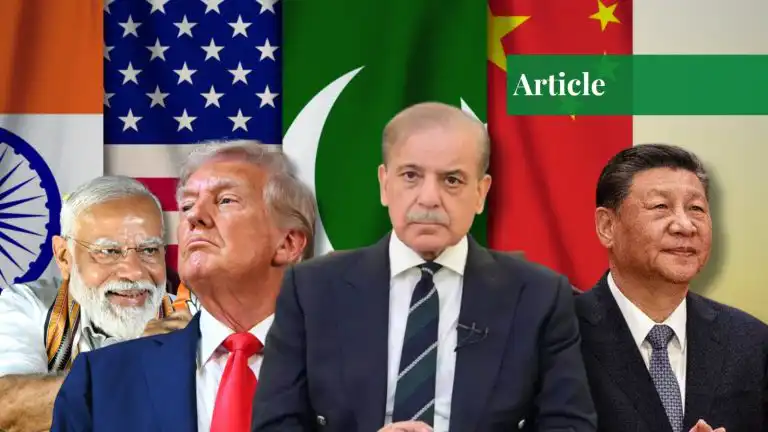

South Asia entered 2025 in the center of several issues, including geopolitical competition, economic instability, and a weakening of regionalism. All of this is happening in a fast-developing multipolar international system. The growing competition between the US and China, increasing multipolarity, and the developing organization of the Global South have changed the way middle powers think about their strategy in the region. In this regard, Pakistan is placed in a strategic location as a nuclear-powered state, a center of regional networking, and an increasingly active diplomatic balancer. As opposed to being strictly aligned to either of the two power blocs, Pakistan has been trying to maintain its strategic autonomy by diversifying partnerships and issue-oriented cooperation.
In 2025, Pakistan’s foreign policy decisions represented a strategic hedging strategy, informed by multipolar factors and having notable implications on the security environment of South Asia, regional cooperation, and emerging geopolitical alignments.
Global Context in 2025
By 2025, the international system is characterized by multipolarity, with the decentralization of material power, contested leadership, and great-power competition. The geopolitical rivalry between the US and China has intensified in the military, technological, and economic spheres, and Russia also continues to influence through asymmetric alliances and energy policy. At the same time, forums like BRICS are also becoming the primary mechanisms for coordination of the Global South, which expresses discontent with the West-dominated governance systems. Instead of extreme alignment, most middle and secondary powers are opting to employ flexible policies to maximize independence and reduce vulnerability. This changing geopolitical landscape presents both limitations and strategic prospects for regional entities, enhancing their flexibility and intensifying the necessity to reconcile competing security and economic demands.
Pakistan’s Foreign Policy Choices in 2025
Pakistan’s foreign policy in 2025 reflects a selective hedging strategy aimed at preserving strategic autonomy while securing external economic and security backing. Islamabad has been pursuing issue-based engagement instead of ideological alignment and alliance politics with various power centers.
Pakistan–China Relations
Pakistan-China economic and strategic relations, being the most important for Pakistan, continue to remain at the center of Pakistan’s foreign policy. The CPEC Action Plan 2025-2029 places major emphasis on industrial cooperation, export-oriented Special Economic Zones, agricultural technology upgrading, digital connectivity, and clean energy transition to bring forth the development of productive capacities. In September 2025, the modernization plan of CPEC in a new format of Sector Specific Corridors and Investment Regimes signaled an intention of Islamabad to integrate China’s investment in the country’s industrial policy. Increased emphasis on counterterrorism coordination and project security mechanisms was among the reasons to further securitize economic cooperation.
Pakistan–United States Relations in 2025
U.S.-Pakistan bilateral relations took a paradigm shift in 2025 and have entered what is referred to as a post-patronage maturity. This shift from the tradition of aid-dependency signaled the emergence of a new framework of engagement that is guided by a strategic geoeconomic investment-based approach. One of the foremost of this new epoch is the signing of a critical minerals agreement in September 2025 with U.S. Strategic Metals (USSM) worth 500 million dollars, which set up a general framework for the exploration and refining of selected rare earth elements, namely Neodymium and Praseodymium. This agreement, paired with a first-ever delivery of these minerals in October 2025 to the US, made Pakistan a preferred alternative supplier in both the high-tech supply chain and defense supply chain globally.
It is no longer based on aid cheques, but on market access, economically. In July 2025, the U.S. government lowered reciprocal duties on Pakistani products from 29 percent to 19 percent, which is much lower than some of the regional rivals. This trade facilitation enabled the imports of U.S. goods in Pakistan to reach 5.4 billion dollars in the year 2025.
In addition, the security pillar has evolved into an operational synergy that is focused. This is seen in the case of the joint operation between the CIA, FBI, and Pakistani intelligence that resulted in the arrest of Sharifullah, an ISIS-K mastermind and the organizer of the 2021 bombing of the Kabul airport. Through such security achievements and the establishment of collaboration with the Trade and Investment Framework Agreement (TIFA) and the Counterterrorism Dialogue, Islamabad leverages Washington as a balance mechanism. This policy will help Pakistan retain its sovereignty and access to Western financial institutions at the same time, without compromising its long-standing strategic alliances with China.
- Pakistan–Saudi Arabia Strategic Cooperation
The Strategic Mutual Defence Agreement in September 2025 transforms the relationship between Pakistan and Saudi Arabia to unprecedented heights, as it institutionalizes the assistance between the two and increases the military cooperation (AP News, 2025; Financial Times, 2025).
- Pakistan–Russia Relations
The involvement of Pakistan in Russia is more of a strategic hedge than a strategic realignment because it is based on energy cooperation and diplomatic coordination.
Collectively, these developments reflect a consistent hedging posture aimed at maximizing freedom, dealing with vulnerability, and maintaining flexibility in a competitive multipolar system.
Drivers Behind Pakistan’s Choices
The structural economic vulnerability, the endemic security threats, and the quest to achieve strategic autonomy determine the hedging strategy of Pakistan. Confrontational or ideologically oriented diplomacy is limited by chronic balance-of-payments strains, foreign debt, and dependence on foreign financing. Different partnerships, therefore, act as economic risk dispersion instruments (IPS, 2025). The internal security remains the central organizing principle of Pakistan’s diplomacy due to security issues, such as militant violence, the situation in Afghanistan, and the threats of hybrid attacks on CPEC (Khan, 2025). Locally, the growing strategic convergence between India and the United States is an incentive to Islamabad to maintain maneuverability by diversifying its relationships (ISSI, 2025). Hedging opposes necessity and sovereignty in a fluid multipolar environment.
Implications for South Asia
Hedging-based foreign policy of Pakistan has contributed to a South Asian regional order characterized by a strategic divergence, weak regionalism, and extra-regional penetration. Regional giants are incorporating themselves into clashing external affiliations. The process of convergence of India and the United States is different than the diversified interactions that Pakistan forms with China, the Gulf, and the West (Khan, 2025; Sidra Khan, 2025). This structural paralysis maintains SAARC stagnation and curtails the opportunities to engage in useful regional economic collaboration. The issue of extra-regional extensions of linkages in security terms heightens the threat of proxy competition and strategic distrust. The diversification of Pakistan economically can reduce its vulnerability; however, there is insufficient intra-regional trade, and as a result, growth remains external and not embedded in the region.
Way Forward
Pakistan should prioritize its hedging strategy into institutionalized economic diplomacy, prudent security interaction, and selective regional re-engagement. Functional regional linkages can be produced through issue-based cooperation on climate resilience, public health, and trade facilitation. There is a need to foster a framework of trust between India and Pakistan to decrease misperception and the escalation of the crisis. At the same time, Pakistan needs to strengthen productive-sector collaboration within the CPEC, expand market access to Western investments, and formalize investment systems with the Gulf states. It is also important to enhance the state capacity, regulatory coherence, and export competitiveness.
The strategic environment in South Asia has changed with multipolarity in the year 2025, where Pakistan had to revise its foreign policy paradigms to hedge based on diversification and autonomy. Although this increases maneuverability, it is also indicative of a broader trend of global integration and regional disintegration. The decisions made by Pakistan thus not only define the national interests, but also the overall security and the economic future of South Asia. Ultimately, sustainable regional stability will depend on transforming hedging from a survival strategy into a platform for pragmatic cooperation.
If you want to submit your articles and/or research papers, please visit the Submissions page.
To stay updated with the latest jobs, CSS news, internships, scholarships, and current affairs articles, join our Community Forum!
The views and opinions expressed in this article/paper are the author’s own and do not necessarily reflect the editorial position of Paradigm Shift.
I am an M.A. Political Science student at Universitas Islam Internasional Indonesia (UIII) and a former Research Associate at the Kashmir Institute of International Relations in Islamabad.