
AI and the New Global Divide
Artificial Intelligence (AI) transforms worldwide power relationships and economic systems through its impact on human societal structures. Technology functions as a key element that will drive economic growth, international power distribution, and governmental systems throughout the 21st century. The Global South, which consists of low- and middle-income countries, faces challenges because advanced economies continue to develop faster without proving their ability to compete at equal levels. The countries of this study face two options regarding their AI development, which will either enable them to build their future or create a situation that leads to greater social inequality.
The common story about AI presents it as an essential technology that will create social equality, but this positive perspective fails to address the existing social systems, which will create international economic divisions. Jensen Huang, who serves as the CEO of Nvidia, described AI technology as the most powerful social equalizer that humanity has ever developed, but he noted that different regions possess unequal access to AI technology and infrastructure resources, which will prevent certain areas from progressing unless they receive proper investment and governance structures.
The Global South zeroes in on multiple obstacles that restrict its access to AI technology, yet the region possesses multiple avenues that lead to victory, according to this paper. The developing countries can achieve success in particular fields through their implementation of precise policies and regional partnerships and their development of ethical governance frameworks, but they need to work toward equity through continuous dedication to this process.
The Rise of AI as a Source of Global Power
AI has transformed from its original status as a niche technological development into an essential resource for both governments and businesses. AI-generated power extends its reach from economic productivity to include military capabilities and surveillance operations, and worldwide influence. Countries that excel in AI research and computational resources, and governance systems, will establish the technological rules that will determine future innovations.
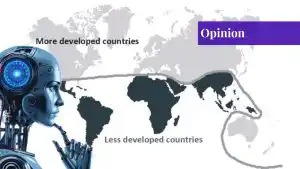
The distribution of AI resources shows how advanced economies, especially the United States and China, control research output and patents, and large-scale model creation and financial backing.
The concentration of power through above-average control of scientific resources enables specific organizations to embed their particular priorities into AI technology. The absence of wider inclusion in AI governance processes will result in decision-making processes that benefit rich nations while excluding diverse perspectives.
Structural Disadvantages Facing the Global South
The Global South faces multiple structural issues that create challenges for its AI.
AI depends on three essential elements, which are data, computing power, and connectivity. Developing nations face challenges because they do not have access to dependable broadband, data center facilities, and power distribution systems. The African region shows a computing capacity that falls below 1 percent of worldwide standards, while the population there accounts for almost 20 percent of global human distribution.
Data and Digital Colonialism: Advanced AI systems need extensive digital data collections for their training process. Major technology companies based in the Global North control most of the data, which critics describe as data colonialism, because Global South countries provide raw data but do not control its usage.
Capital and Talent: The developed economies receive most of the venture capital, which supports AI startups, while the Global South domestic research ecosystems face difficulties in securing financial backing. The higher-income countries attract skilled AI workers who then leave their home countries, resulting in a brain drain phenomenon.
The Risk of Widening AI Inequality
The ongoing disparities in AI development will lead to increased global inequity, according to AI research. The World Trade Organization has warned that AI may deepen global disparities unless poorer countries gain equitable access to its benefits. WTO Director-General Ngozi Okonjo-Iweala warned that AI systems would create deepening social inequalities if their implementation fails to include all members of society, which has occurred throughout previous globalization periods.
Analysts observe that AI technologies continue to develop systems that reflect both their creators’ backgrounds and their original environments. The training of models using Western datasets, which prioritize English languages, results in algorithm bias and functional limitations across Global South languages and contexts.
The existing trends indicate that AI will create wider disparities between technology haves and have-nots because developing nations will remain as technology consumers who lack the ability to create or shape industry standards.
The Global South has chances to develop itself in the AI-based economic system of the world. The AI competition today exists as an industry-specific contest that operates in multiple distinct branches. The existing fields of study provide organizations with chances to join research work while developing their unique strengths.
Developing economies can benefit from AI technologies, which show their most useful applications in agriculture, healthcare, education, and climate change solutions. Smallholder farmers can use precision agriculture to boost their crop production, while AI diagnostics enable rural communities to access better healthcare services, and predictive tools help organizations prepare for future disasters.
The localized solutions developed through AI technology become competitive against global tech products because they address the specific needs of different regions. These context-aware innovations can demonstrate that relevance and impact matter as much as scale.
Local Innovation and Context-Specific AI Solutions
Local developers and researchers achieve better knowledge of their work environments than remote technology centers. AI startups in India create professional tools that support vernacular languages and develop mobile-first interfaces that serve users in informal economies, which existing models do not accommodate. Local communities create their own solutions, which match their specific local conditions, as developing countries utilize this approach to establish solutions that fulfill their community requirements.
Local AI professionals who work on domestic AI projects create economic opportunities and drive social progress through their work because these activities support their professional development.
The Role of State Policy and Governance
Government operations need state intervention for their proper execution. The Global South needs its governments to allocate funding towards AI development through digital infrastructure expansion and STEM educational support, and data sovereignty protection, which enables innovative progress through regulatory framework establishment. National AI strategies that adopt ethical AI standards will enable technology to improve public welfare instead of creating further social exclusion.
The policy frameworks need to establish mechanisms that foster public-private partnerships while providing financial incentives for domestic research and establishing pathways for international research projects, which enable technology and skill transfer.
South–South Cooperation and Regional AI Strategies
The international support that countries need to accomplish their objectives creates a greater impact through collective action than their individual efforts. South–South cooperation establishes research initiatives together with data exchange platforms and technology development centers, and AI regulatory discussions, which enable partners to pool their restricted resources while strengthening their international bargaining power.
The African Union, ASEAN, and other regional organizations can support common AI frameworks, which will advance their member states technological progress through equitable technology sharing. The Global South needs to establish its own ethical AI standards, which will guide universal standards development as binding international law.
Ethical AI and Norm-Setting: A Voice for the Global South
AI governance requires both technical expertise and political knowledge. The future of global technology development depends on decisions about standards, safety, and ethical frameworks. The international community fails to recognize essential viewpoints that Global South nations need to express. Research shows that global AI governance discussions prefer high-income nations while disregarding the needs and perspectives of low-resource nations.
Global governance forums need to enhance representation because diverse experiences and values will create AI regulations that are fairer and more representative of different cultures around the world.
Conclusion
Global South cannot establish its AI capabilities to compete with other countries because it faces both opportunities and restrictions. The existing structural disadvantages create significant obstacles that require professional expertise but can be successfully overcome. Developing countries can achieve their AI-related goals through strategic policy development, human capital investment practices, regional cooperation efforts, and their participation in global norm development activities.
The alternative, remaining passive, risks consolidating inequality because technology creates advantages for a few people while it leaves most of the population without benefits. The choice is clear: deliberate action now can carve a more equitable future where AI serves as a tool for shared prosperity rather than a force of global exclusion.
If you want to submit your articles and/or research papers, please visit the Submissions page.
To stay updated with the latest jobs, CSS news, internships, scholarships, and current affairs articles, join our Community Forum!
The views and opinions expressed in this article/paper are the author’s own and do not necessarily reflect the editorial position of Paradigm Shift.