
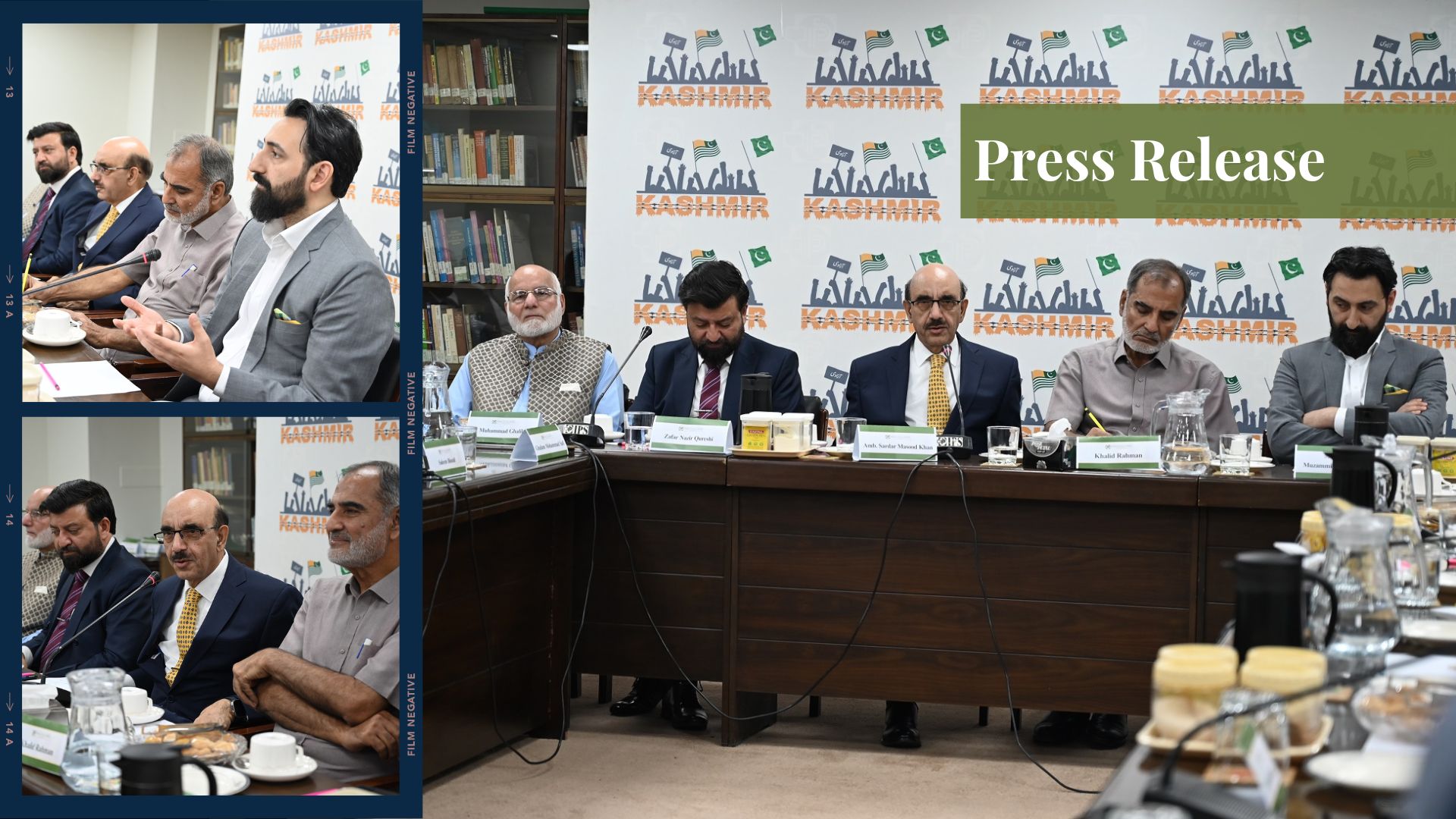

Islamabad, May 19: The portrayal of the Kashmir issue as a bilateral matter between India and Pakistan is gradually giving way to a more globalized understanding, driven in part by diaspora activism. At the same time, Pakistan’s recent shift in diplomacy is characterized by compelling narratives and a more prominent presence in world media discourse. Harnessing this momentum for the Kashmir cause involves articulating a coherent policy, forging closer ties between diplomatic missions and diaspora-driven advocacy, investing in policy research, and deepening engagement with academic and media platforms.

These views were shared at a gathering of Kashmiri diaspora leaders, activists, and former diplomats at the Institute of Policy Studies (IPS) Islamabad, under the theme “Rejuvenated Case of Kashmir: Perspectives and Future Prospects.” The delegation included Muhammad Ghalib, president of Tehreek-e-Kashmir Europe; Dr. Muzzammil Ayyub Thakur, president of the World Kashmir Freedom Movement; and Zaffar Nazir Quraishi, chairman of Kashmir Campaign Global. Also present were Ambassador (r) Sardar Masood Khan, former president of AJK, as the chief guest; Khalid Rahman, chairman of IPS; and other participants.
Speakers underscored that aligning grassroots activism with state-level diplomacy through a unified, narrative-driven strategy is essential to reshaping perceptions and advancing the Kashmir cause on the international stage as a human rights concern.

Ambassador (r) Masood Khan said a shared ideological commitment unites all organizations working for the Kashmir cause. He said it is Pakistan’s responsibility to match the diaspora’s resolve and amplify the Kashmir cause on the global stage. He listed three key outcomes that have emerged after the Pakistan-India hostilities: the US has begun treating both countries as strategic equals, trade considerations are shifting toward parity, and the Kashmir issue has regained global visibility. He added that Pakistan must strengthen its diplomatic, military, and economic pillars while fostering unity.
Muhammad Ghalib called on Pakistan’s foreign missions to more actively support diaspora initiatives aimed at raising awareness. A clear and consistent Kashmir policy is essential for advancing Pakistan’s position globally, and the government should formally engage key countries and energize its diplomatic apparatus. In Europe, the prevailing view of Kashmir as a bilateral issue deters intervention. However, he said, recent events have highlighted the urgency of resolving the conflict, as the consequences could be dire.

Zaffar Quraishi cited the lack of coordination among the Kashmiri activists and urged unifying their efforts under a broader platform. Pakistan’s active and sustained support is vital to this legitimate struggle, which requires preparing a comprehensive strategic framework. It is time for Pakistan to fully own the Kashmir issue and take concrete diplomatic and strategic steps. He suggested producing credible academic research, engaging international think tanks and policymakers, and actively mobilizing the influential Kashmiri diaspora in the UK.
Muzzammil Thakur noted a shift in public interest in the Kashmir issue within the UK, driven by increased outreach and community-level engagement. He said perceptions about India have also changed. India’s use of bot accounts to promote pro-Israel narratives has undermined its credibility and damaged its international image. On social media, Pakistani users have successfully countered Indian disinformation, often using satire and humor to their advantage. This evolving narrative landscape now favors the Kashmiri cause and must be strategically harnessed to sustain progress.

In concluding remarks, Khalid Rahman emphasized that the Kashmir issue must be understood within the broader context of globalization. In the evolving world order, pursuing win-win strategies that protect Pakistan’s national interests while advancing the Kashmir cause is essential. Narrative warfare is decisive in shaping international opinion; however, narratives crafted for domestic audiences often fail to resonate globally. Pakistan must improve its communication strategy to influence global discourse, considering content, context, timing, and presentation. He reiterated that support for Kashmir will always require Pakistan’s consistent engagement, clarity, cohesion, and confidence to help shape a just future for Kashmir on the world stage.
If you want to submit your articles and/or research papers, please visit the Submissions page.
To stay updated with the latest jobs, CSS news, internships, scholarships, and current affairs articles, join our Community Forum!
The views and opinions expressed in this article/paper are the author’s own and do not necessarily reflect the editorial position of Paradigm Shift.

The Institute of Policy Studies (IPS) is an autonomous, not-for-profit civil society organization dedicated to promoting policy-oriented research, dialogue, and human & technological development for better governance. IPS provides a forum for informed discussion and dialogue on national and international issues. The contributions spanning over forty-three years and the overall impact signifies the importance of pragmatic research on policy issues. The institute highlights the role of think tanks in modern democratic polities.