
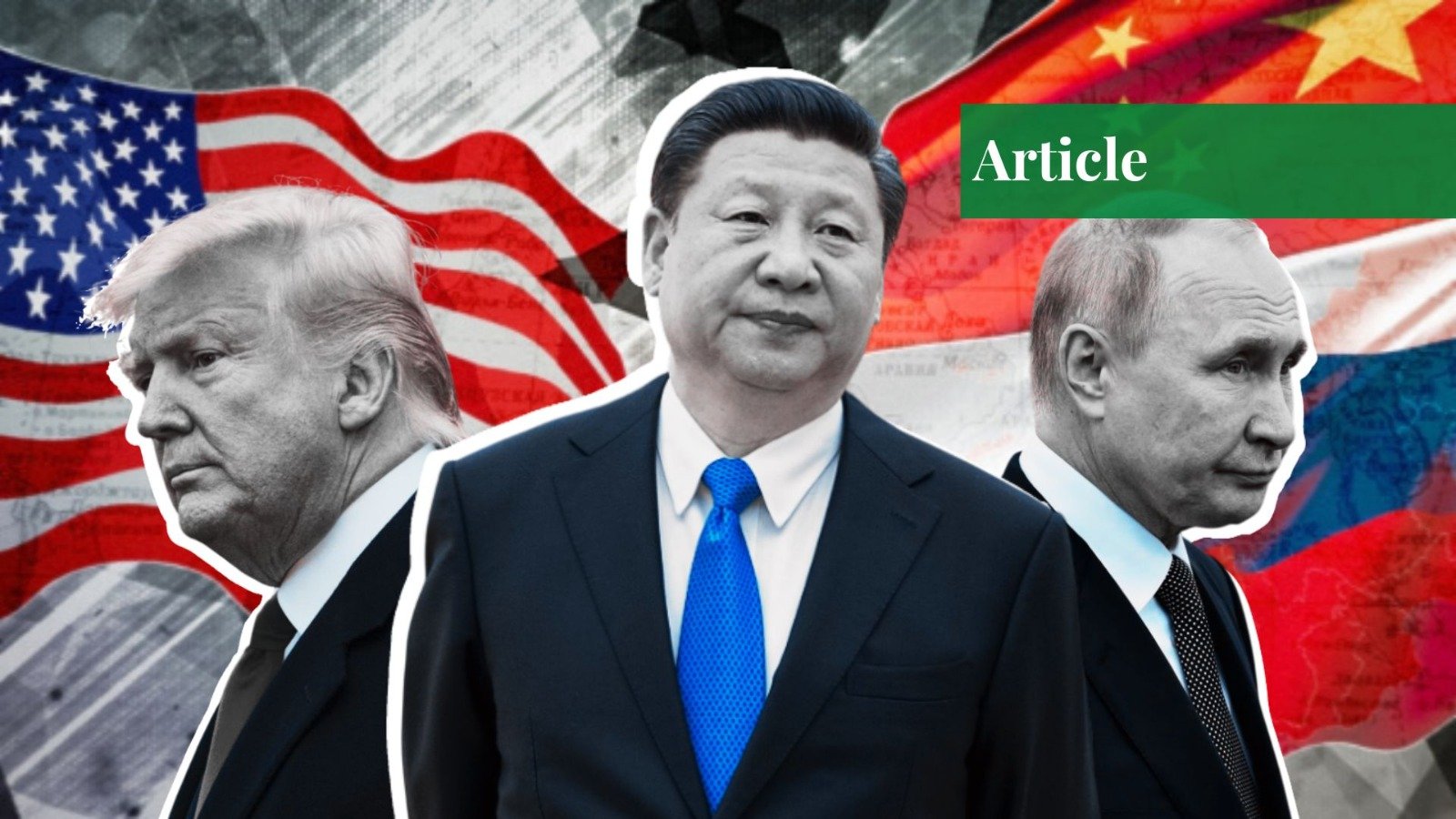

Great Power Squeeze
It is evident that the world has re-entered the era of great power competition, and this now serves as the fundamental basis for international relations. This shift has been clearly visible since around the mid-2010s. We know that the last period of great power competition ended with the collapse of the Soviet Union in 1991. The 25 years that followed were, you could say, a unique and transitional phase in international relations. The focus then mainly was on dealing with the legacy of the Cold War and, of course, the War on Terror.
The end of this 25-year transitional period is generally marked by two significant state actions: Russia’s invasion of Crimea in 2014 and China’s push to militarize the South China Sea, coupled with its program to strengthen its military force overall. The 2017 US National Security Strategy (NSS) document really served as the official signal. It declared the end of the counterterrorism era and formally announced that the US was moving into the great power competition era. It specifically named China as a rising military competitor and Russia as a revisionist power.
Importantly, this document reflected more than just one administration’s view; it showed what the structure of American foreign policy as a whole was thinking. Since that point, the United States has increasingly operated under the principle that great-power competition is the single most central organizing principle for international relations.
Strategic Choices for Smaller States
This focus on great-power competition also carries major consequences for mid-sized regional powers and smaller countries. These nations face constant, real pressure to align with the great powers. This forces them into tough choices regarding military cooperation, trade policy, technological structure, and how they vote in international organizations.
But the rise of great-power competition can also be an opportunity. If these countries manage their policy choices wisely, they stand to gain key resources: securing better aid and loans, improved military deals, more opportunities to attract capital investment, greater access to modern technologies, and similar benefits. Whether these nations can genuinely maintain their independence of action and truly stay focused on their own national interests during such a difficult time comes down to three main factors.
The first factor is straightforward: geopolitical position. Take Iran, for example. It sits in one of the most critical and sensitive areas in the entire world. Because of this, it is, by default, an important element in the great-power competition. Currently, these rivalries provide Iran with only tactical benefits. This means states like China and Russia cooperating diplomatically to help Iran resist US pressure or providing minor assistance in circumventing sanctions and similar measures.
We see China and Russia aligning themselves with Iran today, opposing the “snapback” of Security Council resolutions, and voting against anti-Iranian resolutions at the IAEA and the Security Council. This represents a significant shift from the period between 2006 and 2010, when China and Russia actually aligned with the West. Back then, they not only voted in favor of the two 2005 IAEA resolutions regarding Iran’s non-compliance and referring the case to the Security Council, but also voted for six Security Council resolutions. But despite the current tactical cooperation, if Iran doesn’t make some kind of meaningful shift in its foreign policy, its structural isolation won’t change much. There remains a constant risk that a great power deal could suddenly create very different and challenging conditions.
Second, the ability to exploit geopolitical mobility is also a very important factor. Many countries have performed exceptionally well in this area over the last few years. India and Pakistan are arguably the top examples. During the Modi era, India moved away from its traditional Cold War-style non-alignment policy, establishing major strategic ties and partnerships with the United States. Yet, it diligently maintained strategic relations, including buying weapons, with Russia. India is a member of the Shanghai Cooperation Organization (SCO) and BRICS, and it is also a member of the QUAD—a grouping created to counter China, alongside the US, Japan, and Australia.
Pakistan is also trying a similar high-wire act. Although its strategic relations with China date back to the 1960s, its leaders recently visited the United States and proposed significant strategic plans. One proposal involves American companies developing the Port of Pasni. This port is located approximately 100 kilometers east of the Gwadar Port, where China has been investing substantial amounts of money (tens of billions of dollars) for years. Pakistan also proposed ideas to the US regarding rare earth resources and expanding trade. While Chinese groups are reportedly paying close attention to the US-Pakistan developments, the Chinese government hasn’t yet shown any official adverse reaction. There are many other examples of states attempting to capitalize on these new international conditions.
The third factor, which is essential in this cycle of great-power competition, is internal cohesion and the social capital and legitimacy of governments among their people. When a government has wide acceptance at home, its ability to maneuver against great powers increases significantly. This is a pivotal time when political leaders can make significant foreign policy decisions. However, without widespread acceptance, officials are always vulnerable and worried about an adverse reaction from their own people. A final serious issue is that a lack of domestic acceptance practically encourages great powers to interfere in domestic affairs, influencing the officials’ decision-making process.
Concluding Thoughts
Ultimately, the global system’s decisive turn back toward great-power competition forces a new reality upon all states, especially those without the scale of the major players. For mid-sized and smaller countries, this environment presents a classic dilemma: massive risks of external pressure and alignment demands, but also potential opportunities derived from strategic balancing. A country’s ability to maintain its sovereignty and pursue its national interests is not predetermined solely by geography.
Instead, it is highly conditional. As we’ve seen, success depends on the strategic convergence of three critical domestic factors: geopolitical position (which defines the landscape), the capacity for geopolitical mobility (which represents the action taken within that landscape), and, fundamentally, internal cohesion and legitimacy. Without a robust level of domestic acceptance and social capital, officials will lack the political space needed to execute the high-stakes, multi-vector foreign policy maneuvers that this new era of competition requires. In short, the future independence of these states will be decided not just in Washington, Moscow, or Beijing, but crucially, at home.
If you want to submit your articles and/or research papers, please visit the Submissions page.
To stay updated with the latest jobs, CSS news, internships, scholarships, and current affairs articles, join our Community Forum!
The views and opinions expressed in this article/paper are the author’s own and do not necessarily reflect the editorial position of Paradigm Shift.

Bahram P. Kalviri is a PhD candidate in political science at the University of Hyderabad, Hyderabad, India. His research interests focus on the Middle East, particularly the interplay of international relations and public diplomacy within the region.