

Jung’s Presage on Geopolitics and the Return of Ideological Extremes
In 1957, Carl Jung, in his seminal work Undiscovered Self, wrote, “Historically, in times of physical, political, economic, and spiritual distress, people look to the future with anxious hope, creating many utopias and apocalyptic visions. As the second millennium ends, we again live in an age filled with fears of universal destruction. In the West, subversive minorities, protected by our humanitarian values, spread dangerous ideas, stopped only by the critical reason of a small, mentally stable part of society. This group’s size changes by nation, education, and politics, but at best makes up about 40 per cent of voters. A more pessimistic view is fair, since reason and reflection are rare and often weak, especially in large political groups.” Jung foreshadowed the existential dangers of the modern era, warning that humanity’s destructive capacities could outpace its inner maturity.
Huntington, Fuku, and other political scientists later identified where such destruction could play out: not just ideologically (as Jung saw in fascism/communism), but along civilizational lines in a culturally fragmented world. In the post–Cold War contemporary era today, the world has shifted from the end of history to the clash of civilisations and now to unconventional dynamics shaped by emotional conflicts. Moisi’s “Geopolitics of Emotions” explains that we live in a post-ideological age where emotions like hope, fear, and humiliation dominate global politics. Across the world, wars reflect this: the Middle East faces the brutal Hamas-Israel war, Europe sees the hybrid Russia-Ukraine conflict, and South Asia remains a complex geopolitical chessboard. All these show that history, ideology, and emotion—along with power and pride—drive human behaviour and strategic decisions today.
South Asia’s Complex Security Landscape
With a deductive focus on South Asia, when the security landscape is analysed, it is inferred that the region’s security landscape in present times has been under the radar due to its heterogeneous nature, encompassing multifaceted conflicts of diverse dimensions.
Pioneer in understanding South Asian geopolitical dynamics through IR theories is Bhumtra Chakna. According to Chakna in his work titled International Relations Theory & South Asian Regionalism, South Asia now faces growing “security complexes” which are ignited by the influence of non-traditional weapons of war like economy, diplomacy, culture, and even ideology. Hence, conflicts and competitions between states to states or even with states to non-states lead to regional insecurity, fuelling South Asian already complex politics. Identity crisis and ideological rifts are common themes identified while dissecting the core reasons for complexities. Chakna further elaborates that despite shared civilizational roots, countries have developed different identities due to globalization and outside cultural influences, leading to religious and ethnic divisions.
Year 2025 aptly manifests the thesis of Chakna. In the year 2025, South Asia witnessed a havoc of security disasters like a near Armageddon situation due to flashpoints between nuclear nations, the dismantling and toppling of governments due to youth-led mob protests, and ideological extremism. The most prevailing amongst them is ideological extremism, with Hindutva’s nationalist ideology and the Taliban’s Islamist ideology being the root of all evils.
Hindutva-Taliban: An Ideological Interplay of Extremism
Transitioning from Mujaheddin to emerging as Taliban in the 1990s due to the aftermath of Soviet Withdrawal, their ideology is the weaponization of divine Islamic maxims, heavily relying on the alchemy of the Deobandi school of thought and Pashtunwali. While Islam teaches co-existence, brotherhood, and love, the Taliban’s ideology is based on twisting these divine interpretations, having aims in the aim of establishing an “Islamic Emirate” governed by Sharia.
On the flip side, Hindutva, literally meaning “Hinduness” and a term coined by Vinayak Damodar Savarkar, defined Indian identity as deeply rooted in Hindu culture/heritage rather than purely religious belief. According to this ideology, Indian and Hindu identity are inseparable, pushing down the idea that India is a Hindu nation. On paper, the ideology might proclaim pride in culture, but in practice, the manifestation is brutal and a contradiction of the Indian constitution’s founding objectives, i.e., secularism and celebration of diversity.
While being different from one another ontologically, both ideologies intersect on many similar points. Ontologically, Taliban ideology is religiously fundamentalist, while Hindutva ideology is culturally extremist. However, both ideologies merge religion with the nation by twisting divine interpretation to fuel nationalistic sentiments. Secondly, both ideologies are coercive in approach and have no room for acceptance of diversity, hence completely rejecting pluralism and secularism. Thirdly, both ideologies are power hungry and target minorities, women, by exerting brutality and exploitation of human rights.
Lastly, and most importantly, both ideologies are centric to their land; however, their spill-over effects are beyond their geographical location, impacting entire South Asia, with Pakistan suffering the most collateral damage. From a regional perspective, the impact of ideologies complicates regional cooperation and puts minority protection under threat. Moreover, the prevalence of ideologies has given rise to migration and has led the security complex towards severe border-management challenges, further leading to regional instability.
Regional Implications
Two main pieces of evidence proving the argument that extremist ideologies have risked the security of South Asia are, firstly, the rise of fundamentalist ideologies has provided a haven for transactional militants, and secondly, the harbouring of cross-border radical groups. Recent geopolitical situations have witnessed this abovementioned evidence with a plethora of events.
Firstly, talking about the sanctuary of transnational militants after the 2021 takeover by the Taliban, it was estimated that Afghanistan would become a hotbed of terrorism. Four years later today, the estimate turned out to be accurate when, in mid-October 2025, Pakistan and Afghanistan were at a flashpoint marked by firings and airstrikes, leading to cross-border tensions and the killing of innocents. However, Kabul and Islamabad halted the flashpoint through an agreement on a 48-hour ceasefire. But even after the truce, Afghanistan continued to be a permissive environment for militants. The already weak state control due to the 2021 takeover, the situation worsens with the recent airstrikes, widening the gap between security and governmental oversight. From credible sources, it has been reported that TTP has been operating from within Afghanistan with substantial support from the de facto illegitimate government of the Taliban. Furthermore, reports investigated that there were 17 infiltration attempts up to 10 Oct, many linked to TTP from Afghanistan.
Secondly, talking about harbouring cross-border radical groups Taliban’s fundamentalist ideology has raised human rights concerns with the Hazara Shia community in Afghanistan facing discrimination and violence. On the recent flashpoint halting in a truce and its linkage with harbouring cross-border radical groups, it has been reported in Express Tribune, “instead of curbing militancy, Afghanistan has evolved into an operational hub for TTP activities … the truce will hold only if the Taliban end their covert patronage of militant groups.” It is further reported that there is approximately a 36% rise in organised infiltration groups from mid-2025, with up to 4,000 militants crossing into Pakistan between June and September, many from Afghanistan.
India-Afghanistan Convergence: Ideological Bonding Against a Common Enemy
For India, Pakistan is its concentric enemy, being a state immediately bordering India. In the light of Chanakya’s Mandala Theory, the state immediately bordering the central state(Vijigīshu) is the natural enemy(Ari). Being an enemy nation, India’s major foreign policy goal has always been to destroy and dismantle Pakistan. To achieve the goal, India leaves no stone unturned. In history, India weaponised the internal challenges of Pakistan, leading to the 1971 tragedy. In contemporary times, India utilised Pakistan’s involvement in the War on Terror through the EU disinformation lab to destroy its national image. And in recent times, when Pakistan and Afghanistan were at a crossroads, India hopped in to join hands with Afghanistan against Pakistan. In terms of international relations, India’s joining hands with Afghanistan is a manifestation of the principle stating “enemy of your enemy is your ally”; therefore, despite being opposites, unification persisted.
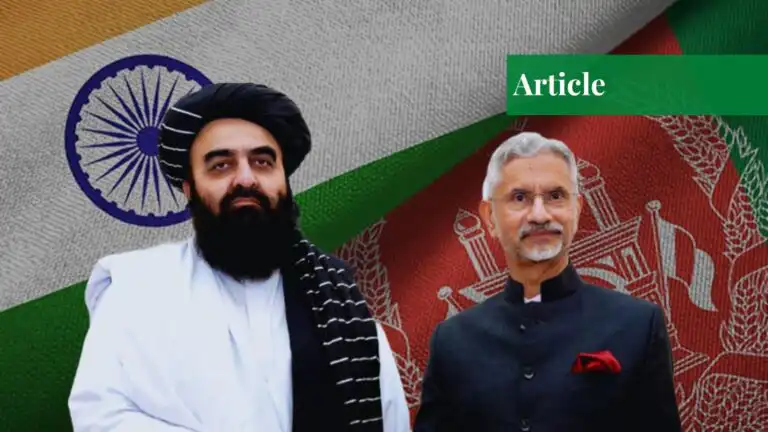
Ever since the 2021 Taliban takeover, India has been engaging with the de facto government without officially recognising it. According to reports by Reuters in January 2025, India’s foreign secretary described the so-called bilateral relations as “a significant regional and economic partner” during the talks with the Taliban. One of the main strategic rationales for India is countering and manoeuvring the Pakistan Taliban; on the flip side, reciprocated diplomatic efforts and shook hands. This convergence of divergent nations with distinct yet the same ideology reflects that Hindutva and Taliban are “ideological twins in different reactionary robes”, i.e., in the case of regional geopolitics, mutual animosity for Pakistan.
The October 2025 flashpoint between Pakistan and Afghanistan, and with India’s hoping in is the living proof of the ideological twining of Hindutva and Taliban. Doha, Qatar, and Turkey chimed in to halt the flashpoint by making Kabul and Afghanistan sign a ceasefire agreement. One of the main clauses stated that “anything coming from Afghanistan [into Pakistan] will be a violation.” While Pakistan, along with nations sharing the spirit of Muslim brotherhood, were trying to sustain peace through dialogue, India and Afghanistan were aiming to upgrade diplomatic ties, signalling an aggressive outlook rather than a collective effort of peace-making. The Indo-Afghan reconciliation is framed rightly as “a pact between kindred spirits,” aptly reflecting the nexus between a fascist Hindutva and a fundamentalist Taliban.
Pakistan’s Strategic Challenges
In The Revenge of Geography, Robert D. Kaplan cites Napoleon’s words, i.e., to know a nation’s geography is to understand its foreign policy. The words reflect the importance of geography and its impact on politics and foreign relations. Pakistan’s sensitive geostrategic location is the key component in Pakistan’s foreign policy and the reason behind the prioritization of sovereign security while being a key player in the peace of the region, providing a win-win situation. However, with one enemy state to its East, i.e., and another enemy state to its Northwest, i.e., Afghanistan has placed Pakistan in a crucial position where it has to choose between the devil and the deep sea for its own sovereignty.
The recent October 2025 worsening of the situation. According to Observations of geopolitics experts, some of the major implications for Pakistan are as follows:
Security Implications
Firstly, Pakistan has positioned itself as a front-line state for counterterrorism and eliminating the evils of terrorism. Pakistan’s efforts authenticate this framing. However, the Hindutva-Taliban bonding through India-Afghanistan reconciliation is a threat undermining Pakistan’s role. India’s strategically adverse outreach to Afghanistan reflects that India’s support to militants and non-state actors against Pakistan will weaken Islamabad’s security calculus.
Strategic Anxiety
Secondly, the deepening of ties post-airstrike has heightened Pakistan’s strategic anxiety. Since the risk of the Taliban regime hosting militants, further ignited by rising TTP mercenary activities with the support of India, is an alarming security risk for both the internal security of Pakistan and South Asian’s regional security as a whole.
Diplomatic Challenges
Lastly, on the diplomatic front, implications are highly risky as Pakistan has a challenge of sustaining a front-line state narrative while combating accusatory narratives by the extremist ideological duo. As India is actively engaging in the region to classify Pakistan as extremist-fueled by heightened hatred of Afghanistan for Pakistan.
Pakistan’s claim to be a front‐line state vs. extremism may face credibility challenges if its neighbour (India) engages a regime many classify as extremist. That could impact Pakistan’s standing in global counter-terrorism cooperation frameworks.
Pakistan’s Counter-Resilience and Way Forward
Hope, according to Viktor Frankl, is a driving force, and the absence of resilience is a game-over sign. Pakistan as a nation embodies deep resilience and hence manifests the words of Frankl. Pakistan suffered from a difficult start, disintegration, propaganda, breaching of sovereignty, and labelling as “hard country”. All these factors are driving causes of discouragement and loss of hope. Nevertheless, Pakistan stood tall and kept on putting in efforts for peace and sovereignty.
Firstly, for counterterrorism efforts as a front-line state, Pakistan launched Operation Zarb-e-Azb in 2024, targeting militants with reported damage of “536 soldiers killed and 2,272 injured”. Transitioned from military to governance, Pakistan further developed a National Action Plan for counterterrorism efforts through law enforcement, socio-economic, and counter-narrative measures taken.
Secondly, Pakistan has been a flagbearer of conflict resolution through peaceful and diplomatic measures. According to Deputy PM and Foreign Minister of Pakistan, Ishaq Dar, “We believe that disputes and differences are resolved through dialogue and diplomacy, instead of conflict and coercion.”
Thirdly, while promoting dialogue, Pakistan declares it to be a big no when it comes to compromising on sovereignty, urging for respect of sovereignty in negotiations for peace and cooperation, emphasising mutual respect, sovereign equality, and non-interference in domestic affairs.
With Pakistan’s high-spirited resilience and efforts to curb the menaces of fundamentalism, terrorism, and extremism, there is a silver lining despite the present situation. With resilience, no compromise on sovereignty, and efforts for peace-making in South Asia, countering Hindutva-Taliban bonding will make Pakistan prosperous.
If you want to submit your articles and/or research papers, please visit the Submissions page.
To stay updated with the latest jobs, CSS news, internships, scholarships, and current affairs articles, join our Community Forum!
The views and opinions expressed in this article/paper are the author’s own and do not necessarily reflect the editorial position of Paradigm Shift.