

Introduction
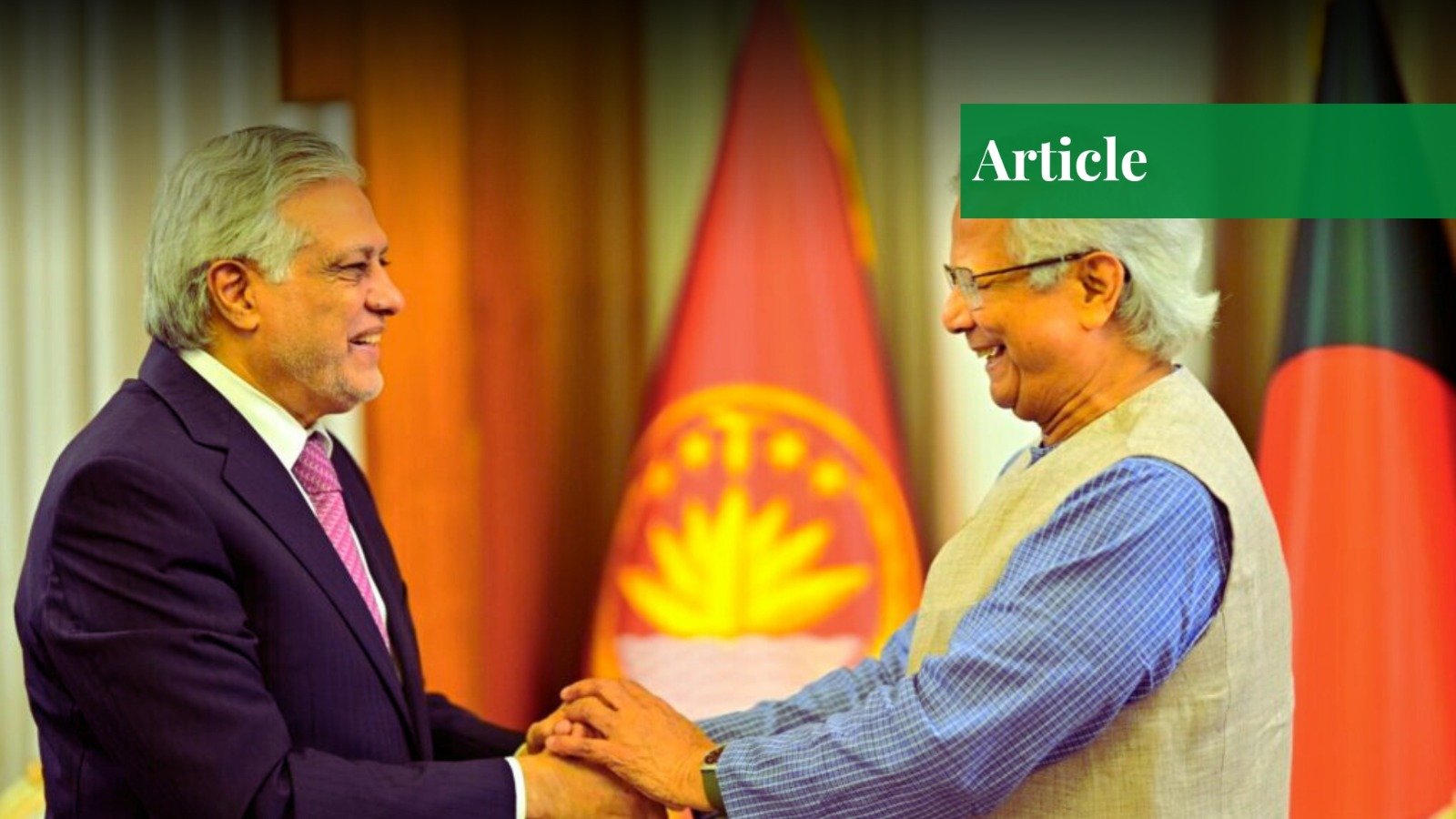
Pakistan’s foreign minister, Ishaq Dar, recently visited Bangladesh on August 23 and 24, during which he signed one agreement and five MOUs with the government of Bangladesh. During his visit, he met with the chief adviser of Bangladesh, H.E. Professor Muhammad Yunus – the Bangladesh Nationalist Party leader – and former Prime Minister Khalida Zia, government officials, political leaders from various parties, and the business community.
Both countries announced cooperation in agriculture, trade, investment, transport, and the energy sector. Commerce Minister Jam Kamal was also part of the Pakistani delegation, and he announced cooperation in commerce and information technology with Bangladesh. During this visit, the Pakistani government also introduced the “Pakistan-Bangladesh Knowledge Corridor.” It would provide 500 scholarships to Bangladeshi students in Pakistan.
This visit is considered a landmark in South Asian political dynamics by analysts. It is the first visit by any foreign minister of both countries in the last 13 years, marking a significant step toward improving Pakistan-Bangladesh bilateral relations. The warm reception of Ishaq Dar in Bangladesh reflects recent changes in Bangladesh’s foreign policy since Haseena Wajid’s government was overthrown last year. The new government now leans more toward Pakistan, while India has been largely ignored in their foreign policy.
Bittersweet Relations between Pakistan and Bangladesh in the Past 54 Years
Pakistan officially recognized Bangladesh in 1974, and that same year, Prime Minister Zulfiqar Ali Bhutto visited Bangladesh. During the 1980s, under Gen. Zia ul Haq’s leadership, political and military relations between the two countries were friendly. From 1996 to 2001, Sheikh Haseena Wajid served as pro-Indian prime minister. In July 2002, Gen. Pervaiz Musharraf visited Bangladesh. He later expressed regret for some events that happened in 1971 in his book.
Haseena Wajid became prime minister again in 2009, and until 2024, diplomatic relations remained cold due to India’s proxies and influence in Bangladesh. The last visit was in 2012 when Hina Rabbani Khar invited Haseena Wajid to the SAARC conference. After Wajid’s government was overthrown in 2024, official government and military talks resumed. In April 2025, Pakistan’s foreign secretary, Amna Balouch, visited Dhaka, followed by Foreign Minister Ishaq Dar’s official visit, both aiming to improve relations in all sectors.
New Political Dynamics in South Asia
In South Asia, the strategic and political landscape is evolving over time. Formerly, India and China were the dominant powers, with the United States backing India to counterbalance China. Currently, Indian influence is waning due to political deadlock with the US and a rigid foreign policy toward smaller South Asian nations. Meanwhile, China launched the Belt and Road Initiative (BRI), engaging nearly all regional countries—Nepal, Sri Lanka, Pakistan, Maldives, Myanmar, Iran, and Afghanistan—boosting trade and investment.
Additionally, in June 2025, Chinese Vice Foreign Minister Sun Weidong, Bangladeshi Acting Foreign Secretary Rahul Siddique, and Pakistani Additional Foreign Secretary Imran Siddique met in Kunming, Yunnan province of China, to announce trilateral cooperation across various sectors. This highlights China’s role in fostering regional collaboration. Currently, India finds itself isolated internationally due to its rigid, isolating foreign policy. It once envisioned a strong, progressive India but neglected to build regional ties, instead relying on intelligence agencies to influence Bangladesh and Afghanistan.
In the recent India-Pakistan conflict, only Israel supported India, while China, Turkey, Azerbaijan, and even Bangladesh openly backed Pakistan. This shifting power dynamic suggests that regional success will favour countries willing to cooperate with their neighbours. The trilateral partnership between China, Pakistan, and Bangladesh is likely to boost regional trade and investment, promoting peace and prosperity.
Steps for Improving Pakistan-Bangladesh Relations in the Future
Next year, elections will be held in Bangladesh, and the government will change based on the public vote. To maintain good relations with every government in Bangladesh, Pakistan must take certain steps.
Proper Framework
Both countries have to make respective committees for the supervision of all cooperative projects in different sectors. It is crucial to make a plan for the next 5 years, and no matter which party comes into government, the cooperative plan should be implemented the same way. The politics in both countries should not affect the mutual coordination in trade and investments. The agreements that are signed in this meeting should be implemented as soon as possible.
Cultural Cooperation
The governments of both countries should announce educational exchange scholarships for students. Already, there are scholarships for specific subjects, but they should be increased to a vast level. The militaries of both countries should expand the mutual exercises. The cultural programs are also very important to enhance the brotherly relations. People from both countries have the same roots, so the people-to-people relationship would help to build a stronger bond among the citizens. The government officials should increase their visits to strengthen the ties at the government level.
Counter Indian Lobby
During the 15-year rule of Sheikh Hasina, Indian intelligence was very strong in Bangladesh. This is because she had a soft corner for India, and she provided unwavering support to the Indian lobby. The current interim government tried to cleanse the Indian proxies from Bangladesh. But it would take time because the internal support of 15 years has made it rigid. To strengthen the partnership between Pakistan and Bangladesh, it is essential to completely stop the Indian involvement in Bangladesh.
Conclusion
In the shifting dynamics of South Asian politics, maintaining good relations with small states in the region is essential. China and India serve as good examples in this regard. China maintained strong trade relations with all the small states in South Asia and provided aid to help them thrive economically. By doing so, China turned all of them into its allies. On the other hand, India’s rigid foreign policy has left it isolated in the region. Pakistan also needs to focus on its relationships with smaller countries. South Asia as a whole is riddled with conflicts because of a lack of cooperation. Strengthening regional connectivity is vital for maintaining peace in South Asia. Peace in the region would naturally lead to stronger economies.
If you want to submit your articles and/or research papers, please visit the Submissions page.
To stay updated with the latest jobs, CSS news, internships, scholarships, and current affairs articles, join our Community Forum!
The views and opinions expressed in this article/paper are the author’s own and do not necessarily reflect the editorial position of Paradigm Shift.

Ms Jaweria Naseem is currently pursuing her Bachelor's in International Relations from International Islamic University, Islamabad.