


The emerging technological advancements are pushing countries to integrate new systems to upgrade their military domain. Keeping in view the introduction of advanced systems, Iran has introduced a new air defense system that has a deep semblance with Israel’s iron dome. Lately, Iran has become the primary topic of discussion in international politics. With its recent clashes, it is turning into a more significant threat for Israel and its Western allies. The incident of the October 26th airstrikes aggravated Iran, which has bolstered its motive to retaliate against Israel at every possible occasion. It has been upgrading its military equipment to tackle the advanced military technology of Israel. One of the recent examples of this is the introduction of the domestically produced “Zoubin Air Defense System” in Iran’s military domain. The air defense system is also known as the Iranian Iron Dome. It is deployed at major strategic points and mainly around Tehran.
The Zoubin Air Defense System of Iran
In contemporary times, the world is witnessing increasing lower-altitude threats. To counter this, Iran has introduced this new system that will help them to retaliate with drones, cruise missiles, and shell attacks. The best part about this air defense system is its ability to detect 100 lower-altitude threats under a 30km radius. Each unit in the system has eight missiles that help them retaliate against a well-coordinated attack spontaneously. It is also capable of detecting targets from a 30km radius and neutralizing the target from a 20km range.
The system can deal with multiple threats, including swarm and scattered attacks. These attacks are the hardest to intercept, yet the system can deal with them. It is also proficient in tackling fighter jets and helicopters that usually get off the radar because of its capability to fly at low altitudes, making it capable of intercepting at 360 degrees. It can also capture artillery shell attacks that are skilled enough to attack urban areas and fortified sites.
Zoubin Air Defense System is based on Iran’s Bavar-373, one of the most potent defense systems. The system is also capable of intercepting long-range missile attacks. Zoubin is installed on a 6×6 chassis truck, allowing prompt repositioning and expansive coverage. It is easy to move and swift to deploy in various places.
The Iron Dome of Israel
Israel’s iron dome is also famous for its ability to intercept low-altitude and short-range drone attacks. The system has batteries spread across Israel. Each battery has a further minimum of 3 or a maximum of 4 launchers with 20 missile inceptors in each launcher, making it a strong and potent interceptor against any short-range threats. The missile inceptors are also known as “Tamir missiles.” Each missile costs $50,000, making it one of the most expensive missile systems. The missile works on a detecting system. It particularly detects those attacks that can potentially target the populated area. After identifying these targets, the launcher instigates a missile attack against them, making the missiles fall to the ground. According to the Israeli Defense Forces, Iron Dome can intercept attacks with a 90% success rate.
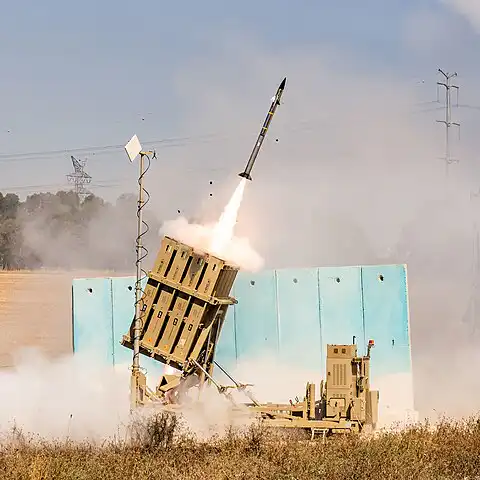
The Iron Dome was built after a well-known war between Hezbollah (Iran) and Israel in 2006. The war is also known as the Summer War. Hezbollah’s massive drone attacks caused massive collateral as well as human damage in Israel. This instance forced the IDF to formulate a system to help them intercept multiple missile attacks simultaneously. The interceptor Tamir missiles can detect and intercept air threats from 4km to 70km. Thus, with the help of some significant Israeli military industries, Israel Aerospace Industries Rafael and Advanced Defense Systems, the Israel Iron Dome was manufactured and deployed on the battleground in 2011. In the very same year, it was used against a missile attack launched from Gaza.
According to a senior research fellow at the University of Singapore’s Middle-East Institute, Jean-Loup Samaan, the credibility of Iron Dome’s 90% success rate is quite contentious. The dome only detects and intercepts missiles that potentially target urban areas. If the rocket is launched in an unpopulated area, it will go undetected, and the success rate of the dome becomes dubious. According to the Forbes Report 2021, the iron dome has a specific saturation point. It can only take down a certain number of drones; if that number exceeds, it becomes overwhelmed and incapable of intercepting the rest.
Yet, the dome is still considered one of the most influential and expensive air defense systems. Its one interceptor missile, Tamir, costs $50,000 and was initially funded by Israel itself, but with its rising cost in other technological intricacies, the United States decided to help Israel in this regard. The US has granted Israel approximately $3 billion for this particular system. The cost covers interceptors, batteries, production costs, and miscellaneous maintenance of the system. Recently, Biden also requested the Congress for an additional $14 billion for Israel on the grounds of military aid.
The Israeli air defense system is expensive, so it relies on the US for its military support. Therefore, it is preparing to introduce a new air defense system, Iron Beam. This system will detect and intercept laser technology air threats. It will be less expensive than the Iron Dome. The missile interceptors in this new technology will cost $2 per interceptor, making them highly cost-effective yet powerful enough to counter new technology threats.
The Zoubin system has been created in line with Israel’s Iron Dome, but it is strong enough to compete with Israel’s Dome. On paper, Iran’s system looks assertive and defensive. Still, it is yet to be tested on the battleground, whereas, on the other hand, Israel’s iron dome has already been tested and verified many times on multiple occasions. Thus, Zoubin has not yet verified whether it can compete with Israel’s iron dome.
The introduction of the latest air defense systems in the military domain will give rise to global security tensions, as any potential attack between Israel and Iran can cause massive damage to both states. Yet, the introduction of Zoubin Air Defense also testifies to Iran’s strong commitment to strengthening its military structure, particularly its air defense system, to protect its airspace from potential aerial threats.
If you want to submit your articles and/or research papers, please visit the Submissions page.
To stay updated with the latest jobs, CSS news, internships, scholarships, and current affairs articles, join our Community Forum!
The views and opinions expressed in this article/paper are the author’s own and do not necessarily reflect the editorial position of Paradigm Shift.

Minahil Baig is currently pursuing her master's degree in Peace and Conflict Studies from NUST. Her areas of interest include conflict management, defence studies, artificial intelligence, and modern warfare.