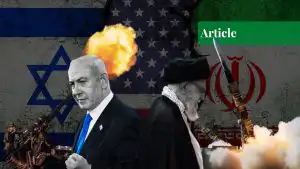

Islamabad, 18 June 2025: The recent unprovoked Israeli offensive on Iran is not an isolated event but a reflection of deeper, long-standing strategic fault lines and geopolitical dynamics. While Israel, backed by the US, seeks to neutralize Iran’s potential and regional relevance, Iran is asserting its strategic autonomy and ideological stance.
This unfolding escalation not only risks further destabilizing the region but also strategically diverts international focus from the ongoing humanitarian crisis in Gaza. Amidst these tensions, Pakistan must maintain its tactful and diplomatically prudent approach, given its historical ties with Iran and evolving regional alignments.
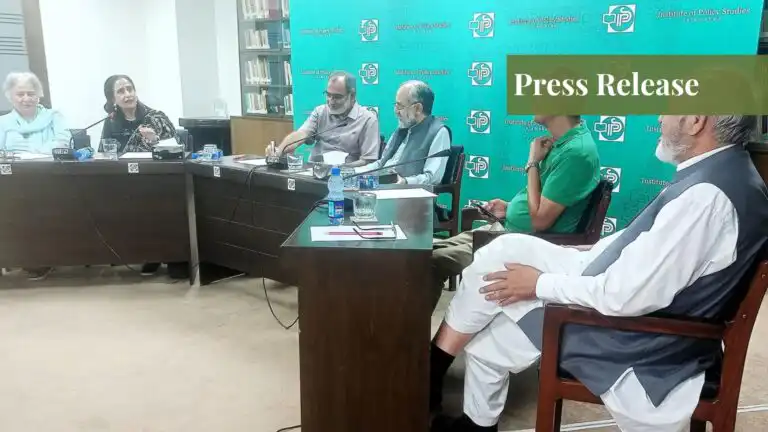
This was discussed during a session on “Israeli Aggression on Iran and the Dynamics of the Middle East,” held at the Institute of Policy Studies (IPS), Islamabad. The session featured insights by Khalid Rahman, chairman, IPS; Ambassador (r) Syed Abrar Hussain, vice chairman, IPS; Ambassador (r) Nasrullah Khan; Ambassador (r) Riffat Masood; Ambassador (r) Naila Chohan; and Brig (r) Tughral Yamin.

The discussion shed light on the historical evolution of Iran-Israel relations. Both countries were notably cooperative during the Shah’s regime when Iran’s nuclear program was initially established under US support, said Ambassador (r) Naila Chohan. However, following the 1979 revolution and Iran’s ideological shift, Tehran’s opposition to the two-state solution to the Palestinian question and its firm stance against Israel’s expansionist agenda have since positioned it as a key adversary in Israel’s strategic calculus.
The speakers noted that, as exemplified by the Abraham Accords, Israel aims to gain favor with all Middle Eastern states and exert regional influence. Iran stands as a major obstacle to this agenda. Moreover, with its high literacy rate, advancing scientific capacity, and abundant natural resources, Iran holds the potential to emerge as a regional power base.
Ambassador (r) Riffat Masood observed that Israel’s primary objective is to undermine this potential by seeking regime change and obstructing Iran’s nuclear development. This, she noted, persists despite Iran being a signatory to the Nuclear Non-Proliferation Treaty (NPT) and not actively pursuing a weapons-grade nuclear program.
Ambassador (r) Nasrullah noted that Iran faces discrimination in the NPT, suggesting a deep mistrust from the West. He noted that Israeli objectives align with those of the US in the region, although the two countries employ different strategies. Despite this alignment, the US appears increasingly uncertain in its Middle East approach, while Israel continues to face resistance and strategic setbacks, as both miscalculated the scale of Iran’s response.

It is noteworthy that the attack on Iran and subsequent escalation are not merely a regional flashpoint but also serve as a deliberate distraction from the ongoing humanitarian crisis in Gaza, said Khalid Rahman. By dominating global headlines, it risks sidelining the global media coverage of the Israeli aggression on Gaza and the plight of Palestinians.
The speakers noted that this war between Iran and Israel is likely not to continue, as Israel has faced an unprecedented setback. Moreover, while Israel is driven by Zionist ambitions such as the “Greater Israel” project, Iran has its strength in its enduring identity, unity in the face of heavy odds, and regional relevance. Unlike Israel, which lacks civilizational depth, Iran has both the will and the means to endure pressure, speakers noted.
In terms of Pakistan’s response, the leadership has adopted a prudent stance, said Brig (r) Tughral Yamin. Given Pakistan’s historical ties with Iran, including Tehran’s support during the 1965 war and India’s growing alignment with Israel, any regional escalation would require Islamabad to act with heightened diplomatic sensitivity.
Ambassador (r) Abrar Hussain reinforced this sentiment, noting that Pakistan is clear in its stance of supporting Iran against Israel, as it is also a matter of strategic necessity. He urged a posture of “tactful handling,” with strategic foresight to safeguard national interests
If you want to submit your articles and/or research papers, please visit the Submissions page.
To stay updated with the latest jobs, CSS news, internships, scholarships, and current affairs articles, join our Community Forum!
The views and opinions expressed in this article/paper are the author’s own and do not necessarily reflect the editorial position of Paradigm Shift.

The Institute of Policy Studies (IPS) is an autonomous, not-for-profit civil society organization dedicated to promoting policy-oriented research, dialogue, and human & technological development for better governance. IPS provides a forum for informed discussion and dialogue on national and international issues. The contributions spanning over forty-three years and the overall impact signifies the importance of pragmatic research on policy issues. The institute highlights the role of think tanks in modern democratic polities.