

Syeda Farani Fatima is an undergraduate student of International Relations at the International Islamic University of Islamabad, with a strong interest in anti-corruption, counter-terrorism and geopolitics. Strongly committed to fighting corruption, terrorism, and supporting national reform through research and public service.
“Kashmir is the jugular vein of Pakistan, and no nation can allow its jugular vein to be held by the enemy” (Quaid-e-Azam Mohammad Ali Jinnah)
Kashmir, the heaven on earth, is contentious between Pakistan and India. Before independence, it was controlled by the Hindu Raja Hari Singh. As per British commands, each princely state was legally free to accede to Pakistan or India. All the princely states were integrated into Pakistan or India either by their own choice or by force, as in the cases of Hyderabad, Junagadh, and Kashmir.
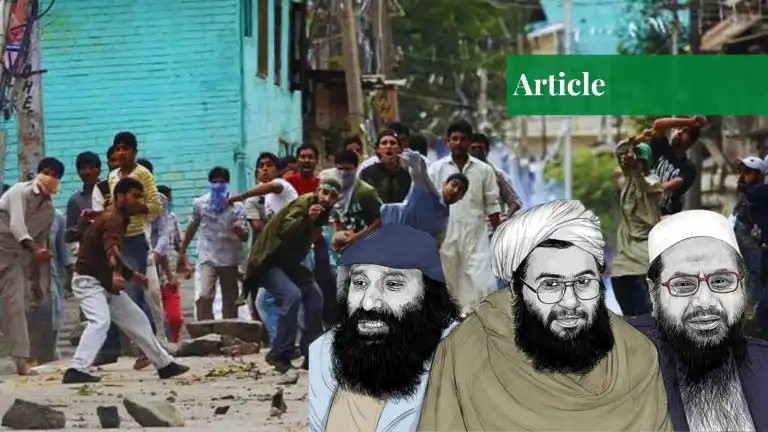
According to the U.S. State Department, three terrorist organizations are active in Kashmir, which include Hizbul Mujahideen, Jaish-e-Mohammad, and Lashkar-e-Taiba. Mostly, these terrorist groups act in the disguise of charitable organisations to avoid sanctions.
India and Pakistan both have been accused of committing human rights violations in Kashmir. Both countries play the blame game with each other. They conduct counterterrorism operations, kill the leaders of terrorist organizations, but do not focus on the point that after the deaths of their leaders, these organizations temporarily run under their ‘shadow commanders’, the decentralized leadership of Kashmir terror groups.
Historical Background
In September 1989, Hizbul Mujahideen was created in Kashmir. Master Ahsan Dar was its chief. Syed Salahuddin is the commander of HM. Hm propagates its agenda through its media, Kashmir Press International. HM also focuses on women in terrorism. It has a women’s wing known as Banat-ul-Islam. Jamat-e-Islami and SIMI are connected with HM Ghazi Nasiruddin, who is the ‘chief commander of operations’; he succeeded Saif-ul-Islam. Saleem Hashmi is the spokesperson of HM. This organisation is backed by Ghulam Nabi’s Kashmir American Council and Ayub Thakur’s World Kashmir Freedom Movement in the USA. HM is divided into the following five divisions:
- Central Division: For Srinagar District
- Northern Division: for Kupwara, Bandipora, and Baramulla Districts
- Southern Division: For Anantnag and Pulwama Districts
- Chenab Division: For Doda District and Gool in the Udhampur District
- Pir Panjal Division: Rajouri and Poonch Districts
In 2000, Masood Azhar created a terrorist organisation known as Jaish-e-Mohammad. It is an offshoot of Harkat-ul-Mujahedin. Its main headquarters is in Punjab and operates from Afghanistan, Indian Kashmir, and Pakistan. Its main agenda is to strengthen Pakistan’s position and gain legitimacy on the Kashmir issue. For this, it has conducted four notable operations in Jammu and Kashmir.
In the 1980s, Hafiz Saeed, Abdullah Azzam, and Zafar Iqbal created a terrorist organization known as Lashkar-e-Taiba. Its motive is to merge Indian-administered Kashmir with Pakistan. It is operating under the guise of a charitable organization through its various fronts, like Jamaat-ud-Dawaa. Its headquarters are at Muridke, Punjab, Pakistan. To achieve its motive and to mark its identity at the top, it has conducted attacks in several parts of India, apart from Jammu and Kashmir.
Scholars on counterterrorism operations analyse that targeting leaders of terrorist organizations often leads militant groups to become more diffuse and harder to dismantle. These militant groups then operate under their decentralized leadership, run by ‘shadow commanders’.
Decentralized Leadership and Its Advantages for Terrorist Organizations
Decentralized leadership mostly happens in cases when the leader of that terrorist organization has died or been killed. This is known as leaderless resistance or phantom cell structure. In this situation, the covert cells or the lone wolf under their shadow commanders challenge the established institution to gain influence. They lack vertical (hierarchical) command and operate horizontally (decentralized).
Intelligence finds it harder to locate decentralized groups because there is no single chain of command to follow. Policy Brief of the Belfer Centre for Science and International Affairs notes that these decentralized groups are unpredictable in nature, as each covert cell of an organization takes its own decision, which changes the traditional modus operandi of that terrorist organization. Due to this, they become more resilient to counter when their leadership is abolished.
This can be understood by taking the example of a terrorist organization like Hizbul Mujahideen. Despite recurrent counterterrorist operations conducted by India, militant activity has not stopped. Instead, local commanders and small cells have continued to operate independently, emphasizing their strategy of shadow commanders.
Thus, counterterrorism operations facilitate leadership replacement through shadow commanders, which causes flexibility in decision-making and increases unpredictability in attacks. Decentralization ensures that targeting leaders doesn’t end terrorism, but rather it restructures it. After targeting leaders of terrorist organizations, armed forces and intelligence must focus on targeting their commanders. Usually, their commanders disintegrate to create small terror groups. Due to this, many terrorist factions are created from the original ‘parent’ organization. These groups become difficult for intelligence to trace, which is a benefit for these organizations. Due to this, they carry out frequent terrorist attacks and gain influence in the region.
Counterterrorism Implications
The following are some implications for reducing terrorism in Kashmir:
- Strengthen Intelligence: Focus on intelligence strengthening at ground levels rather than only stressing leaders. Use human intelligence (HUMINT) to locate the small cells and shadow commanders of terrorist groups. Intelligence must communicate with locals to deradicalize terrorist networks. Also, intelligence must coordinate with neighbouring countries to track the cross-border movement of militants.
- Specialized Patrolling Units (SPUs): Rather than large-scale military operations, small patrolling units will be deployed to track safe havens and their networks. This would help in disrupting their network and cells without civilian damage. These units must have strong communication with other agencies like the police and military.
Conclusion
The shadow commanders in Kashmir highlight the complexity of militant tactics. It shows how decentralized leadership allows terrorists to operate despite the elimination of top leadership. This makes it difficult for intelligence to locate the phantom cells and makes it beneficial for militants to operate independently without being on track. Counterterrorism strategies must evolve. Rather than following traditional tactics, intelligence must focus on lone wolves after targeting top leadership. They must focus on parallel strategies by creating small units like specialized patrolling units, as terrorists are doing.
“Peace is not the absence of conflict, but the ability to cope with it by peaceful means” (Mahatma Gandhi)
If you want to submit your articles and/or research papers, please visit the Submissions page.
To stay updated with the latest jobs, CSS news, internships, scholarships, and current affairs articles, join our Community Forum!
The views and opinions expressed in this article/paper are the author’s own and do not necessarily reflect the editorial position of Paradigm Shift.