

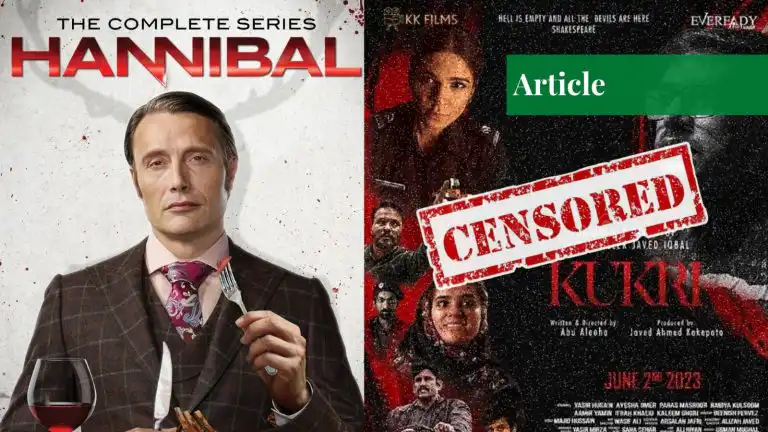
Aesthetic Familiarisation With The Cannibal
A beautifully arranged dinner waits beneath warm candlelight. The table is spick and span, polished silverware, expensive wine, celestial porcelain, and a meal presented with the precision of fine art. Classical melodies saturate the air. The host is august, patrician and courtly. The eerie calm replaced the expected devastation of violence. Only later are we reminded that the meal may contain a human being. This is the disturbing brilliance of Hannibal. It does not merely show cannibalism; it gives cannibalism an aesthetic!
Brutality is meticulously reshaped, transforming human flesh into a masterpiece of stunning culinary creation. The audience is supposed to feel disgust but is also hypnotized to look closely, admire the composition, and praise the table silently by remaining frozen at the table.
Cinema has long represented cannibals as monsters. However, many contemporary films and television series no longer leave the cannibal outside civilization. The cannibal now lives among us. He may be a psychiatrist, an artist, a romantic outsider, an attractive young woman, or an apparently suburban neighbor. He speaks intelligence, dresses elegantly, and possesses an emotional life that the audience is invited to understand. This transformation can be described as aesthetic familiarization with the cannibal, the process through which repeated, beautiful and emotionally intimate representations make an extreme taboo increasingly familiar as an object of entertainment. This does not mean that viewers begin approving of real cannibalism, nor does it mean that watching Hannibal turns the audience into potential cannibals. The issue is more subtle. Cinema makes the previously unwatchable watchable. It does not normalize the act morally; it familiarizes us with it aesthetically.
Historically, Western narratives frequently situated the cannibal at the farthest edges of the known world. He belonged to distant islands, unmapped jungles, and peoples imagined as foreign, primitive, or uncivilized. Such representations did more than produce images of horror only; they also participated in the broader imaginative structures through which colonial societies understood themselves and those they encountered. The cannibal thus became one of the most extreme figures through which distinctions between civilization and savagery could be articulated. By placing cannibalism beyond the boundaries of European social life, these narratives helped sustain a reassuring sense of distance between the observer and the supposedly primitive Other. So, what happens when these reassurances start undressing themselves in broad daylight? The cannibal begins slowly to come home. He leaves the imagined wilderness and enters the city. He acquires education, money, and taste. He may sit in an expansive restaurant, practice psychiatry, speak the language of culture, and understand European art. Boom! He no longer looks unlike us; the horror is altered, touching upon the same fracture as Epstein’s Case. Our cannibals have acquired a class, an untouchable one; he now knows very well which vine to serve.
Beauty In the Abject
Disgust ordinarily asks us to look away. It is the body’s quiet alarm, a recoil from contamination, decay, and a suggestion of something that should never cross the boundary of the self. Yet visual culture has become remarkably skilled at arresting the gaze at precisely the moment instinct demands retreat. Decoring death with visual grace, corpses with sculptural forms, flesh arranged and wounds framed. The camera does not always approach the body as evidence of what has happened to it, but it approaches it as an object to be composed, giving death by violence an aesthetic vocabulary. Here emerges what researchers have described as the paradox of disgust: the capacity to experience revulsion and pleasure within the same encounter. One academic analysis of Hannibal argues that the programme derives much of its aesthetic force from heightening these opposing responses simultaneously. The distinction matters: the viewer does not simply find pleasure in cannibalism; rather, cannibalism is transformed into something presentable with the help of visual poetry. The danger of aestheticization is that the frame is beautiful. A repulsive image can be rejected and left behind, but a beautiful yet repulsive one unsettles the instinctive refusal; the metaphors, the art, hold attraction. The viewer is suspended between the impulse to turn away and the compulsion to look again.
No doubt, cannibalism is a powerful metaphor for societal consumption, capitalism, patriarchy, and whatnot. A streaming service may present a story that condemns the commodification of bodies while advertising the very story through attractive actors, seductive imagery, and carefully selected frames of violence. A series may question the morality of spectatorship while also waiting for their return, episode after episode, season after season, for another encounter with the forbidden. Cannibalism, then, is no longer simply represented. It is packaged as a genre. Awareness may become a reasonable reason for watching, while fascination remains the quieter impulse beneath it. Cinematography provides us with quite a privilege for awareness and fascination to co-exist through our screens. It allows us to stand at the threshold of a taboo, while developing a taste for it, to admire it.
A monster in a two-hour film may remain an intrusion in our daily routine, but a monster followed across several seasons is not an intruder; the viewers’ relation to the character intensifies. The viewers enter his house, observe his etiquette, his dressing, and try to understand his mood, his psychology, just like any companion in a room. Repetition succeeds familiarization. Hannibal Lecter is perhaps a revealing example. His cannibalism consequently acquires a meaning beyond his literal act of consuming another human being. To consume another human can become a metaphor for knowing them completely, possessing them, transforming them, or refusing to let them remain separate from oneself. Such themes can give the audience a new perspective on being emotionally attached to the psychology of the antagonist/protagonist.
In contemporary times, the classes of consumers are curious, depressed, confused, trying to navigate within the hustle. Interest is attraction; metaphors in Hannibal cannot get one on the table as a cannibal, but it may give an idea that interests, that excites, and curiosity above all may become a cherry on top for a viewer of the cannibal to step into the shoes of the cannibal with the help of aesthetic familiarization.
The Comparative Case Of Kukri: Censoring The Real Cannibal
Sometimes this question pops up into my mind that why are we always late to our own values?
While Hollywood uses “aesthetic familiarization” to make a monster like Hannibal Lecter portable through high culture, which is understandable due to the cultural anxieties rooted in it. Pakistani cinema took an opposite approach with Kukri, the dramatization of a serial killer, Javed Iqbal. The film was not merely censored to prevent the “glorification” of a monster; it was censored because the state did not want us to look at the true cannibal in the room. The system itself.
Kukri was hacked by censor boards because it laid bare institutional failure, police incompetence, and a legal void. To this day, the Pakistan Penal Code completely lacks a statutory definition or punishment for cannibalism. When the real-world Bhakkar cannibal case shocked the nation, the state had to scramble, using anti- terrorism and grave discretion laws as a band-aid. By heavy-handed censoring of the local crime, the state actively prevents the audience from realizing that our legal infrastructure hasn’t even evolved to define our darkest realities. When certain parliamentarians like Mr. Iqbal Qadri, Dr. Nikhat Shakeel Khan, and a few others tabled motions to insert relevant provisions, despite parliamentary approval at the committee level, the bill fell into political cold storage because apparently cannibalism was deemed to be a “freak occurrence” and there were other issues to focus on.
This highlights a hypocritical cultural complex: we willingly consume the sanitized, artistic violence the West serves us, celebrating it as peak cinema. Yet, when local art attempts to dissect our own monsters, we shrink back. Instead of proactively tackling these taboos and putting them on the legislative menu before the West defines them for us, our institutions opt for the safety of silence, proving that we are far more terrified of facing our systematic failures than the monsters they produce. The censor board didn’t cut 22 minutes of Kukri to protect us from gore; they cut it to protect themselves. It is high time that we become the pioneers of engineering laws grounded in our own realities.
If you want to submit your articles and/or research papers, please visit the Submissions page.
To stay updated with the latest jobs, CSS news, internships, scholarships, and current affairs articles, join our Community Forum!
Find our FREE quizzes and MCQs here!
The views and opinions expressed in this article/paper are the author’s own and do not necessarily reflect the editorial position of Paradigm Shift.

Omama Z. Khattak is a fourth-year LL.B(Hons) student at the International Islamic University, Islamabad, with a track record of winning the All Pakistan English Declamation Contest, Moot Court Competitions, and Best Speaker awards.