
On 9th October, around 02:00 in the afternoon, Laiba Ijaz said goodbye to her mother, saying she was heading to a nearby market. Little did the mother know that it was the last time she would see her daughter alive.
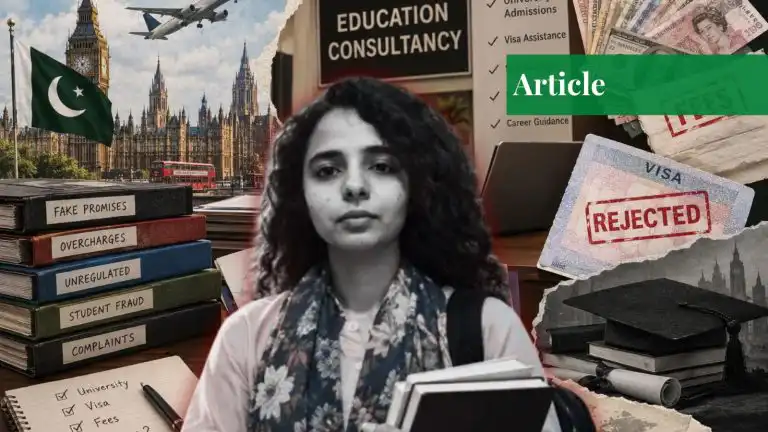
The tragic death of Laiba Ijaz, a Physics gold medalist from International Islamic University Islamabad (IIUI), has sent shockwaves of grief and rage across the nation. The twenty-year-old girl fell victim to a consultancy and immigration scam. Like any other exceptional student, Laiba had high ambitions of securing admission to an Ivy League institution such as Harvard. However, coming from a middle-class background, she knew that securing a scholarship was the only viable path to her goals, and the accused, Muhammed Nouman, claiming to be a high-ranking official, ruthlessly exploited her aspirations.
As per the Federal Investigation Agency, Mr. Nouman fabricated a Harvard acceptance letter, scholarship letter, and fee payment receipts. As per the First Information Report (FIR), the accused got Rs. 9.3 million for these fake documents, out of which the first installment of Rs 2.9 million was paid to him directly through the victim’s bank account, whereas the remaining sum was paid through periodic cash installments. For Laiba and her family, managing this colossal sum wasn’t easy; her father sold his land and her mother mortgaged her gold jewelry just so their daughter could achieve her dreams. This guilt weighed more than the financial ruin and ultimately pushed Laiba to take her own life. Coming from a modest background, Laiba and her family were vulnerable to such deception, as the perpetrator was impersonating an accountant at the Supreme Court. The deceased’s father told the media that his daughter met Nouman in Blue Area and afterwards he, himself, met him as well. Since no proper verification mechanism exists for educational consultancy licenses, there were no certifications the family could check beforehand.
A case has been registered in the Federal Investigation Agency (FIA)’s Anti-Human Trafficking Circle against the two main suspects, Muhammad Nouman and Fatima Sarwar, over the fraud of Rs. 9.3 million, where both suspects were accused of collusion. As per FIA’s account, the fraud and mental anguish pushed Laiba to commit suicide. The report invokes sections 419, 420 and 109 of the Pakistan Penal Code (PPC), along with sections 18 and 22 of the Emigration Ordinance, 1979. None of these stated sections deal with offenses related to any form of qatl. In contrast, under section 306 of the Indian Penal Code, abetment of suicide is an offense punishable with ten years of imprisonment; however, no such equivalent law exists in Pakistan despite suicide being considered a major socio-legal offense. Furthermore, the current criminal justice system also offers no mechanism for rapid recovery of assets lost by the victim’s family. Although a five-day remand has been granted and proceedings against the suspects continue, no form of relief or financial restitution has been provided so far to the victim’s family.
While this incident has shocked the nation due to the sheer cruelty of man, it also exposes major regulatory gaps in the governing system of Pakistan. The foremost is the complete absence of any kind of regulatory mechanism or licensing system for the administration of so-called ‘education consultancies’ in Pakistan. Due to inflation and economic stagnation, recent years have seen an unprecedented rise in Pakistani students or workers moving abroad. In 2026 alone, over 15,850 educated persons left their country for better opportunities abroad. This massive surge has created a multibillion-dollar industry in the “consultancy sector” in Pakistan.
Out of 8000 such firms, only a thousand or so are registered voluntarily, and the remaining operate in unregulated grey zones. As per another data source, almost 2741 educational consultants are working in the country, out of which 87.01% are sole proprietorships, while 12.99% act as a subsidiary branch of larger brands. However, this number should not be treated as absolute because it is mainly derived from consultancies that have a social media presence. Because in reality, you can find a single-room consultancy in any commercial plaza across a metropolitan city.
That’s where the major regulatory void persists because a soaring number of such consultant firms exist, yet no government department entails prerequisites or issues any sort of “education consultant license” for such consultants. Neither the Higher Education Commission (HEC) nor the Federal Education Ministry has any mechanism to oversee such “study abroad firms,” and as a result, anyone can claim the title of an “educational consultant” and can set up an office. There is no mechanism to verify whether the consultant even has the requisite knowledge required to navigate foreign admissions.
Back in 2008, a non-profit organization named Association of Foreign Education Industry Consultants (AFEIC) tried to fill this lacuna by registering professional educational consultancy firms to establish a unified platform to promote transparency for both aspirants as well as consultants. Apart from this, some other firms run on international accreditations such as ICEF certification or country-specific certifications such as AIRC (American International Recruitment Council), which are usually done by consultants working to recruit students interested in moving to the United States. Others partner with the British Council to acquire training for the UK system tailored especially for such aspirations.
Countless firms are operating unvetted, and families risk millions with such unregistered places in pursuit of a better future for their children. While some agencies are legitimate and succeed in securing genuine admissions, many applicants fall prey to fraudulent schemes.
This vulnerability emphasizes why relying solely on the current system of justice would be futile. Preventing such market exploitation requires prior state regulation. Firstly, it is imperative to fix the identified regulatory lacunas through proper legislation by the lawmakers. Pakistan’s legislative history demonstrates that parliamentarians can mobilize rapidly to pass complex constitutional amendments. Now, this is the need of the hour: that those members show the same fervor to draft robust statutes for the protection of their own youth.
The second step should be the establishment of a statutory authority that would issue mandatory licenses under the aforementioned legal framework. Proper scrutiny of the consultants, as well as mandatory tax audit filings, must be legally integrated into the system linked directly to every such firm.
Last but not least, there is a need to understand that academic documents such as confirmation of admission or scholarships are sent to the students directly by the respective university’s administration, usually through email. The consultant’s role is only to act as a middleman to facilitate the student and link him or her to the foreign university. There is a dire need to create awareness among young scholars to critically analyze the opportunities presented to them under the guise of guaranteed admission. They must conduct thorough background research on the educational consultant and all the affiliated institutions to protect themselves from falling prey to such frauds.
Ultimately, Laiba Ijaz’s death demonstrates a stark example of what happens when youth ambitions meet an unregulated and exploited market. Hence, it’s high time for the authorities and lawmakers to treat this crisis with utmost urgency and to take decisive steps to safeguard its youth.
If you want to submit your articles and/or research papers, please visit the Submissions page.
To stay updated with the latest jobs, CSS news, internships, scholarships, and current affairs articles, join our Community Forum!
Find our FREE quizzes and MCQs here!
The views and opinions expressed in this article/paper are the author’s own and do not necessarily reflect the editorial position of Paradigm Shift.