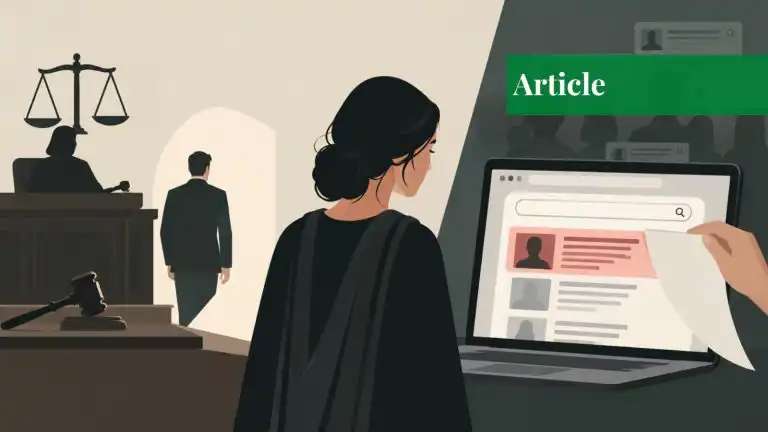
We know many instances where we search a person’s name and the internet has preserved a version of that person long after the law or time has moved on. An allegation becomes a front-page story. The headline turns into a past article. The article is made into a search result. Years later, when someone searches that name, the allegation may appear in a few seconds, while the judgment that acquitted, cleared, or otherwise ended the proceedings may be buried several pages below, if it’s there.
The problem is not that the original reporting was false. It could have been entirely true at the time of its publication. The issue is how to make one part of the story visible forever, while the other part (the legal verdict) is almost invisible. The “right to be forgotten” comes into play in Pakistan here.
The right to be forgotten is generally interpreted as the right to have personal data removed from search results or otherwise deleted when it is no longer relevant, outdated, inaccurate, or unlawfully processed. In the search engine context, this is often referred to as “delisting”: the webpage can still be found on the internet, but no longer appears in the search results when the person’s name is entered.
That distinction matters. The right to be forgotten is not necessarily a right to destroy history. It questions the continued ease with which information can be linked to a person’s identity when the rationale for it being so easily available has become less.
A Right to Erase, But Not Rewrite History
The modern right to be forgotten is the result of the judgment of the Court of Justice of the European Union in Google Spain SL, Google Inc. v Agencia Española de Protección de Datos (AEPD), which was handed down in 2014. The Court acknowledged that search engines work with personal information and that in certain cases, a person might request the search engine to remove links to personal information from search results.
The principle was later enshrined in Article 17 of the General Data Protection Regulation (GDPR), which was specifically known as the “right to erasure (right to be forgotten).” It provides that:
“The data subject shall have the right to obtain from the controller the erasure of personal data concerning him or her without undue delay.”
These encompass the cases in which the data is no longer required for the purpose it was originally collected, consent has been revoked, there are no other lawful bases for processing, the data was processed in an unlawful manner, or the processing is required by law. Article 17 also protects conflicting interests such as freedom of expression and information, legal obligations, public-interest functions, public health, scientific or historical research, statistical purposes, and establishment or defense of legal claims. (EUR-Lex)
Looking at how Article 17 is set out, the core point stands out. The right was not meant to act like a tool to erase any and all records someone dislikes. Instead, it is meant to strike a balance between privacy and the need for access to personal information. The challenge is heightened if the information is about criminal proceedings.

When the Information Is True
A person convicted of a serious offense cannot outright demand that his conviction record disappear from the internet simply because it is damaging to his reputation.
In NT1 and NT2 v Google LLC, the English High Court dealt with requests about old criminal records. It reached different results for the two people who applied. The Court took into account the nature of the offenses, whether the convictions were spent, the applicants’ behavior since their release, the ongoing relevance and truthfulness of the information, the impact on their private and family lives, and their continued relevance when it comes to the public.
The fact that a conviction had become spent was a “weighty factor” in favor of delisting, but it was not decisive. The case demonstrates why criminal information cannot be treated as automatically removable merely because time has passed.
Google applies a similar balancing approach when it comes to the removal of information. When considering such applications, it asks whether the continued display is “strictly necessary” to protect users’ freedom of information. It also takes into account the time that has elapsed since the conviction and the local rules regarding whether convictions are “spent,” “expunged,” or otherwise “put behind” the individual.
The European Court of Human Rights has also been reluctant to accept that the passage of time is an automatic excuse to wipe away criminal records. In M.L. and W.W. v. Germany, the applicants wanted to block media outlets from keeping online archives that would identify them as having been convicted of murder. The Court weighed their Article 8 privacy rights against freedom of expression and the public’s right to information. It did not consider that there was any violation, given the ongoing public interest, the status of the applicants, and the context of the publication.
However, public interest does not constitute an absolute defense to privacy. In Hurbain v. Belgium, the European Court of Human Rights took into account an article published in 1994 concerning a fatal road accident. The complete driver’s name was later added to an online database, where it could still be easily searched. Decades had gone by; the individual was not a public figure, and the information was not of topical, historical, or scientific interest. The Court, taking into account the time elapsed, the harm that would result from the continued availability of the archived article, and the impact of the measure on freedom of expression, accepted the request for anonymization of the article.
However, a middle ground also exists in Węgrzynowski and Smolczewski v. Poland. The Court noted that complete removal of an online archive was not necessarily the only means of protecting an individual’s rights and pointed to less restrictive measures, including rectification or adding information about subsequent developments.
These cases demonstrate that there is no need for a binary remedy. Correction, contextualization, anonymization, and delisting are the perfect balance that the courts are trying to achieve in the long run.
The Harder Case: When the Accusation Survives the Outcome
The most difficult case for Pakistan is not about the convicted person. It is the person who was accused and later acquitted. Take a case of a serious offense for which a person is charged. Newspapers publish it. Social media triumphs. It is used by search engines. The case goes to trial, and after several years, the individual is acquitted.
There is a chance that the acquittal will get some reporting but not as much as the original accusation. The original headline, however, is still available for search because there’s no newsroom that says a story that happened a long time ago has become obsolete. What you end up with is a digital record that can be technically correct but is still missing major chunks.
This is why the right to be forgotten should not be narrowed down to the issue of whether the information is accurate or inaccurate. A statement may be accurate at the time of publication but become misleading due to changed circumstances.
In this case, deletion may not be the correct answer. But we have ample options such as correction, contextualization, anonymization, or delisting. It is where the historical record is not destroyed and can be found by a researcher. What changes is the ease with which the information is attached to the person’s name, so it can no longer damage his life when it comes to personal and professional domains.
Pakistan’s Constitutional Gap
Pakistan’s constitution already recognizes the values that are central to this debate. Article 14 guarantees the “dignity of man and, subject to law, the privacy of home shall be inviolable.” Article 19 protects freedom of speech and expression and freedom of the press subject to reasonable restrictions. The citizens have the right to access information in matters of public importance under Article 19A and are subject to regulation and reasonable restrictions under law.
The Constitution therefore contains both sides of the problem. On one end, it is dealing with dignity and privacy while still upholding expression, press freedom, and access to information. What Pakistan lacks is a clear constitutional doctrine of informational self-determination or a settled right to be forgotten.
Article 14 was drafted before search engines were able to make someone’s history searchable in seconds. However, constitutional rights have the capacity to react to new types of intrusion. Pakistani courts have given various interpretations of dignity and privacy in various contexts, but the digital sphere is still behind when it comes to a coherent framework explaining when continued online availability of personal information becomes disproportionate.
The Prevention of Electronic Crimes Act, 2016, has a punitive mechanism and does not fill that void. PECA does address several forms of unlawful conduct involving electronic systems and digital frauds, but it has failed to create a general data-subject right comparable to Article 17 of the GDPR. A person in Pakistan cannot demand that their lawful personal information be erased, corrected, or delisted because it has become outdated or disproportionate.
The proposed Personal Data Protection Bill takes a step towards that model. Section 5 of the draft introduces a right to be forgotten in specific cases, such as where personal data no longer serves the general purpose, where consent has been revoked but there is no alternative lawful basis for processing, where it can no longer be considered to be in the best interests of the person, or where the data has been unlawfully processed.
But erasure and delisting do not fall in the same basket. Erasure relates to the deletion of personal data that a controller has. Delisting is related to information search. Even when there is a strong privacy concern, it can still be legitimate public information and therefore be disclosed. In circumstances where continued name-based indexing is an imbalance, a historical newspaper archive may still be of value.
This is why Pakistan needs a framework with more than one remedy. We can rely on correction for inaccurate information and contextualization where the original account remains legitimate, but the later outcome is missing. We can go for anonymization, where continued identification is no longer justified; delisting, where name-based accessibility has become disproportionate; and erasure, where processing itself is unlawful or no longer justified. The solutions are right in front of us; all we need is a framework to implement them.
Learning From Other Jurisdictions
Pakistan would not be inventing this framework from nothing. Different jurisdictions have attempted to translate privacy and data rights into practical mechanisms.

Brazil enacted the General Data Protection Law in 2020, which established rights on personal data, while Colombia also provides its citizens with constitutional protection for informational privacy. When it comes to Asian countries, South Korea’s Personal Information Protection Act grants significant deletion rights compared to the more limited approach taken in Japan. China has also adopted the Personal Information Protection Law in 2021, which also affords and recognizes deletion rights.
Pakistan has no responsibility to copy the GDPR or any foreign model.
Pakistan’s judicial system has already established through decisions in cases like Jawwad S. Khawaja v. Federation of Pakistan and Monal Group of Companies v. Capital Development Authority that constitutional rights can evolve along with changes in social reality. These cases don’t create a right to be forgotten but create an opportunity for interpreting Article 14 beyond the traditional interpretation of privacy rights in the light of technological change in the definition of personal injury.
Any Pakistani citizen who thinks that a search result is inaccurate, irrelevant, or disproportionately harmful should be able to make a request for this, be given reasons for the decision, and challenge a refusal before an independent authority or court.
An independent data protection authority would therefore be central to the system. A regulator has to be institutionally independent and have investigative power and authority to impose the remedy. Otherwise, a right to be erased or removed might prove to be a right on paper only and hard to enforce against the powerful platforms and data controllers.
What Should the Balancing Test Consider?
The answer should depend on the circumstances of each case.
How much time has passed? Are there any errors in the information, or is it relevant? Is there a high or low sensitivity? Was the person a private person or a public figure? What are the disadvantages if the access continues? These questions are to be balanced against the public interest.
Apart from that, we need to assess the seriousness of the situation. Is the information related to corruption or misconduct? Is the person a public figure? Does the information have any historical, scientific, or research significance? Will the taking down of the information unduly affect the freedom of the press? Hence, it is not a walk in the park; rather, we need to establish a clear jurisprudence to navigate this delicate path.
Another point that needs to be noted is the identity of the person. Public figures cannot always claim privacy rights over their actions. The statements of politicians can still be recorded in history. Information on corruption can still be deemed significant after many years from the time of reporting.
But this position changes for a private individual whose decades-old involvement in a case no longer bears any meaningful relationship to their present life. Thus, we can safely conclude that time is important. Accuracy is important. Rehabilitation is important. Most importantly, the difference between accusation and conviction is important.
A Possible Constitutional Response
The immediate solution does not necessarily require a constitutional amendment. A constitutional amendment is not necessary for this remedy. It might very well be argued that Article 14 can be interpreted in the digital age to include informational privacy within the right of dignity, and the legislation can set out the process and safeguards.
However, if Pakistan wants to go ahead and constitutionalize informational self-determination, then a proposed Article 14A could provide:
“Every individual shall have the right to informational self-determination and to the protection of personal data concerning them. Every individual shall have the right to request the erasure, correction, restriction, or de-indexing of personal data concerning them, subject to such limitations and safeguards as may be prescribed by law.”
That is the key part. An absolute right to erasure of information cannot be guaranteed, and freedom of expression, press freedom, and the right to access information and historical records must all be taken into account.
The right will be guaranteed through the constitutional principle, the process through legislation, enforcement through an independent body, and balancing through the courts.
The Internet Should Not Become a Permanent Sentence
The right to be forgotten is not about erasing your criminal records or public life. Total deletion is not possible because the information can be copied, cached, archived, and republished, while the delisting of content in one area does not mean that the information is erased in another jurisdiction. Suppression of information will only bring more attention to it.
Law has to remember history objectively.
A charge against someone may have been true at one time in the past, but it is misleading because the charge was overturned. A criminal case may have been true at one point in the past, but its relevance decreases over time. A news story may have been true at the point of publication, but it needs to be contextualized.
The right to be forgotten should therefore not be seen as the right to rewrite history but as the right to wonder if history should define the present. Pakistan does not need the internet to forget but the internet to remember objectively.
If you want to submit your articles and/or research papers, please visit the Submissions page.
To stay updated with the latest jobs, CSS news, internships, scholarships, and current affairs articles, join our Community Forum!
The views and opinions expressed in this article/paper are the author’s own and do not necessarily reflect the editorial position of Paradigm Shift.