
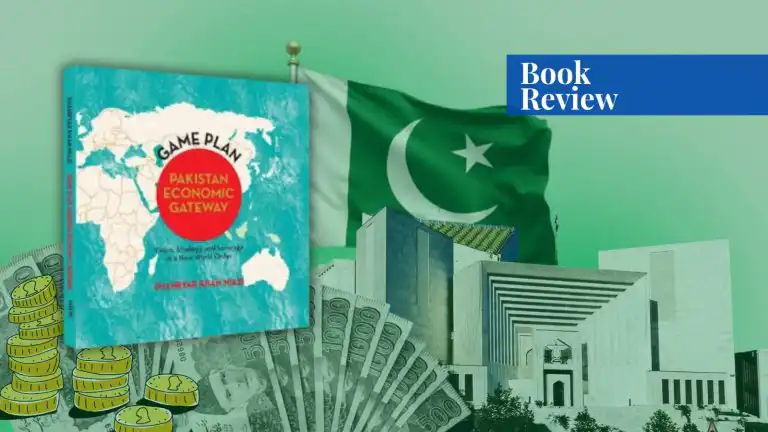
The book, Game Plan: Pakistan Economic Gateway—Vision, Strategy, and Leverage in a New World Order, by Shahryar Khan Niazi, traces the history of maritime routes and trade patterns around the world over the last few centuries in a visually distinctive style. It relies on illustrations, maps, and graphics to present this history, which is an effective way to study the subject and makes the book an engaging read.
The main focus of Game Plan: Pakistan Economic Gateway is the maritime trade routes, the regions, nations, and continents connected by them, and their economic and political importance. Each chapter gives a concise history and an account of recent developments for the countries linked to a major route, so readers can see a whole region in one section. Pakistan’s economic development is the book’s central concern, and the whole discussion revolves around it.
Having established its basic argument, the author turns to Pakistan’s economic resources, its geographical position, and how the country could make use of both. The book is a useful contribution for readers who want a basic understanding of the world’s geo-economic picture. However, it is not a current affairs book. Game Plan: Pakistan Economic Gateway is mostly a historical record, and its recommendations for Pakistan’s development are normative statements that do not account for the geopolitical situation the country faces today.
The book has thirteen chapters on 148 pages in portrait layout. It opens with pictorial and graphic accounts of maritime trade worldwide. The next five chapters cover the Indian Ocean, the Euro-Atlantic region, Russia, China, and India. Chapters 7 to 11 examine Pakistan’s trade routes, geographical position, and economic potential, and how that potential might be tapped. Chapter 12 describes the global dominance of the US and the emergence of a new world order, with China rising as a strong rival to the existing superpower. The last chapter considers Pakistan’s place in this new order and how it could cope if another Cold War were to develop between the major powers.
Game Plan: Pakistan Economic Gateway has both strengths and weaknesses. Its main strength is that it tells history through pictures and detailed maps, which holds the reader’s attention and maintains their interest. The prose is readable, and the author builds a detailed background before moving to his argument. For these reasons, the book can serve as a basic reference on the world’s history, geopolitics, and economic context. It also gives a detailed picture of Pakistan’s economy and of the trade routes that run through the wider region, including its neighbors and the areas beyond them.
Every book that focuses on one topic neglects some related themes, and this one is no exception. It concentrates heavily on pictorial descriptions of global trade routes and their effect on the world economy and, in doing so, drifts from its stated theme, a game plan for Pakistan’s economic development in a changing world. Although a good part of the book is dedicated to Pakistan, the discussion and information remain quite basic. The proposed roadmap for the country’s economic position is thin and lacks analytical depth. The book is therefore suited to readers who want basic information about global trade routes and Pakistan’s place among them.
The book also draws on relatively few Pakistani sources when it presents facts about the country’s economic resources. This makes independent verification of some of the material necessary. Nor can it be counted as an academic book, since it does not follow academic conventions: not every claim or suggestion is backed by clear reasoning or a reference. Finally, compared with other books of its kind, it adds little to the field, as most of its information is already available elsewhere.
Overall, Game Plan: Pakistan Economic Gateway is a good read for building basic knowledge of international trade routes, especially maritime ones, of where Pakistan stands in this picture, and of how it might engage with regional and global economic partners. Its maps, graphs, and figures support its main purpose and keep the reader interested. On the other hand, the economic framework it proposes for Pakistan in the new world order relies largely on normative statements and offers limited analytical depth, which leaves the book largely a record of information that is already available.
If you want to submit your articles and/or research papers, please visit the Submissions page.
To stay updated with the latest jobs, CSS news, internships, scholarships, and current affairs articles, join our Community Forum!
Find our FREE quizzes and MCQs here!
The views and opinions expressed in this article/paper are the author’s own and do not necessarily reflect the editorial position of Paradigm Shift.

Dr. Asim Ehsan is a Senior Research Officer at the Institute of Policy Studies, Islamabad, specializing in Islamic economics and finance, with research interests spanning Islamic finance, economic policy, environment, and institutional development