
In February 1848, a revolt in Paris, backed by economic and political repercussions, overthrew King Louise Phillipe, and within months the fire had spread to Vienna, Berlin, Milan and Budapest. By October 1849, a political and social upheavals grasping the continent, had toppled over more than 50 European countries. Historians gave this synchronized revolution the title of “Springtime of the People.” More than a century later, Europe might be standing at the brink of such a revolution, which again began in Paris, yet this time it might only take weeks and not months for it to spread across the borders.
Riots Across Borders
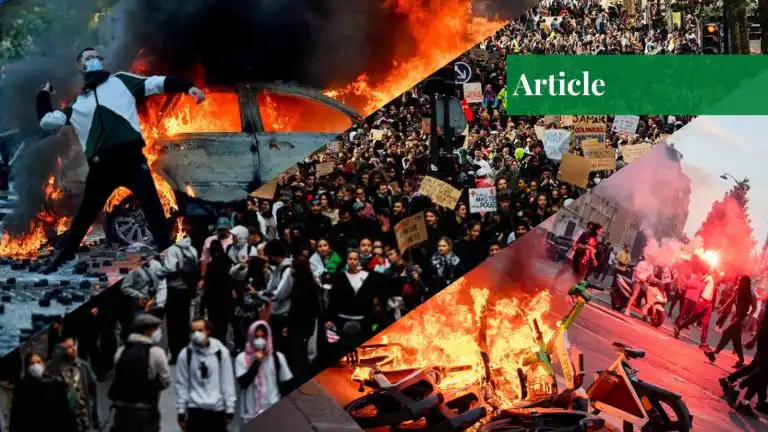
In late September, what began as localized blockades of schools in the suburbs of Créteil and Seine Saint-Denis rapidly expanded, bringing hundreds of thousands of students and teachers into the streets from the Place de la République to the Place de la Bastille. All this led to the disruption of more than seven hundred (700) secondary schools, and more than six thousand individuals, mostly high school students, being arrested by the police.
By October 2026, the riots had crossed the borders. Clashes occurred as thousands of protestors took to the streets in Brussels against austerity measures and budget cuts imposed by the government. Hundreds of students who had already taken the streets of Liège, inspired by their French counterparts, joined the protestors in the capital, holding placards reading “I skipped class to defend class” and “Education is a right, not a privilege.”
However, France and Belgium aren’t the only states facing this overwhelming opposition by their youth. In Spain, the Prime Minister Pedro Sanchez was forced to dissolve parliament and call for early elections because of unprecedented nationwide protests over the housing and rent crises. The eviction of 87-year-old Maricarmen Abascal from the flat she had lived in for seven decades set off nationwide fury and led to demonstrations in 50 cities of the state, with tens of thousands of protesters, with the exact number being ambiguous as police counted 70,000 protesters in Madrid, yet the organizers claimed over 500,000.
Across Europe, this widespread discontent is palpable. Protesters holding placards reading “Gen Z is coming” contributed to the fall of the Bulgarian government in 2025. Bulgaria’s Prime Minister Rosen Zhelyazkov was forced to resign after waves of youth-led protests on corruption and anti-austerity measures. This made it the first European administration felled by the youth protest wave that had already toppled governments in states like Bangladesh, Nepal and Madagascar. While the regional catalysts behind such protests might differ across geographical borders, the centrifugal force behind the entire chaos is strikingly identical. The European youth, just like their predecessors, find the current social contract system quite faulty to be applicable, especially when it yields no tangible results. Hence, this radicalization of protests is not another form of social boycott, it is full blown crises of democratic legitimacy.
Where the Grievances Lie
At its core, the turmoil across the streets of Europe feels like a manifestation of Robert Gurr’s Relative Deprivation Theory. The theory focuses upon societal gaps as a catalyst for social liberation movements when individuals experience deprivation compared to a relative group, and they perceive a discrepancy between value expectations and value capabilities. The post World War II’s Europe was reorganized and reconstructed with two basic commitments and a promise; commitment to education and commitment to work and resultantly the state would make sure that you have a comparatively better standard of living. The promise did hold its value for some decades, yet with the ever-evolving geopolitical landscape of the world, today’s youth find that promise shattered. As per Eurostat’s statistics, the youth unemployment rate in European Union is at 15.4% as of August 2026. Compared with August 2025, youth unemployment increased by 19000 in the EU and by 38000 in the euro area, with the rates soaring to 22.7% in countries like Spain.
European youth have fulfilled their part of Bourdieu’s equation, yet when they expected the state to perform its duty, the dynamics altered and rules contoured. The unexplained budget cuts, anti-austerity measures, uncalled restrictions, and persistent inflation have eroded youth’s trust in the reigning authorities. This has led to the destruction of the public’s faith in the government and in democracy itself. For them, democracy has lost its meaning of “by the people, for the people, of the people”, as they consider the current political systems working solely to protect the wealthy and aristocratic sector.
Mishandling of State Affairs
Retrospectively, Europe has a long history of such protests. In May 1968, French students occupied the Sorbonne and within weeks ten million workers had joined them in a general strike. Yet that revolt didn’t move beyond France. Yet what differs this time is how this generation is radicalizing the entire movement, carrying it beyond borders. The blockades in Créteil did not need months to inspire Liège, and footage from Paris was on students’ phones in Brussels the same night, with a student commenting that they have been in contact with their French counterparts. Each one feeds the others, and together they form a single wave of anger against states that, at the moment, seems unable to satiate the queries of their youth and that is what makes the current riots across European streets harder to contain than back in 1900’s because the digitalization of the world has given even a localized riot transnational influence.
Yet what worsens the entire situation more is how state agencies are handling the way people are expressing their grievances. Rather than addressing the core issues, the authorities resort to hostility and the sight of using tear gas and water cannons has become common to dismiss the masses.
From the state’s perspective, the dismissal is justified. No government can allow schools to be blockaded indefinitely or its metropolitan cities to burn, affecting transportation and public property. Yet the use of force to repress this mounting has left the public, as well as the ruling authorities, stuck in a quagmire of an escalating cycle, because the more the state grows authoritative and deaf to public pleas, the further alienated the youth would get from the democratic functioning of their own state.
If you want to submit your articles and/or research papers, please visit the Submissions page.
To stay updated with the latest jobs, CSS news, internships, scholarships, and current affairs articles, join our Community Forum!
Find our FREE quizzes and MCQs here!
The views and opinions expressed in this article/paper are the author’s own and do not necessarily reflect the editorial position of Paradigm Shift.