

He is pursuing a BS in International Relations programme from International Islamic University, Islamabad and has a keen interest in research works, policy analysis, defence and strategic studies and conflict resolution.
Islam is considered a complete code of life. From birth to death, it provides guidance to its followers in every aspect of life. And war, also known as ‘Jihad,’ is one of the prominent concepts in Islam. Although war has always been denounced in Islam, if imposed, then it becomes imperative for all Muslims to fight in the way of Allah Almighty. Our beloved Holy Prophet Muhammad (P.B.U.H) and his companions have always preferred negotiations over conflict. Nearly every war fought in the history of Islam had been thrust upon them, either through direct challenge or covert means.
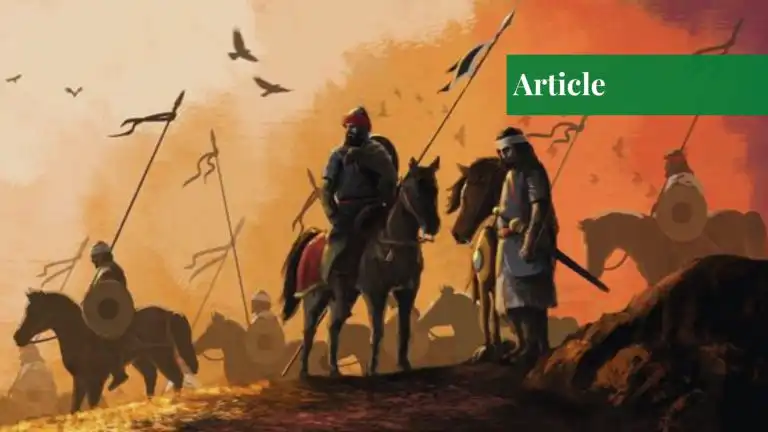
In the Quran, Allah Almighty says, “Be prepared to defend yourself against them, regardless of your capacity for force and warhorses” (8:60). Nevertheless, Allah declared, “And if they desire peace, then grant them the same choice and have faith in Allah…” (8:61). This clearly proves the fact that Islam is against expansionism and war-mongering; rather, it allows its followers to develop the intent and capability in a defensive mode. This article delves into the strategies developed by major Islamic personalities that resonated with modern-day warfare tactics.
- Prophet Muhammad (P.B.U.H)
The introducer and flag bearer of the religion of Allah Almighty was our Holy Prophet Muhammad (P.B.U.H). Being a messenger of God, he represented the highest level of intellect and wisdom. History is evident that through his deal-making and expert negotiation strategy, he had always convinced his rivals. As per the Quran, the Holy Prophet was sent as a mercy to the worlds (21:107).
As a result, his approach has never been to destroy the adversary or fight wars. No doubt, many battles have been fought during his period, but all were accomplished by his companions. He himself had never killed a human, be it the enemy or friend. In the battle of Uhud, he placed his soldiers at strategic locations as reserve forces, knowing the fact that the enemy might come from the back to create chaos in his forces.
One of the most significant events during his reign was the ‘Treaty of Hudaybiyyah.’ Sources such as Sirah Ibn e Hisham and the Life of Muhammad mentioned that he concluded a pact with Quraysh at a place called Hudaybiyyah, when his entire caravan was blocked by infidels from performing pilgrimage in Makkah. Instead of waging war against them, Prophet concluded a deal that favored his enemies rather than himself.
Thus, he preferred persuasion and alliance-making to avoid any bloodshed. However, when Quraysh broke the agreement, he conquered Makkah without any loss of life through isolating and psychologically pressuring the enemy. Thus, he became the first Islamic military strategist to introduce the concept of ‘non-kinetic warfare,’ whereby tactics like psychological warfare, alliance making, and patience are used as primary instruments against the adversary.
- Ali bin Abi Talib (R.A)
After the Holy Prophet, his cousin-brother, Hazrat Ali bin Abi Talib (R.A), is considered to be the most decisive and powerful fighter. History and Islamic literature are evident that whenever Muslims failed to fight the adversary, the Holy Prophet had sent Ali to the battlefield to defeat the enemy alone. It would not be exaggerated to say that Ali was the best manifestation of the Prophet Muhammad’s majesty. Ali (R.A.) became the first Islamic military strategist to introduce the concept of shock leadership and morale-centric warfare.
Throughout his life, Ali entered the battlefield when either the companions failed to control the situation or their morale loosened, creating a sudden shock for the enemy and motivating his forces. The Battle of Khyber is its best manifestation. For almost 39 days, Muslims were failing to control the fortress of Qamus, which was controlled by tyrannical Jews.
Amongst them, the most powerful one was Marhab. Viewing the situation, the Holy Prophet, on the night of the 39th day, said to his companions, “Tomorrow, I’ll hand over the banner to a man who loves Allah and His Messenger and is loved by Allah and His Messenger; Allah will grant victory at his hands.” On the very next day, he provided a flag to Ali and commanded him to fight Marhab.
The appearance of Ali on the battlefield came as a shock to all Jews, which created a sense of fear amongst them. Resultantly, Ali not only killed Marhab but also lifted the heavy door of the fortress, raising the morale of companions to enter and take control of it. In modern-day warfare, this strategy is known as ‘forward leadership at a decisive point,’ introduced by Clausewitz in his seminal work ‘On War.’
- Amr ibn al-As (R.A)
Another prominent military strategist in the history of Islam was Hazrat Amr bin al-As (R.A.). Being an Egyptian strategist and diplomat, he became the first Muslim fighter to introduce the concept of “Mobile Maneuver Conquest” in the vast deserts of Egypt. His strategy revolves around indirect warfare through intelligence and covert missions. He believed that in order to destroy your enemy, it is highly significant to hurt the enemy at its weakest point. Thus, his best military campaign was the Siege of the Babylon fort, or the Conquest of Egypt.
Tarikh al-Tabari stated that Amr applied the art of tactical movements as opposed to an open military attack on the fortress. Instead, he decided to surround it, block the supplies, and force the Byzantines to give up. Instead of assaulting the mighty Byzantine strongholds, he quickly cut through the desert, cutting off their communication systems, and convinced the citizens to join him or remain neutral. In this way, he could conquer Egypt with minimal losses. This strategy is reflected in modern-day ‘maneuver warfare’ introduced by J.F.C. Fuller, a British Officer and Theorist.
- Khalid ibn al-Walid (R.A)
Hazrat Khalid bin Walid (R.A) is considered one of the top military commanders and strategists in Islamic history. He became the first to introduce the doctrine of “encirclement warfare,” whereby focus is not laid on the numeric strength of the forces; rather, mobility, integration, and strategic retreat are utilized to destroy massive rival forces. Khalid bin Walid (R.A.) was popular amongst other companions as a man who could fight a massive army with just a very small number of troops.
Therefore, during his lifetime, whenever Muslims faced difficulty in fighting a large number of enemy forces, he was formally invited to lead the military campaign. The Battle of Yarmouk has been documented in historical texts, such as Tarikh ibn Kathir, as the greatest military victory of Khalid bin Walid over the Byzantine forces. Muslims were limited to 25,000 soldiers only, and the opposing forces were almost 100,000.
Khalid (R.A.) could inflict tremendous blows on the enemy army with a few soldiers using his masterful military tactics. He separated his army into small but tactical mobile units and positioned them at strategic positions. Through the integration of these units, Muslims successfully launched rapid counterattacks, shocking the enemy forces. He compelled the rival forces to fight in tactical platoons by distorting their lines of force. In modern times, this strategy is known as ‘blitzkrieg operations,’ introduced by German military strategist Heinz Guderian.
- Sa’d ibn Abi Waqqas (R.A)
Known for his expert military campaign, Hazrat Sa’d bin Abi Waqas (R.A.) is considered one of the top military strategists in Islam. His most famous and successful military venture was against the Persian empire, known as al-Qadisiya. He was appointed as the commander of Iraqi forces by Caliph Umar bin Khattab. The Persian forces were comprised of a large number of horses, elephants, and soldiers. Instead of engaging with them directly, Sa’d (R.A.) introduced the strategy of ‘attrition warfare,’ whereby the enemy is compelled to fight for a prolonged period of time with the gradually decreasing strength and morale of the rival.
He placed his soldiers in defensive positions and allowed the enemy forces to strike back again and again. By exploiting this opportunity whereby enemy forces loosened their strength, they killed their commander, which resulted in chaos and confusion amongst the rival forces. Resultantly, Sa’d (R.A.) ordered to launch a counteroffensive, which broke the Persian forces completely. In modern times, Russia is pursuing this same strategy against the NATO countries in Ukraine, which has resulted in a complete failure of Europe to defend its member state.
Conclusion
Every sacred personality in Islamic history has come up with their expert military strategies in their respective time periods. One can wonder that without having technological advancements, they have defeated their enemies in nearly every battle. Through intellect, wisdom, and the rulings of the Quran, the Holy Prophet and his companions not only won every battle but also provided a blueprint for the upcoming generation to learn and understand how military strategies are executed.
All those modern concepts of warfare that the current academic discourse has dedicated to Westerners were introduced and developed by our Islamic ideals. From diplomacy to war, Islamic history comprises numerous strategists who are a beacon of light for the modern Muslim world. Instead of learning from outsiders, Muslims should focus on what their forefathers have accomplished and strive to bring up the new generation on their path.
If you want to submit your articles and/or research papers, please visit the Submissions page.
To stay updated with the latest jobs, CSS news, internships, scholarships, and current affairs articles, join our Community Forum!
The views and opinions expressed in this article/paper are the author’s own and do not necessarily reflect the editorial position of Paradigm Shift.